Eleven 'far-right agitators' banned from UK ahead of rally, government says

 Reuters
Eleven foreign "far-right agitators" have been blocked from entering the country to attend a rally organised by anti-Islam activist Tommy Robinson, the government has said.
Thousands are expected to join the Unite the Kingdom event on Saturday, while an annual pro-Palestinian demonstration takes place in another part of London.
Sir Keir Starmer said "we're in a fight for the soul of this country" ahead of the protest.
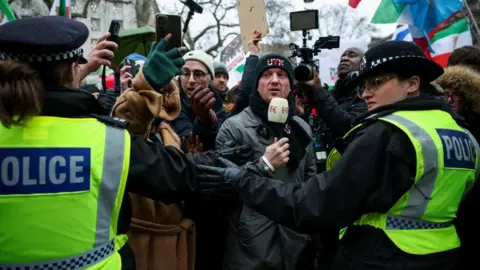
The Metropolitan Police is anticipating one of its busiest days in recent years, and has drafted more than 4,000 officers over fears of clashes if the rival protests coincide.
In a statement on Friday, Sir Keir said: "We're in a fight for the soul of this country, and the Unite the Kingdom march this weekend is a stark reminder of exactly what we are up against.
"Its organisers are peddling hatred and division, plain and simple. We will block those coming into the UK who seek to incite hatred and violence.
"For anyone who sets out to wreak havoc on our streets, to intimidate or threaten anyone, you can expect to face the full force of the law".
The BBC has approached Unite the Kingdom for comment.
In a post on X on Friday, Robinson - whose real name is Stephen Yaxley-Lennon - wrote: "Keir Starmer's regime are the enemy of the British people. Descend on London."
Among the 11 blocked from entering the UK is the US-based, anti-Islam influencer Valentina Gomez, who attended the first Unite the Kingdom march last September.
While that rally began largely peacefully, there were a series of violent confrontations with police and anti-Muslim hate speech incidents.
Protesters are due to march to Parliament Square on Saturday, while the separate pro-Palestine Nakba Day march will end in Waterloo Place.
In addition, tens of thousands of football fans are expected at Wembley Stadium for the FA Cup Final.
The Met said the risks meant it had to impose the "highest degree of control", including the first use of live facial recognition cameras as part of a protest policing operation - specifically at the Unite the Kingdom rally.
"We're expecting significant public attendance and intelligence indicates there is likely to be a threat to public safety at this specific protest," the force's head of facial recognition, Lindsey Chiswick, told BBC Radio 4's World at One programme.
"To be clear, we're not deploying this at the protest, we're not deploying in the middle of the march, it's very much on the outskirts."
She added that the use of the technology will also help protect peaceful protesters because it is able "to spot the people there to cause violent harm".
Other measures include deploying drones to identify suspects, putting armoured vehicles on standby, and equipping all officers with riot gear.
Specialist officers are also primed to take swift decisions to arrest and charge hate speech crimes, which may include arrests for chants referring to "intifada" at the pro-Palestinian march.
New guidance, issued by the Crown Prosecution Service (CPS), also pushes prosecutors to consider whether protest placards, banners and chants viewed on social media may amount to offences of stirring up hatred.
Director of public prosecutions (DPP) Stephen Parkinson said: "This is not about restricting free speech. It is about preventing hate crime and protecting the public, particularly at a time of heightened tensions.
"Where the line into criminality is crossed, we will not hesitate to prosecute."
