Chris Mason: Inside the shadow contest to be our next prime minister

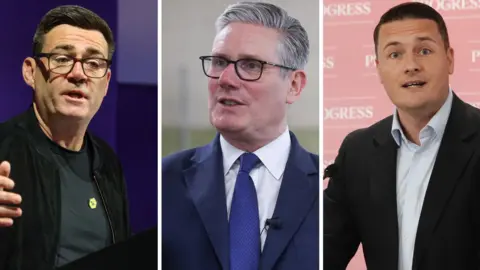 Reuters/ PA
It is now likely, perhaps highly likely, that we will have another new prime minister, possibly within weeks, or perhaps within months.
Things are considerably less fraught, noisy and wildly unpredictable than they were last week.
However the politics that will shape who is most likely to replace Sir Keir Starmer is playing out before us.
But hang on a minute. As supporters of the prime minister like to point out, there has been no formal challenge to him yet, and he is making clear, for now at least, that he is getting on with the job.
Some Labour MPs are exasperated that he hasn't set out a timetable for his departure.
Others ponder that it might be helpful to Andy Burnham, in his forthcoming by-election contest in Makerfield, if the prime minister hasn't announced a plan to step down, so Burnham can make the argument that a win for him would ensure Starmer was forced to.
And there is another curiosity here: not only is this a shadow contest rather than a formal one, but Burnham has that by-election to win while his potential rival, the now former Health Secretary Wes Streeting, does not.
It means there is an asymmetry to the audiences they are currently talking to. For Burnham, there is a geographical and demographic focus to his immediate pitch: the collection of towns and villages near Wigan, St Helens and Leigh in the north west of England that make up the Makerfield constituency.
For Streeting, the audience is rather different: Labour MPs and Labour Party members whom he needs to convince if there is a contest next month.
Streeting, now a backbencher, is unshackled from the obligations of front bench collective responsibility for the first time in years.
This means he is able to speak freely in public, and chose to set out over the weekend that he believed Brexit was a "catastrophic mistake" and that he hoped, one day, the UK would rejoin the European Union.
Burnham's view isn't wildly different – he said last autumn, for instance, that he hoped the UK would sign up to the EU again in his lifetime. But the mayor of Greater Manchester has rather changed his emphasis, saying talking now about rejoining the bloc is "the last thing we should do". Given Makerfield voted decisively for Brexit and heavily backed Reform UK at the local elections, perhaps this is no surprise. He says his emphasis now also reflects his desire to try to bring people together – he said over the weekend he entirely understood why many people had been drawn towards Reform UK.
Incidentally, there are plenty of Labour MPs exasperated that the whole issue of Brexit is a major public talking-point again. "It's mad. The referendum decision has to stand," one minister said to me. "I know what plenty of Labour Party members are like. They think the country got it wrong and they'd love to reverse Brexit. But it makes us look very detached. Improve Brexit, sure, but let's not get into overturning it, for goodness sake."
Burnham has also said that as prime minister he would maintain the borrowing limits the current government has described as "fiscal rules". He has been at pains to try to reassure the markets about this, having floated the idea recently of excluding some defence spending from them and telling the New Statesman last autumn that the government had to "get beyond this thing of being in hock to the bond markets".
He was publicly rebuked for the comments by some Labour MPs at the time, including the prime minister and the chancellor. He has since claimed this remark referred to politicians placing the country "in hock" to the markets because they had lost control of public spending.
There is plenty more where all of this came from. Burnham is expected to be confirmed as Labour's candidate in the by-election in the next day or so and we can expect to hear more from Streeting later this week.
There will be plenty of scrutiny to come of both of them as they each attempt to sketch out their vision for the country that is both distinctive and appears different from Sir Keir's, while sufficiently close to Labour's manifesto of two years ago to take on critics who will say that whoever replaces the prime minister doesn't have a mandate of their own and so should call a general election.
Already some in the party are privately pondering that if Burnham does win the by-election such would be the sense of relief within the party that they had found someone capable of beating Reform that he could be installed as party leader without a contest and become prime minister within weeks. Let's see.
But others also wonder how on Earth the party might react if the opposite happens and he loses the by-election. The noisy rows and ructions of last week might seem like nothing to what might happen in that scenario.
