Morris dancing 'antidote to toxic masculinity'

 Jamie Niblock/BBC
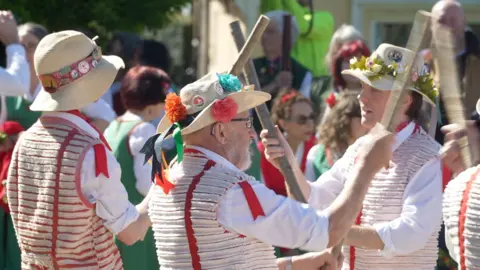
Morris dancers marking a century of Easter performances claim taking part in the folk tradition is an antidote to toxic masculinity.
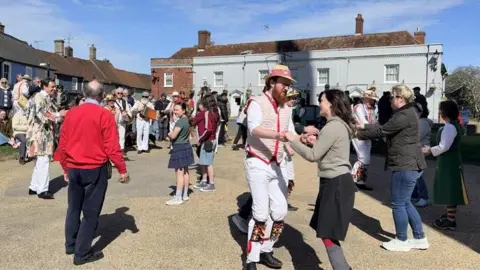
Thaxted Morris Men reached the 100-year milestone with a display in the Essex village on Easter Monday.
And members said the centuries‑old activity had provided a rare space for men to form close friendships.
"It's a way that the boys can become masculine without being toxic," said organiser and secretary Rob Evans.
 Jamie Niblock/BBC
Evans, 56, added: "When do men ever get together to be in a non-toxic environment?
"We don't shout at the television, we don't rough up pubs.
"We have several ex-soldiers, I have several children myself - we don't have to prove ourselves as men," he added.
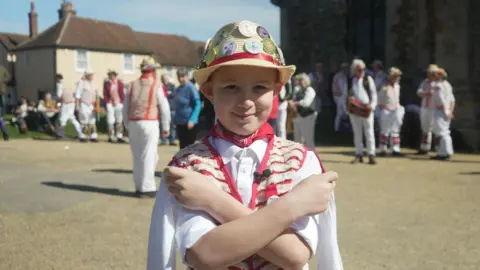
Members of the Thaxted group range in age from 93 to 10.
 Jamie Niblock/BBC
Ten-year-old Tyler, the youngest member, said he loved Morris dancing because "everyone was really kind".
"My friends think it's pretty cool, but they're more into video games," he said.
"I'm into video games too, a little bit, but mostly this. I'm proud to be part of this organisation.
"Everyone is so nice and it's just really fun to be part of."
Bells and sticks
Morris dancing is an English tradition that dates from at least the mid-15th Century.
It is thought it could have originated as an elite Moorish court entertainment in Europe.
It evolved into rural, communal performances associated with May Day and church festivals.
Dancers do choreographed steps while wearing bells, waving handkerchiefs and sometimes wielding sticks.
Morris has experienced a significant early 20th Century revival.
Dancers can don ribbons and bells to emphasize their rhythmic steps.
They are often accompanied by folk musicians playing violins and accordions.
Do you have a story suggestion for Essex? Contact us below.
Follow Essex news on BBC Sounds, Facebook, Instagram and X.
