What does a 'perfect' NHS hospital week look like?

 BBC
BBCEveryone would like a perfect NHS. But what, in reality, would that look like?
Early diagnoses and shorter waits for procedures and appointments would be high on most people's list.
The BBC spent time at Heatherwood Hospital, near Ascot, Berkshire, as a "high-efficiency week", sometimes called optimisation or "perfect" weeks, took place. The NHS uses these weeks, in the planning at Heatherwood for two months, to rapidly increase the number of planned operations.
Orthopaedic surgeon Rakesh Kucheria said: "What we are doing is pushing the boundaries. What we want to do is 10 to 15% more procedures, use every bit of the building, which means not just theatres, outpatient procedure rooms, X-ray, MRI scans to show how much we can do."
The weeks are short, intensive periods where hospitals run at high efficiency, with tightly planned theatre lists, extra clinical support, minimal downtime and every patient fully prepared in advance so there are no last-minute cancellations.
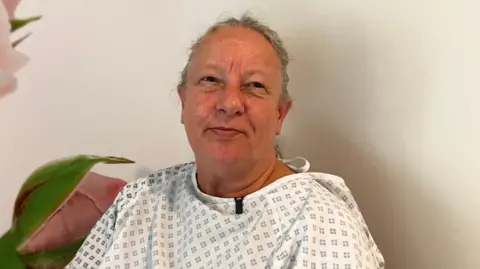
At the start of the week, I met 64-year-old Vanda Instone, waiting for one of the most successful procedures on the NHS.
She is having the first of two hips replaced.
Vanda was on the Frimley Health waiting list for 48 weeks.
"I'm glad this day has come. I'm a bit nervous but they do say hips are not as painful as knees so I'm going with that."
Vanda's timing is good. The hospital has everything in place to deliver what it calls "a perfect day's work".
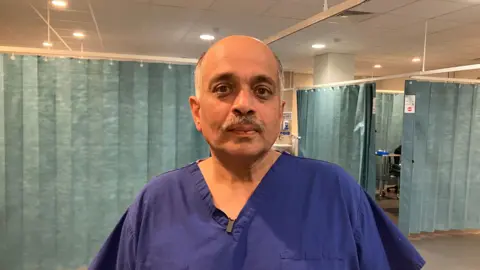
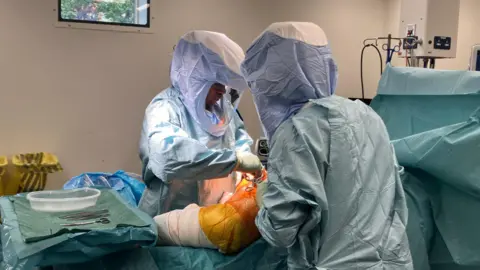
Kucheria is running two theatres today doing 10 hip and knee replacements. Normally he would do five.
As he prepared to operate, I asked him what the secret was behind running "perfect" days like this?
'We have planned well, we have a little extra resources, we get about 10% extra staff and we can show with 10% extra staff we can do another 10 to 15 extra procedures, so why not use the facility to the hilt?
"You've got to look after your staff. Investing in people is the key to the future."
During these weeks, surgical teams focus on high-volume, low-complexity procedures such as cataracts, joint replacements or general surgery.
A high-efficiency week typically delivers 10 to 25% more operations, and sometimes more for straightforward procedures.
For example, the NHS says a surgical hub doing 100 cataracts a week might do 120 to 130 during a "perfect" week.
These weeks do not run all year because they rely on conditions that cannot be sustained continuously - such as additional staffing, extended lists and intensive coordination across theatres and wards.
The hospital is part of Frimley Health NHS Foundation Trust, which narrowly missed the government's interim target of treating 65% of patients within 18 weeks in the past year. The trust came in at 61.2%, up from 53% at the same point last year.
Tina Benson, chief operating officer, said a big focus had been on reducing long patient waiting times. It is the second most improved trust in England when it comes to reducing long waits.
"Two years ago, some patients were waiting two years for treatment. We're now down to a few hundred patients waiting over 52 weeks which is a massive improvement."
Benson explained: "When you treat in that time order, your 18-week performance does go up more slowly but we have made an 11% improvement this year and will commit to improving again next year so we hit what we planned to hit.
"It's always disappointing that we can't go further faster for our patients but we did overachieve on the plan that we agreed."
NHS England recently released data to show the percentage of patients starting consultant-led elective treatment within the government's interim 18-week target after a GP referral. Its target for the past year was 65%.
For the South, the figures include:
- Royal Berkshire NHS Foundation Trust: 83.8%
- University Hospitals Dorset NHS Trust: 67.5%
- Hampshire Hospitals NHS Foundation Trust: 64.5%
- University Southampton NHS Trust: 63.5%
- Isle of Wight NHS Trust: 63.2%
- Oxford University Hospitals NHS Foundation Trust: 63%
- Dorset County NHS Trust: 62.7%
- Portsmouth Hospitals University NHS Trust: 61.4%
- Frimley Health NHS Foundation Trust: 61.2%
The interim target was met overall in England, with 65.3% treated within 18 weeks by March 2026.
That government target is set to rise - by March 2027 it will be 70% to wait fewer than 18 weeks and by March 2029, it will rise to 92% of patients.
On the day I attended Heatherwood, the hospital achieved a 23% increase in work in its theatres and orthopaedic surgeon Kucheria managed to carry out the 10 joint replacements in a day, rather than the standard five.
In outpatients, there was a 17% increase in work and in endoscopy performance was 15% higher than on an average day.
To deliver a "perfect" week at Heatherwood Hospital, lists of less complex patients were put together.
Staff and resources were taken from other sites and there was a big drive to make sure every patient turned up.
Frimley Health says while it is not possible to deliver perfect weeks all the time, they are an important exercise from which they can learn how the trust can continue to reduce its waiting times.
Having watched Vanda Instone's operation to replace her right hip, I caught up with her later while she was recovering from the procedure and asked her how she felt.
"Really good, I don't feel any pain because of the drugs, I'm very pleased that I've done this.
"I probably won't go back to work. I'd like to see some of the world and go travelling. I am optimistic," she said.
You can follow BBC Berkshire on Facebook, X (Twitter), or Instagram.
