'I was a baby when Nazi officers took over our home'

 BBC
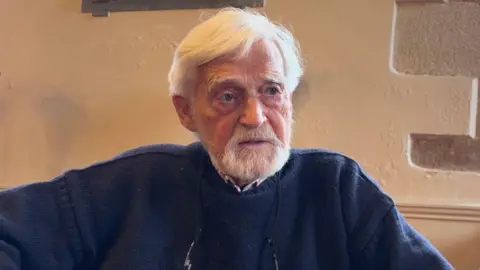
BBCA man whose family could not leave the Channel Islands to escape the German invasion because he was about to be born has described growing up during the occupation.
Peter Martel, 85, was born in Guernsey on 21 June 1940 - nine days before Nazi forces arrived on the island.
His mother had been due to be evacuated from the island but was forced to stay after doctors refused to let her travel so close to giving birth.
"I stayed here right throughout that period of time for five years," Martel said.
Although he was too young to fully understand events at the time, Martel said the reality of occupation became clearer as he grew older.
"It didn't really affect me personally because I just grew up with the situation," he said.
"But looking back, it was a hard period of time."
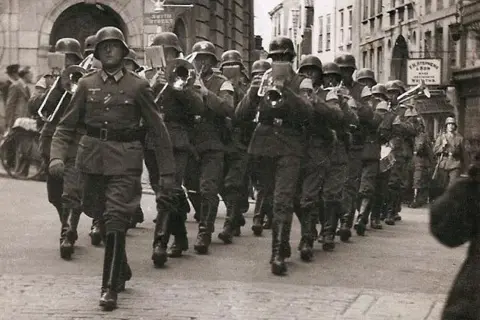
Soon after his birth, his family were ordered to leave their home in St Andrews within 24 hours before German officers took over the property.
His family first moved to an evacuated house before eventually settling into another nearby property for the remainder of the war.
Martel said he remembered the German soldiers and their presence during the early years of his life.
"There were hundreds and hundreds of them, all around our fields," he said.
"I just looked almost upon them as sort of uncles - they weren't uncles at all, but they were friendly."
He added in the later years of occupation, many German soldiers were also struggling.
"They were suffering probably more than some of the people in Guernsey," he said.
Despite the close proximity to occupying forces, Martel said some islanders resisted and recalled family members secretly hiding meat, as well as acts of sabotage.
"My uncle and my father used to go out in the middle of the night," he said.
"I can remember bombings and goodness knows what."
Martel also spoke of a remarkable record kept by his aunt, who documented daily life throughout the occupation in a series of pocket diaries.
Each entry detailed events such as raids, bartering and sightings of gunfire.
The diaries, written day by day, have since been preserved by his family.
'Traditions are traditions'
Martel said he remembered Liberation Day on 9 May 1945 vividly, despite being shortly before his fifth birthday.
He recalled watching Allied forces arrive in St Peter Port.
"I remember the ship coming in and the ducks coming out," he said.
Later, he climbed on to the roof of the Prince of Wales pub, where he saw naval ships gathered between Guernsey and Herm.
He said his memory of Liberation Day was very special and remembers it "as if it was yesterday".
Decades later, Martel said Liberation Day remained deeply personal, but he was concerned the significance of the day could be lost on younger generations.
Martel said: "It's not just a case of a day off, there's a little bit more thought to that."
He believes education is key to preserving the memory of occupation.
"Traditions are traditions, but it's very difficult to keep them going," Martel said.
Follow BBC Guernsey on X and Facebook and Instagram. Send your story ideas to channel.islands@bbc.co.uk.
