New eel fishery measures 'devastating' for Lough Neagh fishermen

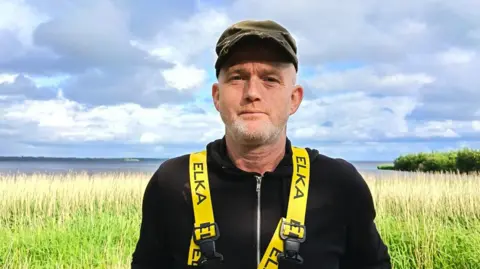 Gary McErlain
Agriculture Minister Andrew Muir has announced a series of measures for the Lough Neagh eel fishery to ensure long-term recovery of stocks.
For the 2026 season a number of actions will be implemented including the closure of the yellow eel fishery for a period of three years.
In a statement issued by his department on Thursday, Muir said he recognised eel fishing is an important industry.
Gary McErlain a fisherman and chair of the Lough Neagh Partnership said it was "devastating" and "certainly from a financial point of view it's not a good scenario right now".
Other measures announced include a maximum landing size of 90 centimetres and a total allowable catch of 25 tonnes for the silver eel fishery.
Speaking to BBC Radio Ulster's Good Morning Ulster programme, Muir made "a commitment" to provide "some form of financial support package" for the Lough Neagh fishing community economically impacted by the new measures.
"We hope to bring forward details associated with that in the short time ahead," he added.
The minister also said he is happy to publish the scientific data that has underpinned his department's decision, in the interest of "transparency".
Speaking to Evening Extra McErlain said it was not "good news" for the lough's fishing industry.
"Aside from the fact that it's your livelihood, there is a very deep history and heritage, cultural value to the whole thing as well, it's something that generations of our families have done on the lough shore," he said.
He said it was "devastating" and "certainly from a financial point of view it's not a good scenario right now".
"It seems the announcement of help or some sort of funding, financial help, is lagging behind so we would like to have seen that as part of this story today."
McErlain explained that fishermen on Lough Neagh have been a "blue print" in relation to European eels "by way of good practice".
He said the biggest issue facing the lough and eels is not over-fishing but pollution.
The minister insisted the Lough Neagh measures "are necessary to support the recovery of eel stocks and to ensure that this important fishery can be sustained into the future."
Muir also confirmed that a temporary cessation scheme is being developed to support permit holders affected by the closure of the yellow eel fishery.
'Minimal consultation'
Kathleen McBride, chief executive officer of the Lough Neagh Fishermen's Co-Operative, said it had done a lot to conserve the eel over many years and to restock the lough and that would continue.
She said these are "hard-hitting regulations coming down with minimal consultation".
"We haven't changed the goal posts here and I think we need to take a step back and look across Europe, what are other countries doing to conserve the species as well?" she told BBC Radio Ulster's Good Morning Ulster.
"It would be good to see the scientific data to know how many eels we have in Lough Neagh and I think that would be quite telling to see from our perspective here, how good and how robust our conservation actually is within Lough Neagh."
The Department for Agriculture, Environment and Rural Affairs (Daera) said the new measures are informed by scientific advice and reflect the department's statutory responsibilities to protect the European eel, which is classified as critically endangered.
Advice was given by the International Council for the Exploration of the Sea (ICES) and the Agri-Food and Biosciences Institute (AFBI).
Eel decline clear 'for quite some time'
Derek Evans, a senior fishery scientist with AFBI, has been a member of the ICES for the past 28 years.
He said the decline in eel stocks has been "evident since 1984" not just in Northern Ireland but across parts of Europe as well.
"This writing has been on the wall for quite some time," he told BBC News NI.
"Lough Neagh is not unique or unusual in what's happening... the Lough Erne fishery was closed in 2010 and fishermen there were put out of work.
"Eel fishing is completely banned and closed in Ireland since 2009. It's closed in Norway, and in many other areas across the EU, fisheries are being closed."
The scientist also disagreed with McBride's claim there had been minimal consultation, saying the Lough Neagh fishery was advised that eel population predictions "were insufficient to sustain the amount of harvest".
"Any of the work that we do is circulated, distributed, and all the members within the front office at Lough Neagh Fisherman's Cooperative would have had that work distributed to them.
"They have had elements of the work explained to them in numerous presentations, and they have had other peer-reviewed publications, etc, sent to them and circulated as they are produced," Evans added.
