'Globalise the intifada' chant is racist, says Starmer

 Reuters
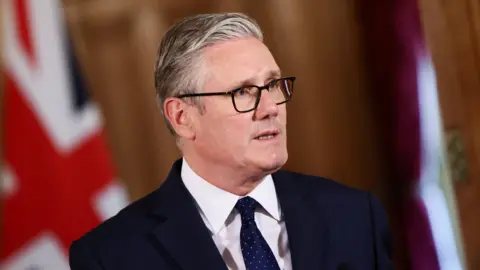
Sir Keir Starmer has called for police to prosecute people chanting "globalise the intifada" during demonstrations, calling it an example of "extreme racism".
Speaking after two Jewish men were stabbed in Golders Green on Wednesday, the prime minister said the chant, based on an Arabic word for uprising, had left Jews feeling "scared, intimidated, wondering if they belong".
He added that the government was also looking at what "further measures we can take on protests", as it responds to concerns over rising antisemitism.
Metropolitan Police Commissioner Sir Mark Rowley told BBC Breakfast that people using "globalise the intifada" are "likely to be arrested".
Wednesday's attack in the north London suburb, which police have declared a terror incident, has reignited debates over the protection of British Jews and the policing of pro-Palestinian marches.
The Green Party and the Jeremy Corbyn-led Your Party have warned the response to the "abhorrent" attacks should not restrict civil liberties.
Speaking at a news conference, Sir Keir said there were too many people who "don't want to see" examples of antisemitism in British society.
"Of course we protect freedom of speech and peaceful protests in this country, but if you are marching with people wearing pictures of paragliders without calling it out, you are venerating the murder of Jews," he said.
"If you stand alongside people who say globalise the intifada, you are calling for terrorism against Jews - and people who use that phrase should be prosecuted.
"It is racism, extreme racism and it has left a minority community in this country scared, intimidated, wondering if they belong."
Sir Keir also called on people to "open their eyes to Jewish pain", adding that the issue was "about society every bit as much as it is about security".
His comments at the news conference mark the prime minister's strongest public comments yet about the approach he wants to see forces take to marches.
The Met Police's Sir Mark said the force will "will exploit the full reaches of the law" to protect communities, adding: "Anything that has a hint of stirring up racial hatred, for example, must be stamped on."
Sir Mark noted there are major protests coming up and the force is looking at "what's reasonable" in terms of "restrictions we can put on them".
He said: "There's no power to ban protests outright, there is a power to restrict their movements and an extreme is to restrict it to a static event.
"We've got to work our way through that but we will do everything we can do to maximise the sense of safety in London."
Sir Mark, asked if someone could be arrested for using "globalise the intifada" on banners, replied: "If you use that sort of phrase you are likely to be arrested.
"We said that before Christmas and we've already got people arrested and charged and in court for such behaviour."
The term intifada came into popular use during the Palestinian uprising against Israeli occupation of the West Bank and Gaza Strip in 1987.
Jewish groups have described the term as a call for violence against Jewish people. Pro-Palestinian groups have said it is a call for peaceful resistance to Israel's occupation of the West Bank and actions in Gaza.
In December, the Met and Greater Manchester Police said they would adapt their approach to the slogan in the wake of the attack on a Jewish festival on Australia's Bondi Beach, and arrest those using it in chants or on placards.
Government review
A government review of public order and hate crime legislation, commissioned after two Jewish people were killed in an attack outside a synagogue in Manchester last year, is yet to report back.
Since Wednesday's attack, however, the government's adviser on terrorism, Jonathan Hall KC, has called for a "moratorium" on pro-Palestinian marches, adding it was "clearly impossible at the moment" for them not to "incubate" antisemitism.
Both the Conservatives and Reform UK have called for the government to take a tougher approach to the demonstrations.
But Green Party leader Zack Polanski has said it would be wrong if Wednesday's "abhorrent" attack "curtails our civil liberties".
"For a government to seek to use the pain of the Jewish community to restrict our right to peaceful protest would be a dangerous error," he said.
Your Party said some politicians are "weaponising the abhorrent stabbings to take away our civil liberties and baselessly attack the Palestine movement".
They said: "No to antisemitism. No to racism. No to attacks on the right to protest."
Future marches in London include the traditional May Day march and rally, led by trade unionists, on 4 May.
The Stop the War Coalition is planning its annual march to mark Nakba Day, which commemorates the 1948 displacement of Palestinians during the creation of Israel, on 16 May.
There is also a "Unite the Kingdom" rally led by far-right activist Tommy Robinson planned for the same day.
