Decision not to extend Troubles pension scheme criticised

 PA Media
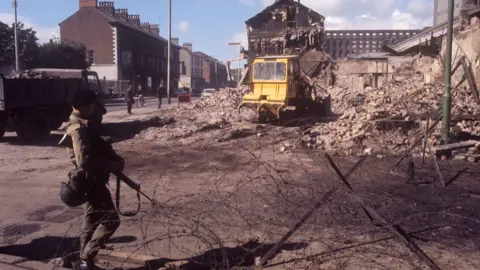
Victim and survivor groups have criticised a decision not to extend a scheme for people permanently disabled as a result of the Troubles in Northern Ireland.
The Troubles Permanent Disability Payment Scheme was established to provide financial support for those living with physical or psychological injuries sustained during the conflict.
The process for new applications closes at the end of August, though applications made after this date can be considered in exceptional circumstances.
Commissioner for Victims and Survivors Joe McVey has said there might be hundreds of people who recently became eligible to apply for the scheme.
McVey told BBC Radio Ulster's Good Morning Ulster programme that the "recent judgement in May changed the landscape and provided an opportunity to say perhaps we need a pause".
"We are told there might be in the regions of 300-400 people in one group who are saying they have people now who would qualify to apply under the recent judgement," he said.
 Executive Office
McVey added that he had recommended a three to six month extension of the deadline in light of the judgement.
However, he said the issue is who will foot the bill.
"Everything seems to come down to money, and in that discussion victims and survivors are nowhere near the heart of the discussion.
"This is one of the many examples where victims and survivors are caught in the middle between the Secretary of State, Westminster, and our Northern Ireland Executive all sitting back and pointing the finger at the other."
Extension could lead to a 'delay'
Jeanitta Larkin was just 10 years old when her father Peter McCabe was shot by the IRA at the family home in Newry in 1990. They both applied to the Troubles Permanent Disability Payment Scheme.
At the time, Larkin said she expected the process to be completed within 12 months.
However, her and her father's case are being re-assessed after they were previously denied payment.
"It was very re-traumatising," she told Good Morning Ulster programme.
"I found myself in situations that were completely unexpected. Situations of distress and despair."
Larkin said that she has concerns about extending the deadline for applications to the scheme beyond 30 August.
"If opening this application for another year means that it is going to delay them further in completing the applications they have, I would say that's very unfair to the victims that have waited this length of time," she said.
Larkin said she would have no issue with extending the deadline if it did not effect "the timeline for the victims who are already waiting".
'Causes a lot of trauma'
Andree Murphy, from Relatives for Justice, said that it is a "very onerous task" for victims and survivors to consider an application with such a short amount of time before the deadline.
"It causes a lot of trauma and it is very difficult," she said. "Ourselves and all of the groups who are supporting victims and survivors all felt the scheme should be extended."
Murphy added that the cut-off would like exacerbate existing issues for victims and survivors.
"There are victims and survivors who have been marginalised and isolated and putting in place this absolute deadline, and even talking about exceptional circumstances, will only compound that experience of isolation."
 BBC / Naj Modak
 Kenny Donaldson, director at South East Fermanagh Foundation (SEFF), said "the manner in which this has happened is highly regrettable".
He said there has been "no consultation" with organisations that support victims and "little to no awareness raising of the scheme's existence" for people outside of Northern Ireland.
Donaldson added that the 30 August deadline means it will be "absolutely impossible" for organisations supporting victims and survivors to reach many of the eligible individuals.
"There is just so much ambiguity around all of this. And victims and survivors are fed up of ambiguity. They deserve better."
"The Westminster government and the Dublin government [have been] very lacking right throughout this process"
Westminster and Dublin need to help out financially as Stormont is under a lot of financial pressure
Secretary of State 'did not' consult executive
A spokesperson for The Executive Office said it is a "matter for the Secretary of State who alone has the power to extend the scheme".
"He did not ask the Executive for a view before making his decision," they continued.
A Northern Ireland Office spokesperson said over £150 million in payments have been made so far.
They added: "To ensure no one who is eligible for the scheme misses out for reasons beyond their control, the regulations provide for applications made after this date to be considered by the Victims' Payments Board, in exceptional circumstances."
What is the Troubles Permanent Disability Payment scheme?
The scheme, also known as the victims' pension, was originally set up in law by the Westminster government in 2020 to provide pensions to people who suffered physically and/or psychologically during the Troubles.
The level of payment could range from about £2,000 to £10,000 per year, depending on the extent of the applicant's disability.
The scheme will be open in total for five years from the date it first launched on 31 August 2021.
It is being run by the Victims' Payment Board, which determines each application and administers the fund.
However, some victims' groups have been critical of the decision-making process and the length of time it takes.
