Michael Sheen says he was snubbed by first minister over toxic pollution claims

 BBC/Wall to Wall
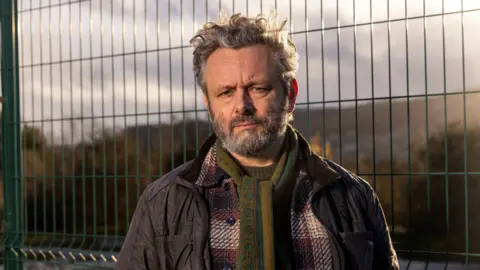
Michael Sheen says an offer to meet Wales' first minister over claims people have been poisoned by decades of exposure to toxic waste dumps "was not taken up".
The Welsh actor contacted Rhun ap Iorwerth ahead of a BBC documentary which looked into claims of widespread chemical contamination in Wales.
In Parliament on Thursday, Sheen urged MPs to back a national testing programme for historic toxic dumps to make sure sites were safe, after high levels of cancer-causing chemicals - known as PCBs - were found in soil samples and in the blood of people living near sites linked to chemical giant Monsanto.
Eastman Chemical Company, which is responsible for its legacy production, was asked to comment.
The Welsh government said addressing the issue of contaminated land was "a key priority".
One MP at the UK Parliament committee hearing later suggested to the BBC that there was confusion about whether it was the Welsh or UK government that would be responsible for any testing.
Sheen told the Welsh Affairs Select Committee that he had contacted Welsh government leader ap Iorwerth before the documentary, Buried with Michael Sheen, was broadcast in August.
"I invited him and whoever he would like to bring forward to watch the documentary before it went out publicly, because I feel like this is not about trying to point blame at anyone," Sheen said.
"I thought it was a very good opportunity for the first minister... to be able to get on board with this, to look for solutions."
He added: "Unfortunately, that offer was not taken up."
 Parliament TV
The committee's questioning focused on testing and cleaning up of suspected sites, of which there could be thousands.
"The people who are responsible for doing this in the first place seem to have got away from it, they seem to be protected and buffered and inured," Sheen said.
It meant that "at the moment there is a sort of stand-off," he said, with councils "terrified of making a judgement" whether or not land is contaminated as the cost of then having to deal with it would be enough to bankrupt them.
"The burden has to be taken off the councils," he said - calling for national "if not a multinational" funding for thorough testing and clean-ups.
 BBC/Wall to Wall Media/Stephen Perry
Sheen had interviewed farming consultant turned campaigner Douglas Gowan shortly before his death, who had spent decades warning that communities were at risk of toxic chemicals.
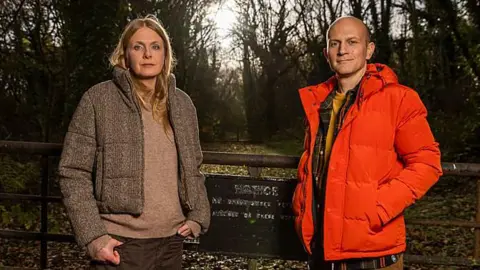
The actor later teamed up with investigative journalists Lucy Taylor and Dan Ashby who had inherited all of the campaigner's documents and research.
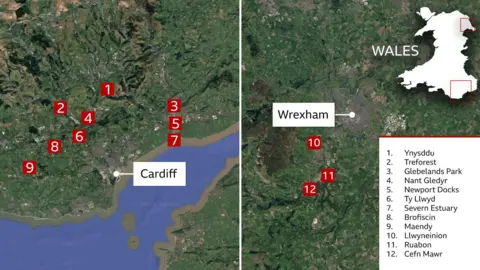
They set about testing 14 sites in Wales and north west England where it was thought Monsanto had been dumping PCBs, and found elevated levels at all but one.
Taylor told the committee they were told that one of the samples was so toxic "if you touch it it would be dangerous for health".
"The scientists told us if a dog ran through a puddle the dog could die because of the levels of the chemicals in the soil," she said.
The team had tested public land around former landfill or industrial sites, she emphasised, rather than fenced off areas.
"We're talking about chemicals leaching out of those sites... [onto] public footpaths, public woodlands, sports fields and roads," she said.
 BBC/Wall to Wall
They had also carried out blood tests on a handful of local people - two of whom had higher levels of PCBs than the average recorded in another study in the USA.
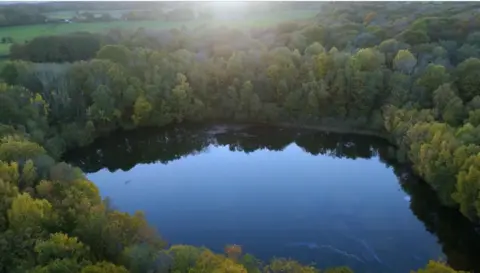
They included Michael Phillips, who appeared in the documentary in which he recalled playing with his friends at one of the most notorious dumpsites as a child - Llwyneinion lagoon in Wrexham.
Decades later, several of those friends and Phillips himself developed rare cancers, which they believe may be linked to this.
Ashby called the lagoon "a shame on Britain" and said it was "outrageous" it was still in place.
"I think Wrexham council would acknowledge that and would acknowledge their frustration that they haven't got the money to clean it up - and probably Natural Resources Wales as well," he said.
Ashby said the USA was "digging up and cleaning up these sites" and seeing PCB levels in the environment falling as a result.
After the hearing, the committees' chair Ruth Jones called the documentary's findings "disturbing", and suggested there was confusion about which government would be responsible for testing.
"We've already written to the new secretary state for Wales [Stephen Kinnock] asking him about the testing - and the response we got back from him was 'well it's not our responsibility'," she said.
"Well, to be honest, the committee doesn't care who's responsibility is is - at the moment we seem to be falling between stools - is it UK-wide testing, is it Welsh government testing? We don't care, we just want the testing to happen."
 Contributor photo
Gowen's investigation into Monsanto - which had factories in Newport and Wrexham - found it had been producing what he had called "some of the worst contaminants known to man" in the 1960s and '70s.
The chemicals known as PCBs were once widely used in everything from lipstick to white goods, and had been revered for being non-flammable and hard to break down.
But they were later classed as carcinogenic, banned worldwide, and are seen today as the first "forever chemicals" - which are building up in the environment, threatening wildlife and human health.
Community councillor Katie Witherden organised a public meeting in Acrefair, Wrexham - close to the former Monsato works - following the airing of the documentary, and said the community wanted "answers" and "thorough testing of all the suspected sites".
"Until that's done there's a risk that future generations will be poisoned by this without ever knowing and I'm not willing to accept that," she said.
The Welsh government said it would develop a strategy to "progressively restore post-industrial land so that communities are no longer exposed to potential risks".
"This will include strengthening the 'polluter pays principle' while we continue to press for environmental justice by raising the importance of seeking UK government funding direct with the UK Treasury," a spokesperson said.
"This should be used to continue our joint efforts to address the legacy of Wales' industrial past through restoring coal tips and remediation of contaminated land."
The UK government and Wrexham council were also asked to comment.
