The race against time to find eagles escaped from Dollywood

 Getty Images
They chased him all day Sunday throughout the mountains of Tennessee, a team of cops and executives and avian specialists all racing to bring a bald eagle named Rockland back home safe and sound.
First he was spotted at a local hotel. Next a caller reported him perched on a car across town. Each time, team members rushed to the site, but "the advantage those little stinkers have, that we don't, is they can take off," wryly notes one who watched him soar away - twice.
Rockland first vanished two weeks ago, along with winged compatriots Wesley and Caesar, when a storm sent a century-old tree through their netted enclosure in Dollywood, the theme park in Tennessee's Smoky Mountains that Dolly Parton co-owns. The attraction in the singer's hometown houses the largest sanctuary for non-releasable bald eagles in the world, since partnering with the American Eagle Foundation (AEF) 35 years ago.
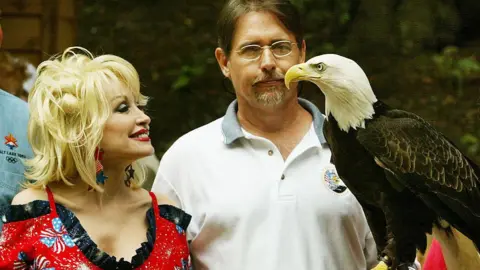
"Bald eagles have symbolised our country's freedom and heritage for more than 220 years," the singer said in 2003, when she was honoured for her work in eagle conservation by the federal government.
Although the sanctuary has released 185 bald eagles into the wild over the years, all three of these escaped eagles have limited flight ability, and there is real fear for their safety if they remain at large.
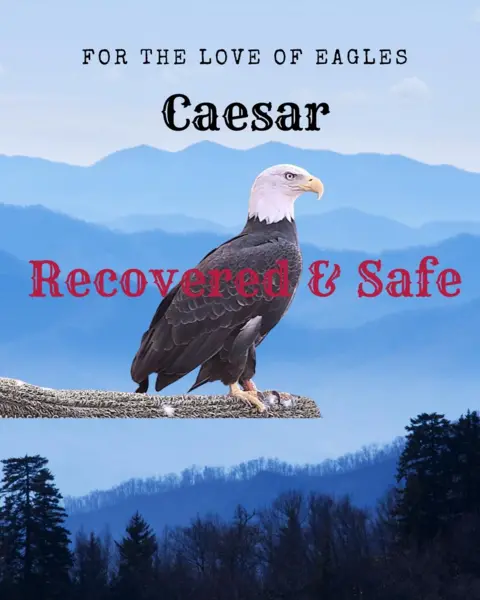
So the sanctuary has sounded the alarm, asking for people to report sightings, and identifying the trio's distinctive leg bands – orange for Caesar and Rockland and black for Wesley, the lone female escapee.
And the tips have come pouring in.
"We've gotten calls from Indiana. We've gotten multiple calls from Virginia. We've gotten calls from Georgia," says Lori Moore, CEO of the American Eagle Foundation.
The most helpful calls, however, have come from the Smoky Mountains themselves, where the eagles have remained - and where one tip led to the successful recovery of Caesar last weekend.
He was spotted in a local pasture, where an avian care specialist Moore calls "the bird whisperer" arrived to "play a little game of tag" with the eagle, she says. Eventually,
"Caesar got tired enough," Moore recalls, to allow himself to be captured.
The chase continued the following day for Rockland, without the same success. The foundation's chief operating officer jumped in her car when a call came in with a sighting, hoping the rainy day would keep him more stationary. But Rockland remains on the lam.
"He's out misbehaving, and he's trying to get food that he shouldn't be having," says Moore as the search continues for both Rockland and Wesley.
"Any time that we get a truly viable lead - that we know that that's one of our birds - the excitement level gets really, really high," she says. "The adrenaline starts flowing, because we know, hey, maybe we've got a chance to get our bird."
 American Eagle Foundation / Instagram
Not only are the eagles' flight abilities limited – Wesley has a chronic shoulder injury, and Rockland has a displaced wing - but they're also "way too comfortable around people" to make it in the wild, Moore says.
Rockland, in particular, would "be a lot smarter if he would just come back and let us take care of him, because I don't know how long he will last out there," says long-time foundation member and chair James Rogers, 76.
"It just makes you want to cry because you're afraid he's going to, you know, tangle with something that he shouldn't and get hurt, and you just can't stand the thoughts of that," he says.
Amidst the "chaotic" effort to bring the birds back, Moore says, the foundation still chooses to see a silver lining.
"This has been such a great opportunity for the general public... to get their eyes in the sky and look around," she says. "We've had so many people call and say, 'I think I saw your eagle,' and it's in an area that we know they're not in right now.
"But they get super excited because they say, 'Are you serious? You mean I saw a wild eagle?'" Moore says. "I mean, I literally had a guy whose voice was cracking, and he said, 'I've never seen an eagle before.'"
 Getty Images
Before Dollywood partnered with the AEF, 35 years ago, it's highly unlikely those sightings would have happened. Bald eagles were still on the endangered list, their population decimated largely by the insecticide DDT, which caused severe eggshell thinning.
It was an entertainer in the Dollywood park who first helped alert Parton to the eagles' plights.
Musician James Rogers, now AEF chairman, began his lifelong love affair with eagles after spotting one on a Florida fishing trip at a time when such sightings were rare.
"I made a kind of silent promise, on that day to that eagle, that I was going to see what I could do to ever try to keep that bird from becoming extinct, so that my children and grandchildren - which I didn't even have at the time, any children at all - would be able to see eagles," he says.
He wrote the 1973 song "Fly, Eagle, Fly," released on Capitol Records, and soon became involved with other eagle advocates. They eventually approached the park's business team to "see if we couldn't make an arrangement with Dollywood and create a very special place" for the majestic birds.
"We didn't envision it being as grand as it actually turned out," he says. "In the beginning, I knew that we had maybe 20 or so eagles around the country that needed a home, needed a better setup, needed better conditions … but then, my gosh, the scope," he says.
Dollywood - and the musical icon at the helm of it - fully embraced the opportunity to showcase, house and rehabilitate the birds.
"I don't think it ever would have happened if she had not been for it," says Rogers, who's repeatedly shared the stage with Parton over the years. "I think she thought it was a beautiful idea, because it was something that was just like Americana.
"Just like we say, the eagle is not a Republican or Democrat."
When the Eagle Mountain Sanctuary at Dollywood opened in 1991, the species was still endangered, and the facility soon began breeding and hatching. They'd bring eggs from nests in Alaska, Rogers says, and feed the hatched birds with eagle puppets to ready them for the wild before their eventual release.
The releases, 185 of them since the sanctuary opened, were "tearful, joyful type things," he says.
"I'm very proud of that," he says. "Those were birds that would never have been out there … then they breed, those wild ones; they'll meet other eagles."
Rogers witnessed some of Dolly's first interactions with the birds, when she was "amazed" - and "kept her vision fixed on the eagles".
The same year the sanctuary debuted, she penned Eagle When She Flies, which also became the title of her 31st album.
At the time, with the eagle populations were so depleted, such releases truly made a difference, says Michael Patrick Ward, professor of wildlife biology at the University of Illinois Urbana-Champaign. The bald eagle was taken off the endangered species list in 2007.
"Bald eagles live a long time … decades," he says. "For a bald eagle that might live and reproduce another 15, 20 years, it does make a big difference."
Conservationists' efforts to save bald eagles, he says, is "a big success story that we probably don't do a good job of highlighting".
He credits a combination of cleaning up the environment and waterways over decades of dedication.
"It takes time for things like the Clean Water Act and laws to reduce the use of certain pesticides to have a population level effect," he says. "But we're seeing that now, and people notice that …it's good that people are noticing that these birds are returning to the landscape."
 Getty Images
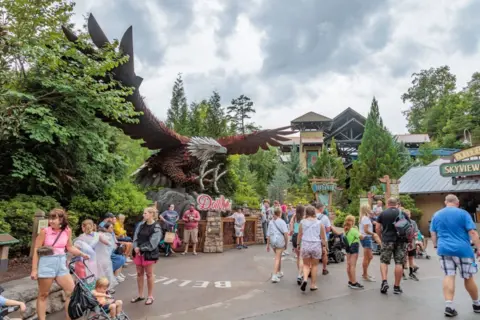
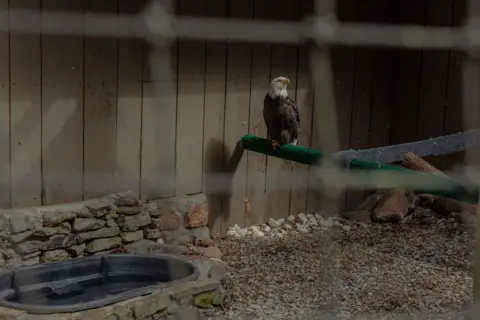
Nowadays, the sanctuary houses, cares for and exhibits the birds. It's committed to education and awareness, showcasing Dollywood's famed Wings of America show daily for the park's 3 million annual visitors.
Many of those guests are now keeping their eyes peeled for Wesley and Rockland. And as the sanctuary, Dollywood and wider Smoky Mountains community stay on high alert, Moore reflects on how the singer's support for the birds has been instrumental for more than three decades.
"What she brings to the table by being associated with the American Eagle Foundation and letting us have the Wings of America show and letting individuals get to be up close and personal with bald eagles, I think that impact is immeasurable," she says.
Echoing Rogers, she notes just how much the bald eagle means to citizens - and what the search itself can signify.
"In a time that our country is a little bit divided, having something - even if it's just looking for our national symbol - to unite us all, you can tell people are doing it from the heart," she says. "They are genuinely concerned, as we are. So that part of it has been incredibly heartwarming for us."
