Action to be taken on confusing low bridge signs

 BBC
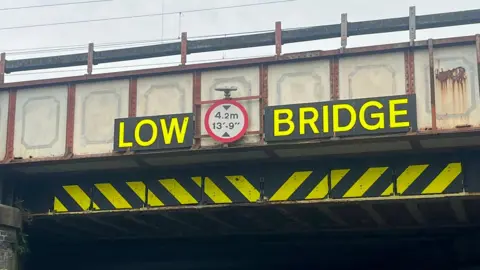
BBCConfusing signs at a railway bridge are set to be replaced after concerns were raised they could increase the risk of lorries hitting the structure rather than prevent it as intended.
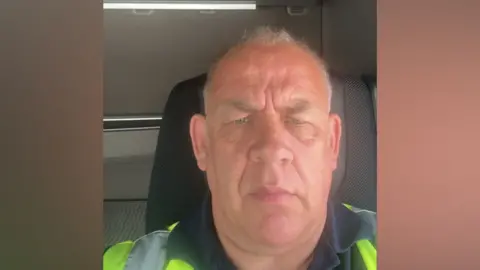
Lorry driver Mike Craney said he had repeatedly reported rogue signage near the bridge carrying the West Coast Mainline at Rugeley Trent Valley station in Staffordshire.
Approaching from Colton a mile away, the bridge is first signed as 14ft 3in (4.3m) in height, then 13ft 9in (4.2m), before reverting to 14ft 3in immediately before the bridge, which itself is correctly marked 13ft 9in.
Craney, who has spent more than 20 years driving HGVs, said the conflicting info could give drivers "a false sense of security".
Network Rail said there had been seven strikes at the Colton Road bridge in the last three years. The height of the bridge was reduced in 2021.
Staffordshire County Council confirmed it was working with Network Rail to replace the signage.
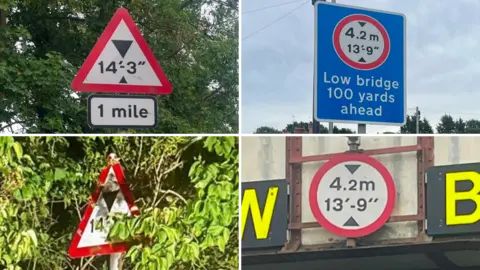
Craney, who lives in Cannock, told the BBC: "As soon as I've seen a sign that says 14ft 3in, I'm like, 'right, I'm all right on that road'.
"But if you get to the bridge and it's suddenly 13ft 9in, you aren't going to make it. That's the big issue.
"If we hit any other bridge, it's a fine from the police. If we hit a railway bridge, it's an invitation to an interview with the traffic commissioner, and we do lose our licence for it."
Peter Mason, cabinet member for strategic highways at the council, said all signs associated with the bridge would be updated where necessary to reflect the correct maximum headroom of 13ft 9in (4.2m), with work part-funded by Network Rail.
"We will also continue to monitor this location," he said.
 Supplied
Network Rail said the bridge itself measured 14ft 4in (4.38m), but the height restriction was deliberately reduced from 14ft 3in to 13ft 9in in 2021 to reduce the risk of bridge strikes.
It said all the signs on the route it maintained were correct but admitted it had been unaware of discrepancies on council-maintained signs until Craney raised the issue.
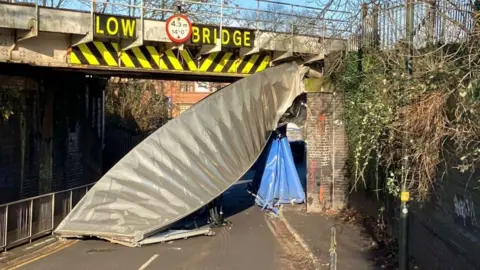
The rail operator added there had been seven bridge strikes at the location in the last three years despite the reduced height restriction, describing that figure as "very concerning".
 Network Rail
Craney, who first reported the issue more than six months ago, said the consequences of striking a railway bridge were severe for drivers.
He believes replacing the incorrect sign would "take 10 minutes".
"The alternative is a lorry hits that bridge, and it can be 12 to 24 hours of road closure and railway closure," he said.
According to Network Rail, there were 1,666 bridge strikes across Britain's rail network between April 2024 and March 2025, with such incidents costing about £23m a year in repairs.
A spokesperson said: "We are committed to working closely with local authorities, haulage operators and communities to identify and implement measures that help prevent strikes from happening in the first place.
"This includes reviewing signage, raising awareness and exploring other practical interventions where appropriate," they added.
Follow BBC Stoke & Staffordshire on BBC Sounds, Facebook, X and Instagram.
