Hunting the hidden stories of Lincoln Cathedral

 Amber Gash/BBC
It is one of Britain's largest and most beautiful churches, but beyond the familiar architecture and history, Lincoln Cathedral is full of little-known stories just waiting to be told - from one of the oldest surviving tennis balls to a mischievous "servant of the devil".
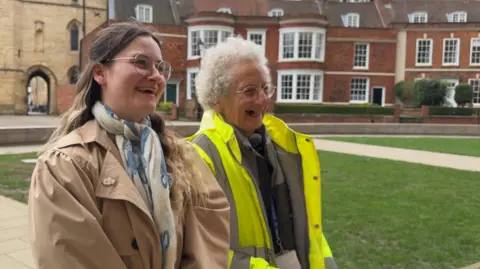
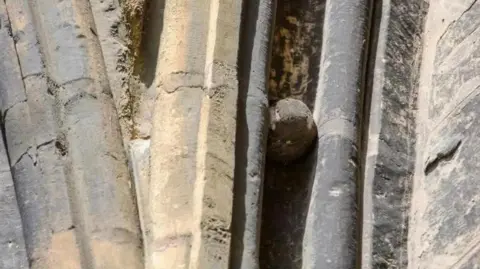
Tour guide Dorothy Moss is peering up at the ball, which has been lodged high up on a wall since 1914 and now matches the colour of the stone.
"The story goes that it was someone who lived here in the minster, presumably clergy, and the son had been told he could go and play tennis, but he must not hit the ball against the cathedral," she explains.
The boy was called Gilbert Bell and, back in 2005, his nephew, David, who was 78 at the time, contacted the cathedral to ask for his ball back.
"We said, what tennis ball? We didn't know anything about it," Dorothy says.
"He was told he could have it back when we get going with scaffolding on this side. I think he will be long gone, I certainly will be."
 Steve Stringer
The ball is believed to be among the earliest surviving examples in the UK, and is two years older than the earliest proper tennis ball held in the Wimbledon Lawn Tennis Museum, which dates from 1916.
"If you go to Wimbledon, you can tell them we've got an older one," Dorothy adds.
The foundations of the cathedral were laid in 1072 and the building has continued to evolve ever since.
In fact, one of the latest additions pays tribute not to Biblical or historical figures, but to the cathedral's longest-serving member of staff.
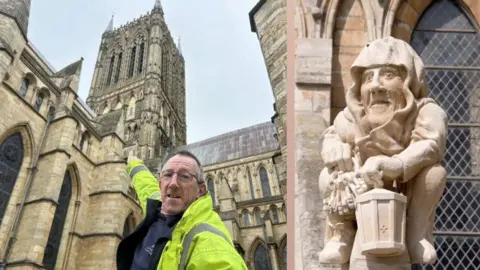
Stuart Boyfield has been working on the site for 48 years and, positioned high up on the cathedral wall, faithfully overlooking his place of work, is a stone carving in his likeness.
It was made to mark his 30th anniversary in the job and shows him holding a bunch of keys, a lantern and a tool basket on his back, reflecting his work in building services.
 BBC/Lincoln Cathedral
As we stroll down the south side, by chance we spot the real Stuart.
He is full of enthusiasm as he comes over to tell us about the carving.
"I feel brilliant about it, I'm part of the cathedral's fabric, it's a great honour," he says.
"When you've worked somewhere for so long, it becomes more than a job, it's just a way of life.
"It was made 18 years ago, so I'm not sure what I'm getting for my 50th year, we'll see."
 Eleanor Maslin/BBC
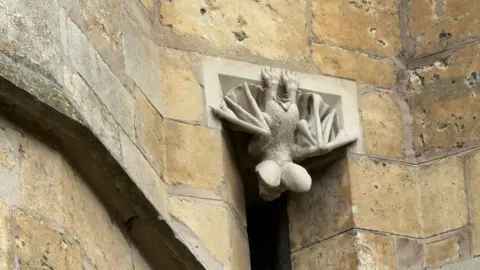
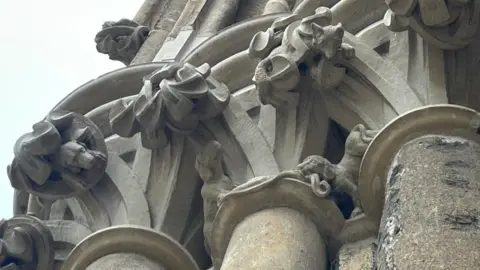
We wander to the opposite side of the church, Dean's Green, which can be seen from the cathedral cafe, on a mission to spot a cheeky little bat.
We scan our eyes across the windows and pillars – and then we spot two little feet, a pair of outstretched wings and little ears.
The bat hangs above one of four arrow-slit windows, close to the beautiful rose window known as Dean's Eye, and is peering mischievously inside.
Dorothy tells us: "He's looking in to see if he can get in and do some mischief.
"People are scared of bats, so they are possibly servants of the devil trying to squeeze in and can't get in."
The Dean's Eye is one of the highlights of a building considered to be a medieval masterpiece.
By the 14th Century, it was the tallest building in the world, only for the spire to collapse in 1548.
While the original design was Norman, the cathedral has been influenced by many architectural styles over the years.
Among the modern additions is an intricate carving of a hunting scene above the north-east doorway.
It depicts the sweet faces of a horse, hounds and a fox, and was placed there to commemorate the ban on fox-hunting, which came into force in February 2005.
 Lincoln Cathedral
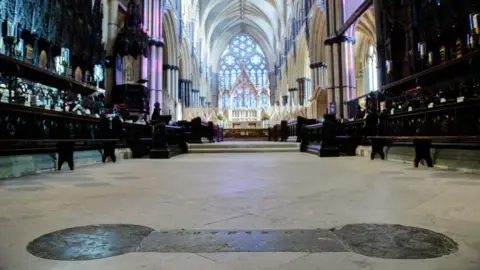
After entering the interior, we come across an old grey stone that reads "Cantate Hic" – Latin for "sing here" – in the floor of St Hugh's Choir.
It marks the best spot for singers to stand to be seen and heard all around the cathedral.
The cathedral choir still sings most days during term-time and its choristers include 40 boys and girls from 16 local schools.
Highlights in the calendar include concerts of Handel's Messiah at Christmas, Bach's Passions during Lent and collaborations with the military bands of the RAF.
 Eleanor Maslin/BBC
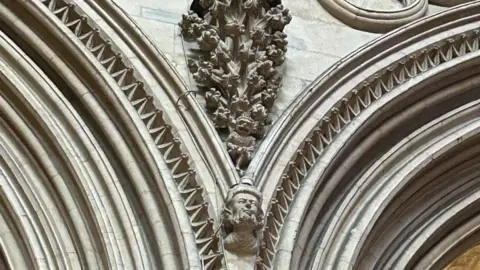
Of course, we cannot end our tour without taking a look at the mischievous Lincoln Imp – arguably the most famous symbol of the city, which is included in the football club's badge and on numerous local door knockers.
As the tale goes, the devil sent out his imps to play and the wind blew two of them to Lincoln. One flew into the cathedral and was attempting to destroy the Angel Choir, when an angel appeared and turned it to stone.
To this day, you will find the petrified imp high on a pillar above the choir.
Perhaps it is not such a bad place to spend eternity, enjoying such magnificent surroundings.
Listen to highlights fromLincolnshire on BBC Sounds, watch thelatest episode of Look Northor tell us about a story you think we should be covering here.
Download the BBC News app from the App Storefor iPhone and iPad orGoogle Play for Android devices
