Budget negotiations entering 'no-deal territory', says Givan

 PA Media
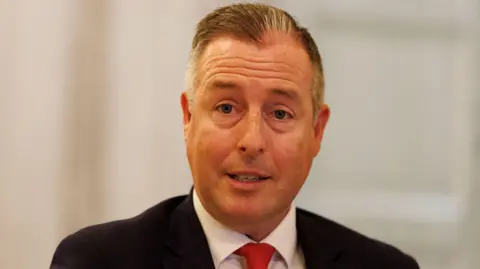
A budget "ultimatum" offered by the Northern Ireland Secretary to the Stormont executive "isn't going to bode well for trying to get a settled outcome", Education Minister Paul Givan has warned.
Givan said negotiations with the UK Government were entering "no-deal territory", after Sir Chris Bryant said on Thursday there would be no improvement on his £1.5m offer.
Sir Chris said there was "no more money" available and has given executive parties until next Thursday to respond.
Givan said the current budget offer could not provide full funding for the Department of Education for this financial year, even if no other department received any money.
The Democratic Unionist Party (DUP) minister said the cost of running the entire executive this year had been calculated at £1.6bn.
It is estimated the same figure would be required for each of the next two years.
Sir Chris's current offer "doesn't even come close", Givan told BBC Radio Ulster's Good Morning Ulster programme.
"If the secretary of state continues to take the approach that he outlined yesterday, then it is moving to a no-deal territory."
He added: "Now he puts down this ultimatum and if that is his style of negotiation, then it isn't going to bode well for trying to get a settled outcome, which is what the people of Northern Ireland need."
 Getty
GettyGivan said the fundamental core of the issue was a funding formula discrepancy between Northern Ireland, Scotland and Wales, which he said had to be addressed.
He said any offers from Sir Chris should not "mask the failures in the current formula" and instead should "get to the core of the challenge… an unfair funding formula which has created this cycle of financial problems for our executive".
 PA Media
Finance Minister John O'Dowd said Sir Chris and his predecessors have been "unable to refute our argument that we are underfunded compared to Scotland and Wales".
The Sinn Féin assembly member said the secretary of state's final offer approach "isn't a response to the fundamental problem at the centre of this argument".
"It's about fairness and equality and about treating people here with a modicum of respect even, in terms of how they get a return on their taxes," he told Good Morning Ulster.
If Northern Ireland's funding arrangement was equal to Wales', "we would be able to meet the vast majority of our pressures," he added.
O'Dowd said the biggest priority now, "in the absence of a budget", is to find a way to give public sector workers a pay increase.
"First we have to find a technical mechanism… then we have to find a quantum of funding to pay our public sector workers."
'Time for Stormont to come up with plan'
Also speaking on Good Morning Ulster, Ann Watt, from the public policy think tank Pivotal, said the Northern Ireland's negotiating strategy has so far been successful, forcing two increased offers from the British government.
"They've moved a lot," she said.
She said "the UK government has moved significantly", now Stormont need to "put together a plan of what are they going to do".
Watt explained how Sir Chris's offer would be spent, and outlined that one of Northern Ireland's biggest costs is "far higher employment in the public sector than elsewhere in the UK".
"That £1.5bn is over three years, so around £525m per year... and that is mostly spent on day-to-day costs of running public services."
This, she said, meant "delivering health, education, infrastructure, the environment and so on".
Around £450m would be spent for that primary purpose, said Watt, with the remainder used for modernising public services, building social housing, and tackling benefits fraud.
"But that money is well, well short of what the executive says it needs," said Watt.
