Why drones are flying over Manchester railways

 British Transport Police
Police drones are being launched remotely over railway lines in Manchester as part of a scheme aimed at finding trespassers and reducing delays.
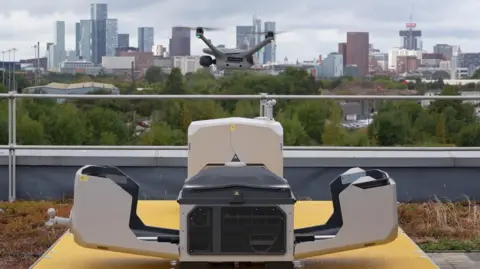
The aircraft are kept in weatherproof boxes at sites beside the railway and can be launched remotely by pilots based in London when an incident is reported.
Since the British Transport Police (BTP) launched its first site in Leeds in April 2025, four sites have been introduced across south London, as well as sites in Leicester and Manchester.
The BPT said Manchester was chosen because it is a known hotspot for trespass and disruption.
A pilot does not need to be on or near the site before the drone can take off, and the drone can also be used proactively - to patrol areas where intelligence suggests trespassing may be taking place.
BTP hopes to establish further sites in the North West as it expands the programme, although no additional locations have been announced so far.

Chief Constable Lucy D'Orsi said the average response time for the system since April had been three minutes and 28 seconds.
"The fundamental difference is that we wouldn't be able to get officers there that quick," she said.
BTP said that between 1 April and 25 July the system conducted 550 flights across Britain, with drones typically being the first resource on scene in 68% of operational incidents.
The force claimed drone deployments had helped to prevent an estimated 7,911 minutes of delays during the same period.
How does the system work?
The Manchester site has two weatherproof boxes which house and charge the drones when they are not in use.
Simon Bachelor, BTP's head of drones programme, said that when a pilot wants to use one, the box opens remotely and the aircraft takes off, before the box closes again.
"It's completely self-contained and allows us to not need officers or drone pilots near the location," he said.
BTP said having two boxes allowed it to provide near-continuous coverage while allowing for battery depletion and recharging.
Bachelor likened the system to "having a resource permanently on scene".

He said one of its main benefits was being able to establish quickly whether there was someone on the railway track.
Officers and railway staff may otherwise have to travel to the area and embark on a physical search, during which time trains might have to be delayed or services suspended.
"If we can arrive at that point far more quickly, then we cause less disruption and the travelling public can continue on their journeys without those delays - or with a reduced amount of delay," said Bachelor.
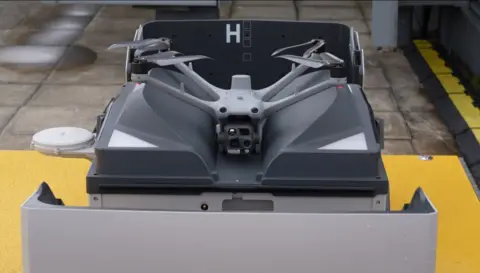
The drones can also provide aerial support during other incidents, including lineside fires, if there are incidents within the aircraft's operating area.
BTP said they had also been used to help locate vulnerable people.
D'Orsi said there were currently seven operational sites across Britain and that her ambition was to double that number by the end of the year, adding she anticipated more being introduced in the North West at a later stage.
Listen to the best of BBC Radio Manchester on Sounds and follow BBC Manchester on Facebook, X, and Instagram. You can also send story ideas via Whatsapp to 0808 100 2230.
