'I fear for my son's farming future due to costs'

 John Fairhall/BBC
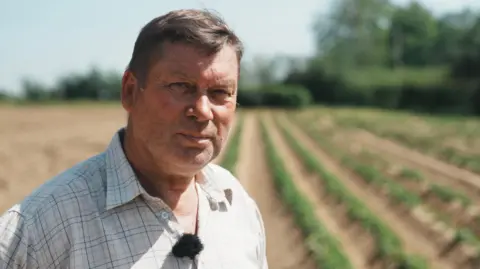
A fourth generation farmer whose fuel costs have doubled in the past 12 months said he felt guilty to pass on a farm to his son that would not give him the income he deserved.
Chris Suckling runs Woodlands Farm in Holbrook, Suffolk, and said his costs this year had risen to £40,800 from fuel and fertiliser alone.
He blamed the Iran war and said he had tried to diversify his products but said it cost more money.
Emma Reynolds, Secretary of State for Food, Environment and Rural Affairs, said the government was working to protect the farming sector from global pressures.
 John Fairhall/BBC
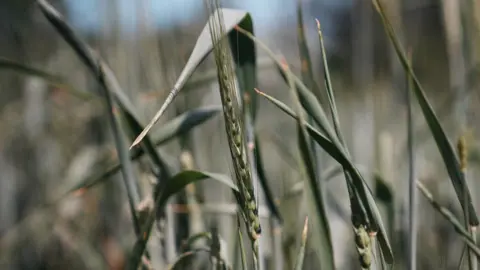
Suckling, who grows potatoes among other crops, explained he was previously spending £27,000 a year on red diesel which had now doubled to £54,000.
He added that hauliers were also putting surcharges on their mileage and the cost of his fertilisers had risen from £53,200 to £67,200 a year.
The farm has been running at a loss, he added, with next year's crops also not projected to earn Suckling much.
"Farmers are voting, they are packing it in," he said.
"Increasingly we are seeing land left bare. We are seeing land turned into solar farms and renewables and housing, because farming doesn't pay.
"I'm the fourth generation, Harry is the fifth generation, and he is keen as mustard to carry it on. I feel guilty I am passing him on a farm that perhaps is not going to give him the income he deserves.
"We hope a change of government or change of political stance will encourage people to farm."
'A perfect storm'
 John Fairhall/BBC
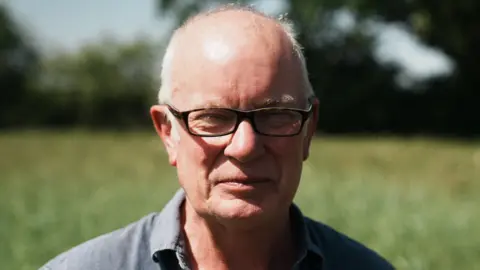
Elsewhere, John Pawsey is an organic farmer at Shimpling Park Farm near Bury St Edmunds.
He said while he did not buy artificial fertiliser, he had seen increased costs for diesel. However, he said his crop was "at the mercy of the weather".
"The other thing that's really going to potentially affect us this year with this drought is a lower yield," he explained.
"So it's fine if we get an average yield, we can probably pay for some of those increased prices, but if we get a lower yield, it's a perfect storm."
Pawsey said his fixed costs had risen between 25% and 35%, and he could not see a solution to the issues farmers faced aside from an increase to food prices.
"We're not a charity. We need to be paid a fair price for doing it, but we also have to keep our customers," he added.
 John Fairhall/BBC
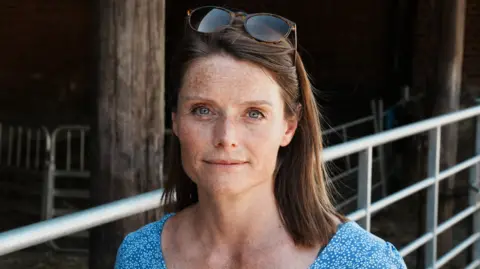
Cath Crowther, regional director of the Country Land and Business Association (CLA), said she had spoken to "a lot of people recently that have said this is the worst they've ever had it".
"We don't want to put doom and gloom on everything because we are a very innovative industry," she said.
"But we need to see that innovation, we need to see that investment, and without the profitability you can't see the investment.
"It's very, very tough out there at the moment."
Emma Reynolds said in a statement: "This government is taking decisive action to support farmers by cutting red diesel [fuel duty] to its lowest rate in over 20 years.
"We're committed to protecting the farming sector from global pressures, including the war in Iran."
Do you have a story suggestion for Suffolk? Contact us below.
Follow Suffolk news on BBC Sounds, Facebook, Instagram and X.
