Developer plans to save 19th Century textile mill

 Grace Wood/BBC
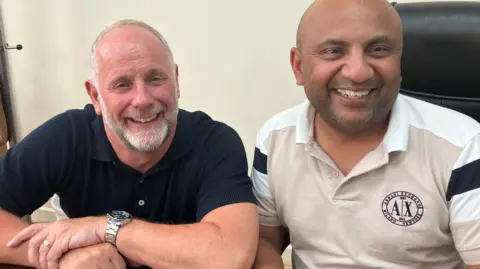
"All our forefathers used to work in these mills," says property developer Sandeep Gupta.
"In fact, one day I was sat in a pub and I was speaking to somebody from our Indian heritage. He was saying, 'where are you based?' and I told him I own Legram Mills. He got very emotional.
"People of my father's background or era, when they came to England, they used to work in the mills – so for him to see somebody owning that mill from our heritage was quite emotional and he was very happy to see it."
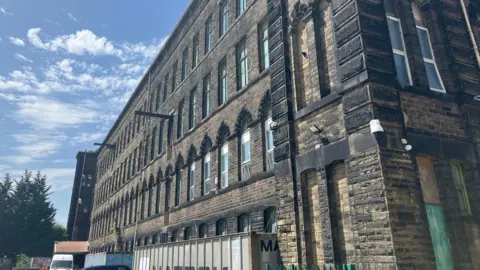
Gupta owns Legram Mills in Bradford and is planning to convert the former textile mill, built in 1871, into 130 student and residential apartments.
The project was recently highlighted by Historic England as one of 20 sites that, with investment, have the potential to create new homes.
Designed by architectural firm Lockwood and Mawson - who also designed the village of Saltaire, a UNESCO World Heritage Site - Grade II listed Legram Mills was used as a warehouse and spinning mill.
 Grace Wood/BBC
Textile manufacturing has been central to Gupta's business. Alongside owning several former wool mills across West Yorkshire, he also runs a home textiles importers called SK Imports, which brings fabrics from India and China to the UK.
"We have practically used all the floors in this building for storage and warehousing and distribution and I think now I want to use this building for alternative uses," he says.
Gupta is working with Beckwith Design Associates on the project, which has converted about 30 listed mills within Bradford and Leeds.
Architect Tony Lupton says it is important to see the project through, because you often "see mills with planning permission but they're never ever delivered".
Lupton has helped build "maybe 1,000" homes in Bradford and he says they all work on a process of the developer renting out the properties until he gets his money back.
"It does have its challenges in delivering in Bradford - I don't think you ever can deliver these sort of schemes to sell to the market because in reality the construction and the delivery cost more than you can sell the apartments on to the public," he says.
But to Gupta, saving the city's heritage is as important as the business.
"I think there's a lot of heritage in this country – I think our future generations, if these buildings are lost, would never understand what the history of this country was, what an industrial background this country had."
He says it is often assumed in Bradford that people who purchase mills are doing it for the wrong reasons.
"The minute you put these things in the press, a lot of bad press, a lot of negative comments and 'another mill is going to get burned down' and that really, I find it very disheartening to see," he says."
But projects like these do require huge amounts of money, and while Gupta has purchased the property and is investing significant amounts, it's still not enough, he says - which is why the scheme was featured by Historic England.
According to the public body that champions England's historic environment, the vacant textile mills of Yorkshire and Lancashire could provide 42,000 homes - and it is advertising a range of properties for investment.
Historic England places adviser John Lambe says it's not as simple as "just buying the site".
"You do have to have a plan in place and generally that comes through partnership," he says.
"So when you say partnership, that's working with the local authority in lining up the planning, and talking to a body like ourselves, Historic England, because there are listed items involved on the site."
And, he says, converting mills is not as straightforward as building new properties.
"It's a total transformation which is required and that needs careful planning in terms of fire escape and fire regulations and soundproofing and then insulation, you know, retrofitting to a great standard," he says.
However, mills remain a "great part of local life", says Lambe, and according to Historic England, 89% of people agree Britain's mills are an important part of our heritage.
"They are landmarks and symbols of place, particularly the chimneys, they offer great character on the skyline and they are very distinctive," he says.
Much like Gupta, Lambe is drawn to mills because of his heritage - of mixed Irish and Pakistani descent, his father came to Bradford to work in Drummond Mills.
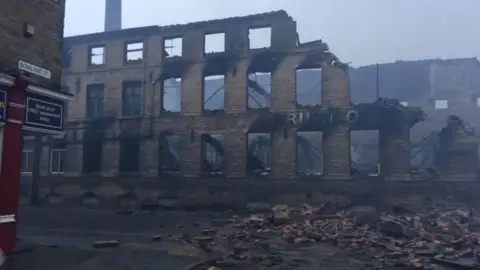
Drummond was not saved. After closing in 2002, the former textile mill was destroyed in a fire on 28 January 2016.
"A lot of these mills have been susceptible to fire, and Drummond was one of those," says Lambe.
"The chimney and engine house still exist there, and that's part of the issues about why these sites don't come forward so easily, because you've got to try and adapt them."
Listen to highlights from West Yorkshire on BBC Sounds, catch up with the latest episode of Look North.
