'Weaving my parents' coffins helped me to connect with them'

 BBC
BBCA woman has said helping to make her parents' coffins gave her a sense of "closeness" to them after they died.
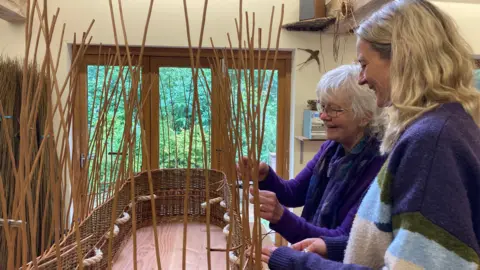
Felicity Rock, from Cubbington, in Warwickshire, wove part of her stepmother's willow coffin two-and-a-half years ago and did the same when her father died just six months ago.
"At both funerals, when I was looking at the coffin - absolutely beautiful coffin in both - I felt I was a part of that journey.
"Part of my step-mum's journey, and part of my dad's journey and that would always stay with me."
She said weaving her step-mother's coffin was particularly special.
"I'd been ill around the time that she was dying, and so I hadn't able to be with her and it felt a way in which I could sort of, you know, experience some sort of closeness after she'd gone," she said.
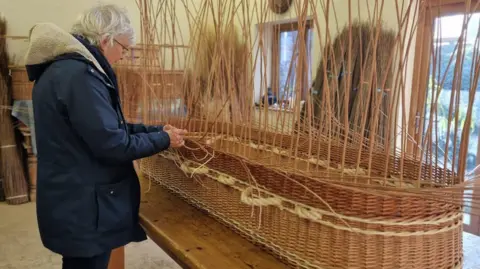
Rock worked with Caz Ingall from Wild Heart Coffins at its workshop in Radford Semele, Warwickshire.
Ingall started off by weaving wicker baskets, but set up Wild Heart Coffins more than six years ago after the experience of a family member's death.
 Supplied
She said: "In 2015 my aunt-in-law Rosie died and she [had] asked for a willow coffin.
"We went along to help make the coffin which was where the inspiration came from and having gone from making baskets to seeing what was possible to make coffins, I just absolutely fell in love."
Ingall uses willow branches from Somerset and timber for the base.
'Very special place'
Rock is a friend of Ingall's and was familiar with her work and knew it was something she wanted to do when her parents died.
She described the workshop as "a very special place" and just what she needed while trying to manage her loss.
"After somebody dies, it's a busy, busy time, and you've been in such a state of anticipation and loss and grief and uncertainty, and suddenly you're whizzed into this place of having to do, do, do," she recalled.
"So to come here and spend an hour, an hour-and-a-half, sort of in quiet. Well, it wasn't completely quiet, but it's really hard to describe how special and healing it is, and to also do something that was an act of love."
While Rock picked up the weaving technique quite easily, she admitted it was "quite hard on the hands" and said she had full respect for artists like Ingall who can weave willow for hours.
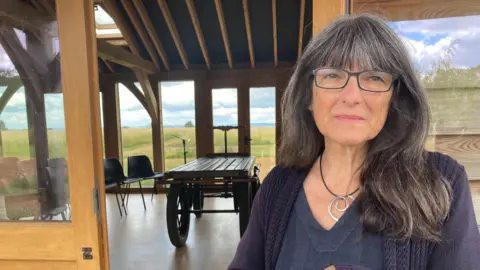
Ingall has seen an increase in demand for willow coffins, and anecdotal evidence gathered by The National Society of Allied and Independent Funeral Directors (SAIF) suggests there has been wider interest in environmentally friendly options in recent years.
One of those is natural burial grounds.
Emma Restall Orr, who owns a site in Lower Tysoe, said it was not always easy to define what a natural burial ground was, although they could look very different to a traditional churchyard.
"Essentially a natural burial ground is where nature takes a priority over the human impact," she said.
"So you don't have great big granite or acrylic or slate headstones and you don't have verges which are paved and tarmac roads. It's very much more about nature."
She said she started off by doing about three to 10 burials a month 20 years ago, but that has now risen to up to 16 a month.
"We're pretty much as busy as we want to be," she added.
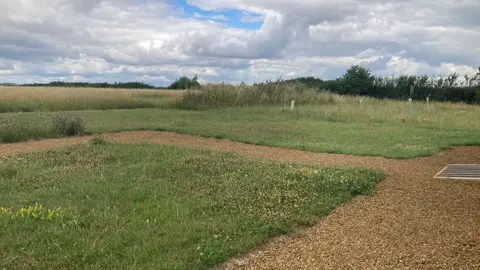
At the Sun Rising Natural Burial Ground there is not a headstone in sight, just meadowland and wildflowers, edged with gravel paths, to keep human footsteps from straying.
Although there are small memorial slates beside trees, visitors often have to rely on What3words, Restall Orr said, to track down their loved one's final resting place.
The app divides the world into 57 trillion squares, each measuring 3m by 3m (10ft by 10ft) and accompanied by a unique three-word address.
Sun Rising occupies 16 acres and Restall Orr reckons it will run out of space in another 20 to 30 years.
Afterwards, she said the site would be protected as essentially a nature reserve, giving a "sense of peace and and security".
Follow BBC Coventry & Warwickshire on BBC Sounds, Facebook, X and Instagram.
