Popemobile child clinic yet to reach Gaza one year after Francis's death

 George Jaraiseh
On the first anniversary of the death of Pope Francis, one of his last wishes - to convert his popemobile into a mobile clinic for children and send it to war-torn Gaza - is still waiting to be granted.
"It was really the wish of the Holy Father to be able to do something for the children of Gaza," a close confidant of the late pontiff, Cardinal Anders Arborelius of Sweden, tells me. "It's a symbol of hope."
The iconic popemobile - from which the pope waved at crowds of thousands of Palestinian Christians during his trip to the Holy Land in 2014 - was afterwards kept on display outside a Church-owned ice-cream parlour in Bethlehem in the occupied West Bank.
Last November, I was shown the newly refitted vehicle equipped for trauma care and vaccinations and told it could treat up to 200 children a day. However, today it remains in a glass case in the same place.
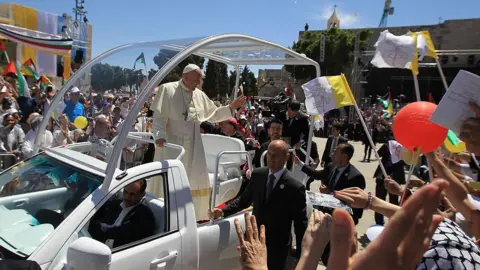 AFP via Getty Images
Caritas Jerusalem - the local branch of the international Catholic charity, Caritas - carried out the work on the popemobile for the Vehicle of Hope project and planned to send the vehicle to Gaza.
Then, in December, it was included on a list of 37 foreign non-governmental organisations (NGOs) ordered to stop work by the Israeli authorities after they failed to comply with controversial new "security and transparency" requirements, including staff disclosures.
Since then, the Latin Patriarchate of Jerusalem has successfully made the case that the new regulations do not apply to Caritas Jerusalem because it has a long-standing, special legal status "operating under the aegis and governance of Catholic Ordinaries of the Holy Land".
Regarding the Vehicle of Hope, a local Caritas spokesperson told the BBC that the organisation was "in dialogue with the authorities" and that a permit for the converted popemobile was being processed through the Church.
In a statement, Cogat, the Israeli defence body which controls the crossings to Gaza, said it had arranged for two mobile clinics to be sent by the Latin Patriarchate in February and was "not aware of any request to bring additional vehicles into the Strip."
It added: "Should an orderly request be submitted through the accepted channels, it will be examined accordingly."
 George Jaraiseh
Cardinal Arborelius hopes that permission will soon be given for the converted popemobile to enter Gaza. "It's a purely humanitarian action, it has nothing to do with politics," he says.
"We think it could be very important for everyone. It would show the goodwill of the authorities of Israel, it will give hope to the people, and it will show that somehow the spiritual heritage of Pope Francis is respected."
"That was his wish, to create good relationships between all peoples, all religions, and especially in favour of children who have a very, very difficult situation."
A short video released by the Vatican upon the death of Pope Francis showed his intimate relationship with Gaza's tiny Christian community, many of whom he came to know by name. He can be seen chatting with priests at the Holy Family Church in Gaza City.
After war broke out following Hamas's deadly attacks on Israel in October 2023, many displaced Christians moved into the church. The late pope took to calling almost nightly to check on their wellbeing and would talk to different members of the congregation.
In his Easter message last year – his last public appearance – Pope Francis repeated his call for peace and a ceasefire in Gaza. With his words read by an aide, he said: "The terrible conflict continues to cause death and destruction and to create a dramatic and deplorable humanitarian situation.''
Two years of conflict in Gaza have severely weakened Gaza's health system. According to the World Health Organization (WHO), only half of all hospitals are partly functional and specialised medical care is largely unavailable.
Since a ceasefire came into force in October, work has been slow to repair damaged healthcare facilities and increase medical supplies and services. The WHO says some 18,500 people, including 4,000 children, are on waiting lists for medical evacuations, in many cases for lifesaving treatment.
