Key Indian state polls begin in test for Modi's party

 AFP via Getty Images
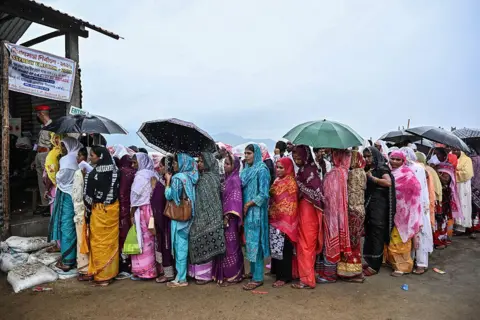
Millions of Indians have begun voting in elections across two states and a federally-administered territory, in a set of contests seen as an early gauge of support for Prime Minister Narendra Modi.
Polling is under way in Assam and Kerala states, and Puducherry. The electoral cycle will extend to West Bengal and Tamil Nadu later this month, with results from all five due on 4 May.
For Modi's Bharatiya Janata Party (BJP), these elections are less about federal stability and more a test of its ability to make inroads in regions where it has historically struggled.
For opposition parties, the polls are a test of whether they can unite against BJP dominance.
 NurPhoto via Getty Images
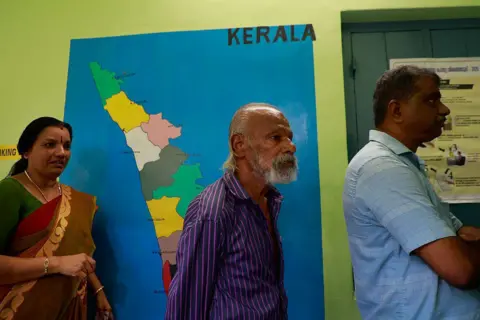
According to India's Election Commission, the five regions have a combined 174 million voters - about 18% of the country's electorate.
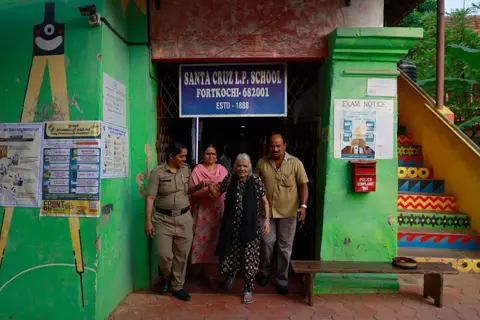
A total of 296 seats are at stake in Thursday's polls: 126 in Assam, 140 in Kerala and 30 in Puducherry.
By 15:00 India time (09:30 GMT), Assam saw the highest voter turnout at 75.91%, according to data shared by the Election Commission of India. The turnout in Kerala was 62.71% and 72.40% in Puducherry.
The BJP governs Assam and is part of the ruling alliance in Puducherry, but has never formed a government in West Bengal, Kerala or Tamil Nadu, where it faces entrenched regional parties battling to retain or regain power.
"It's a big test for the BJP, which has spent years trying to expand in West Bengal and southern states like Kerala and Tamil Nadu," Rahul Verma, a political scientist at the Centre for Policy Research, told the BBC.
But, he said, the polls are an even bigger challenge for opposition parties, particularly the Congress, whose electoral strength has declined in recent years.
"The results will show whether they [Congress] can mount a serious challenge in Assam and build on recent local election gains in Kerala. The election will also give a glimpse into how the broader opposition alliance is managing internal tensions," he added.
The summer polls - covering 824 assembly seats across the five regions - come amid a major controversy over a revision of electoral rolls, known as Special Intensive Revision (SIR). The Election Commission says that the exercise is aimed at removing duplicate or outdated entries and adding legit ones.
But opposition parties allege it has been used to delete millions of voters, especially Muslims, to benefit the BJP. The BJP and the Election Commission have denied this.
 NurPhoto via Getty Images
Each region voting in April has its own political dynamics.
In Assam, politics has long been shaped by anxieties over migration, identity and citizenship, particularly along the Bangladesh border. The BJP has ruled the state for a decade, making this election a test of whether it can retain its dominance.
The campaign in Assam has been marked by sharp rhetoric from Chief Minister Himanta Biswa Sarma, who has focused on undocumented immigration and demographic change, including remarks about Bengali-speaking Muslims. The opposition, led by the Congress, is trying to rally support around governance, economic concerns and regional identity.
Kerala ranks among India's top performers on literacy, healthcare and life expectancy, and campaigns here centre on welfare and governance.
Power has traditionally alternated between alliances led by the Communist Party of India (Marxist) and the Congress. The Left alliance, in power for a decade, is seeking to overcome anti-incumbency.
West Bengal, the most populous of the five regions with over 70 million voters, has been ruled by Chief Minister Mamata Banerjee of the Trinamool Congress since 2011, with the BJP emerging as its main challenger. Voting will take place in two phases on 23 and 29 April.
Banerjee has cast the BJP as an outsider at odds with West Bengal's linguistic and cultural identity, a charge the BJP rejects as it campaigns on undocumented immigration and national security, sharpening an already polarised contest in the Bangladesh-bordering state.
The race has also been overshadowed by controversy over the SIR exercise, with a final list showing about nine million voters removed, many from the Muslim-majority district of Murshidabad.
Tamil Nadu has long been dominated by two regional parties - the Dravida Munnetra Kazhagam (DMK) and the All India Anna Dravida Munnetra Kazhagam (AIADMK), which is contesting the election in an alliance with the BJP.
This election - with voting scheduled on 23 April - has drawn extra attention with the emergence of a third political force led by superstar Vijay.
The BJP has struggled to gain a foothold in the state, where politics is shaped by regional parties rooted in social justice, state autonomy and a distinct linguistic identity. Even modest gains would mark a breakthrough, signalling its ability to expand in southern India.
Puducherry, a coastal enclave with a 30-member assembly, is governed by the BJP-led National Democratic Alliance, with campaigns focused on welfare, jobs, development and ties with the federal government.
