Could the death of these women's grandmother help us all to live longer?

 BBC
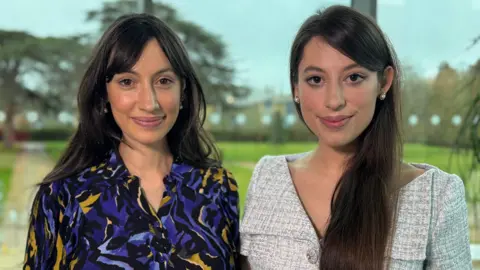
BBCWhen her beloved grandmother died, it changed the course of Dr Carina Kern's life, sparking a deep desire to understand why ageing makes us more likely to become frail and die and, ultimately, to stop it.
Twenty-five years on, the Cambridge-based company she founded with her sister, ex-lawyer Serena Kern-Libera, believes it has made a breakthrough that could change outcomes for all of us.
Unlike some research teams working on the science of ageing, they are not working towards immortality, aiming instead to extend and improve quality of life.
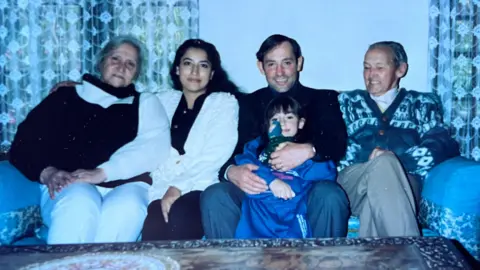
Growing up in the mountains of southern India, the sisters saw their grandmother, Sydia Kern, every day.
"When I was four or five, I would try to avoid school as much as possible and I'd run to my grandmother's house," Kern, 31, recalls.
Kern-Libera, 37, adds: "She loved the outdoors and would always take us for walks. She was very active. It was a childhood full of joy."
 Serena Kern
But in 2001, everything changed. Sydia was hospitalised with a chest infection and never came home.
"Her health spiralled downwards, she was robbed of her dignity and within weeks, I lost her," says Kern.
"Doctors said it was a natural part of ageing, but I couldn't understand why. I was a real tomboy, always getting injured, and the hospital always fixed me, so why not her? It was a real killer for me.
"That was the start of my desire to try to fix this problem."
In the years since, Kern has focussed on finding the single factor that drives the biggest deterioration in our overall health.
Using AI, she identified necrosis – the unexpected death of our cells – and a potential drug to stop it.
The Health Innovation Network – established by the NHS to help fast-track the most promising research from the lab to patients – is now supporting the sisters' company LinkGevity to advance their drug, and "talking to Papworth and Addenbrooke's hospitals" about facilitating a trial.
 Getty Images
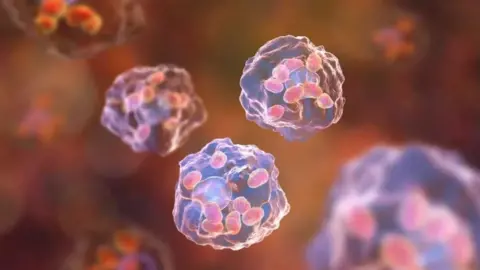
Cells are the individual building blocks of living organisms and while some are naturally programmed to die, necrosis is not part of the biological plan.
It happens when cells are damaged through injury, lack of oxygen or blood. Calcium floods into the cell, causing it to explode. This, in turn, damages neighbouring cells and can start a cascade of inflammation throughout the body.
It is more likely as we get older and Kern says it plays a central role in major conditions including stroke, heart attack, kidney disease, Alzheimer's, Parkinson's, cardiovascular and liver diseases.
It also fuels several of the fastest spreading, most aggressive cancers.
"If you were to identify a means to block necrosis, it wouldn't just mean one drug for one disease: you would have a Swiss Army knife type of drug that is capable of protecting the system as a whole," she says.
And that is what LinkGevity, based at Babraham Research Campus, believes it has developed: a first-of-its-kind drug that can block the calcium overload through two specific channels and allow the cell to stabilise and begin to repair from the damage.
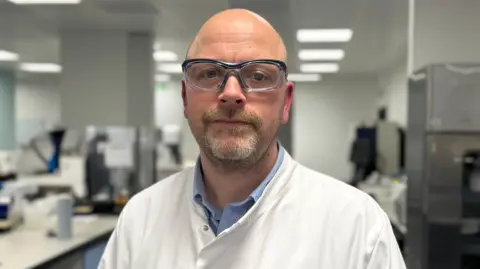
LinkGevity's data has been independently verified by medicine research specialists Domainex, which ran tests on human kidney cells at its lab in Pampisford, near Cambridge.
"We are truly independent when it comes to the science. We present the results, whether they are what you want to see or not," says group leader Dr Jesse Peterson.
He admits his team, like many who heard LinkGevity's claims, were sceptical at first.
"Typically with necrosis, we see cell death between 24 and 48 hours of exposure to harm and in this case, we saw it blocked up to 11 days, so this is really quite remarkable," he says.
The results have also attracted the attention and funding of renowned scientific organisations including Innovate UK, The Francis Crick Institute and NASA. In space, microgravity ages human tissue faster than on Earth, and so finding ways to prevent it is key to exploration, which the Artemis II voyage has rekindled with the first crewed Moon mission in 50 years.
But the next vital step is a human clinical trial.
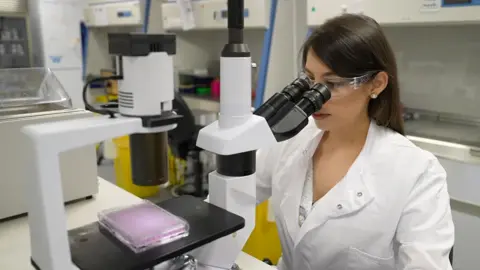
While still preparing for regulatory approval, this will focus on preventing necrosis in the kidney – an organ highly susceptible to this type of cell death.
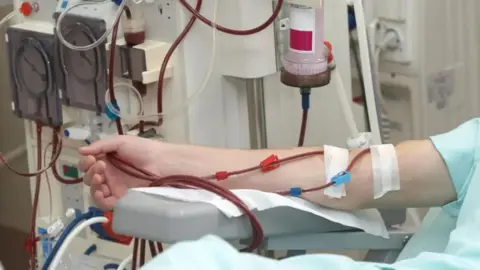
It is estimated that seven million people in the UK have kidney disease and currently, there is no cure. Kidney failure is fatal without dialysis – using machinery to filter the blood – or transplant.
Acute kidney injury (AKI) is also a common problem in heart surgery patients.
"Most heart surgery requires the patient to be put on a heart-lung bypass machine," explains Narain Moorjani, clinical lead for cardiac surgery at Royal Papworth Hospital.
"Unfortunately, the machine can have significant side effects on kidney function. That ultimately results in kidney cell death, which is associated with extended stays in intensive care and increased mortality.
"Although there have been many attempts to reduce the effects, they have had limited success."
Moorjani believes LinkGevity is the first to "attempt to specifically block the endpoint of necrosis, which is what makes the plans for this trial so exciting".
Phil Shelton, director of industry partnerships at Health Innovation East, says: "It costs a lot of money to run a trial so we're co-applying for grants with the company and bringing contacts together.
"Addressing AKI is a huge unmet need for us, so there's a lot of interest in this.
"If the bids are successful, we could potentially get things into a trial quite rapidly."
 Getty Images
The sisters also believe their drug, LINK-001, will benefit medical research.
"It's difficult to grow complex human tissue in a lab," says Kern-Libera, who was so impressed by her sister's scientific achievements that she left a successful career as a lawyer to become LinkGevity's chief operating officer.
"Very quickly, the cells in the middle are starved of oxygen – because unlike in the body, they have no blood supply – and necrosis sets in, destroying the tissue from the centre out."
A drug that can prevent this could potentially pave the way for transplant organs to be grown in a lab, complex tissue to be frozen more successfully, and testing on animals to be reduced.
Blocking necrosis may not prevent us getting disease but it is likely to slow its progression.
"One of the biggest problems affecting our economy and society is that we have an ageing population which is decrepit," says Kern-Libera.
"Carina and I always say we're not afraid of death but that downward spiral in health that hangs over all of us and takes our dignity, like it did for our grandmother. I think she would be very proud of what Carina has done."
Kern adds: "No-one wants to have their mind robbed; their body falling to pieces.
"If you can intervene in that, I think it's one of the greatest goods you could do on this planet."
Follow Cambridgeshire news on BBC Sounds, Facebook, Instagram and X.
