Can homegrown social workers help to free up NHS beds?

 NIKKI FOX/BBC
Freeing up hospital beds is a key element in reducing hospital waiting lists, but often a real challenge. Could councils' efforts to "grow their own" social workers through apprenticeships be the answer?
With people living with more complex conditions, the NHS says it is more important than ever to get them out of hospital quickly.
Social workers are crucial to achieving this, but filling these roles as demand rises is a growing challenge.
Across England, there were 1,650 vacancies for social workers in adult care in 2024-5, 8.8% of the total positions.
In the team supporting hospital discharges in Hertfordshire, the vacancy rate is down to 4.1%.
With overseas recruitment more limited following tighter visa rules introduced in 2025, local authorities such as Hertfordshire County Council have instead focused on hiring from within and training new social workers through on‑the‑job apprenticeships.
Across England, it is a model that has expanded rapidly, with the number of enrolled apprentices almost doubling from 660 in 2019-20 to 1,290 in 2024-25, according to the Department for Education.
Social Work England says it approved 44 undergraduate and 11 postgraduate apprenticeship courses in the past year.
Sarah Blackmore, its executive director of external engagement and professional practice, says: "It is encouraging to see the growth in apprenticeships… which helps build a diverse workforce that reflects the communities that social workers support."
 NIKKI FOX/BBC
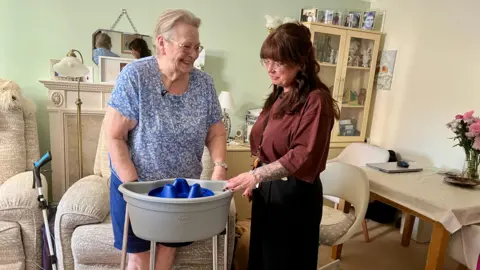
Claire Colvill, 39, is in the final year of a social work degree apprenticeship with Hertfordshire County Council.
She previously worked for the council in a related role, allowing her to progress without leaving.
Before that, she worked in beauty and moved into home care because she wanted "something more rewarding".
She had not previously considered social work as a career and believes its reputation is part of the challenge.
"When you walk away, hopefully somebody's life is a little bit better than when you walked into it," she says.
Working alongside social workers showed her the "huge scope of roles available". Learning on the job, she says, gives a realistic understanding of pressures and "what is expected in the real world".
 NIKKI FOX/BBC
The scheme allows her to retain income while studying part-time at the University of Bedfordshire.
"On a personal level, the apprenticeship route offered the ideal balance," she says.
Much of her work involves helping people fulfil their wishes around where and how they want to live.
"I've had people that may have been considering care homes but didn't particularly want that, so to be able to find avenues where they can remain at home is rewarding," she says.
The team she works in dealt with an 8% rise in referrals between 2024-25 and 2025-26, with numbers increasing from 2,895 to 3,148.
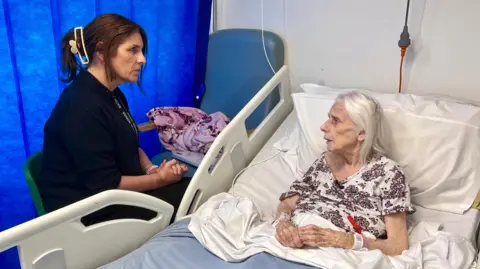
Dawn North, 82, was admitted to hospital with a chest infection after a fall.
Social workers helped arrange practical support to rebuild confidence at home, including a caddy clipped onto her walking frame and a height‑adjustable chair in the kitchen.
Her husband, Bill, was also helped to remain at home before he died in January.
"As long as he was looked after, which he was, I was happy," she says.
"I've got memories and everything else here. I wouldn't like to leave at all to go into a home… no way."
 NIKKI FOX/BBC
In Hertfordshire, the authorities deal with about 30 complex discharges from Lister Hospital in Stevenage daily.
The county council has 27 social work degree apprentices working in adult social care, all of whom were existing employees.
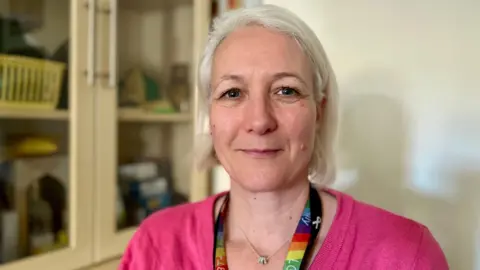
Heidi Hall, head of its transfer of care team, says recruiting internally has clear benefits.
"They understand what the work is and what they're coming into. They understand what's available in Hertfordshire and they've got that resilience," she says.
"It's really important to have people in the job who know what the job is."
Hospital social workers in the integrated discharge/transfer of care teams can expect to earn between £42,327 and £45,176 a year.
Hall believes more people will take this route, although Skills for Care, the strategic workforce development and planning body, believes there are limits to how many staff want to upskill.
 NIKKI FOX/BBC
Hall says her team aims to get people out of hospital within 24 hours of being medically fit and has helped to speed up discharges at Lister Hospital in recent years.
Numbers rose from 6,429 in 2022-23 to a peak of 7,020 in 2024-25. But she says it is becoming more difficult.
"The main thing has been the complexity of the need and balancing the number of people coming into the hospitals that we need to discharge," she says.
"There used to be time when people stayed in hospital for longer. Now a lot of that care is completed in the community."
She says pressures on beds mean people are discharged sooner, often with higher ongoing needs.
"More people want to live in their own homes, so we need to support them to live where they want to be," she says.
But Nikki Jefferson, a senior lecturer at the University of Hertfordshire, says policy and funding often focus too narrowly on discharge.
"It often misses the wider reasons behind why there's people in hospital," she says.
"Can they be enabled and kept at home without the need for that very significant amount of medical support?
"So I think it's really important that when you're looking at how do you make things better, that you consider every aspect of the pathway."
Colvill agrees that prevention matters.
"A lot seemed to change over Covid; things came and went," she says, adding that better community support can help people who are isolated avoid crisis in the first place.
Andrew Reece, of the British Association of Social Work, says the profession is facing a big retention problem, with areas such as hospital discharge and older people's care "acutely affected" by "ever-increasing caseloads".
He says apprenticeships are valuable, but not enough on their own, and is calling for more funding for student bursaries for traditional degrees.
The government offers grants of up to £5,000 to a limited number of students on traditional degrees.
It says applications – particularly from postgraduates – have fallen, prompting a public consultation on changes to the scheme, which closed on 7 April. Results are now being analysed.
A Department of Health and Social Care spokesperson said: "Social care apprenticeships are an important route, offering individuals the opportunity to earn a salary, avoid tuition fees and get hands-on experiences working with people.
"But we know there is more to do to ensure that all patients get the level of care they expect and deserve. That's why we are making over £4.6bn of additional funding available for adult social care."
Do you have a story suggestion for Beds, Herts or Bucks? Contact us below.
Follow Beds, Herts and Bucks news on BBC Sounds, Facebook, Instagram and X.
