Supermarkets hit back over pressure to cap price of milk, bread and eggs

 Getty Images
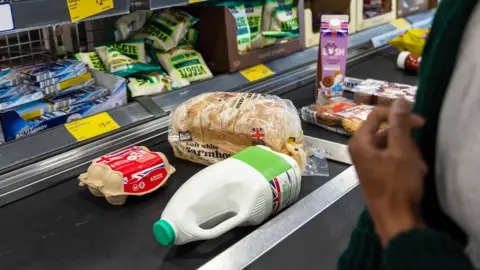
Government ministers are pressing supermarkets on cutting costs for shoppers but will not force them to cap prices on essentials such as eggs, bread and milk.
Multiple supermarket sources told the BBC that the government had urged them to voluntarily freeze the price of key groceries, in return for an easing of regulations.
On Wednesday, Treasury secretary Dan Tomlinson confirmed talks with the sector had taken place"about the steps that they can take to support people with the cost of living".
He said supermarkets would not be forced to cap prices, but even a voluntary scheme has been described by Marks & Spencer's chief executive Stuart Machin as "completely preposterous".
The BBC learnt on Tuesday that the Treasury had asked retailers to freeze price rises on certain products in exchange for an easing of packaging policies and a potential delay to rule changes around healthy food.
The proposals, first reported by the Financial Times, come after the Scottish National Party (SNP) pledged to introduce a similar policy in Scotland last month, but its price cap would not be voluntary.
Tomlinson told BBC Radio 4's Today programme there were no plans to instil a mandatory price cap on food by the government in Westminster.
There also are no plans to include any food price controls in announcements on measures to combat the cost of living expected tomorrow, government sources told the BBC.
The sources also said discussions were continuing with retailers who had not "briefed against" the government – citing particular frustration with comments from Marks & Spencer's Machin.
Pressed on a voluntary agreement to limit prices, Tomlinson highlighted the conflict in Iran and people's concerns over price rises.
"It's right that the government looks across the board at what more we can do - both government levers but also talking to industry about the steps that they can take to support people with the cost of living," he said.
Newly-published inflation figures show the annual rate of food price rises was 3% in April, which was higher than the overall rate of inflation of 2.8%.
Some industry groups have warned the rate of food price rises could hit nearly 10% by the end of the year.
'Completely preposterous'
The suggestion of a voluntary freeze in the price of groceries was met with a furious response by key figures in the industry.
Stuart Machin, chief executive of Marks & Spencer, said any move to cap food priced by the government was "completely preposterous".
"My advice is that the Government should reduce some of the tax and regulatory burden and free us up in a very competitive market," he said.
Meanwhile, former chairman of Ocado and Conservative peer Lord Stuart Rose told the Today programme: "I think the whole idea is the stuff of nonsense and it will never fly."
"This smacks of state control, it's idiotic, it's dangerous, and it'll never work."
He said there was "no better system than a free market economy", adding there could be "unintended consequences" of government intervention to limit prices.
The former boss of Sainsbury's Justin King told the BBC that the proposals were "pretty silly" and would create "all sorts of competition law issues".
He added that the British supermarket sector was already highly competitive and that it was "hypocritical" for the Treasury to ask supermarkets to cap prices when its policies were contributing to inflation.
"If the government holds back on some of the things it's increasing... that will quickly flow through [to consumers]," he said.
Others say price rises are being caused by a surge in fertiliser and animal feed prices since the US-Israel war with Iran effectively blocked their transport through the key Strait of Hormuz waterway.
Helen Dickinson, the chief executive of the British Retail Consortium, said: "Rather than introduce 1970s style price controls and trying to force retailers to sell goods at a loss, the government must focus on how it will reduce the public policy costs which are pushing up food prices in the first place."
She added: "The UK has the most affordable grocery prices in Western Europe thanks to the fierce competition between supermarkets," she also said.
A government source told the BBC the BRC's comments were "hysterical".
Andrew Bailey, the governor of the Bank of England, said there could be some short-term benefits to limiting the price of essentials, but it would not be sustainable "in the long run".
Tougher rules around price gouging
The groceries price cap row comes as the Chancellor brings forward measures to give the consumer protection watchdog more powers to tackle price gouging.
The Competition and Markets Authority (CMA) will be allowed to "name and shame" firms who have changed their margins in response to an economic shock.
It will also get new, rapid investigatory powers to identify firms taking advantage of crises.
Chancellor Rachel Reeves said on Wednesday: "When global events drive up costs, working families feel it first.
"I will not tolerate anyone exploiting a crisis to make a quick buck off the back of hard working people."

