Oldest natural history museum completes redisplay

 Fisher Studios and Museum of Natural History, University of Oxford
The first ever scientifically named dinosaur is featured at the heart of a long-term exhibition project by the UK's oldest natural history museum.
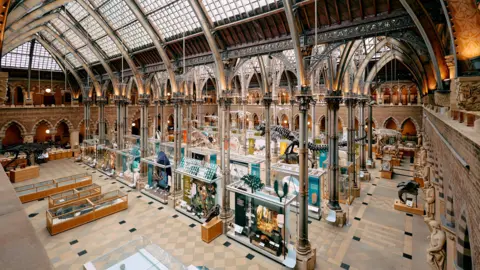
The 166-year-old Oxford University Museum of Natural History, on Park Road, has completed the final phrase of its historic redisplay initiative, called "Life, as we know it", with more than 3,000 objects installed.
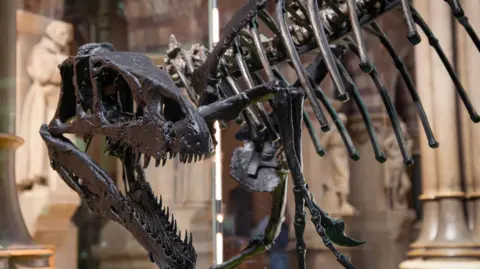
That includes the Megalosaurus, a Jurassic dinosaur discovered in a quarry in Stonesfield, Oxfordshire, in the late 18th Century.
Museum director Dr Gavin Svenson said the new displays, which open on Monday, "bring together thousands of specimens to tell some of the most important stories in science".
 Fisher Studios and Museum of Natural History, University of Oxford
The project has seen the installation of 48 new displays in 24 state-of-the-art showcases themed around biodiversity, ecosystems, evolution, and Earth.
The museum said that together, the exhibits "encompass the intricate relationships between our planet and life".
Thousands of specimens have been staged "in a fresh, bold design" within the main court and unique Victorian building.
The Megalosaurus, whose name means "great lizard", is recognised as kick-starting the study of what would collectively become known as dinosaurs.
University of Oxford Prof William Buckland presented its fossilised remains to the Geological Society of London in 1824.
The remains, which measure nine metres in length and weigh about a tonne, will form part of the new prehistoric ecosystems displays.
 Fisher Studios and Museum of Natural History, University of Oxford
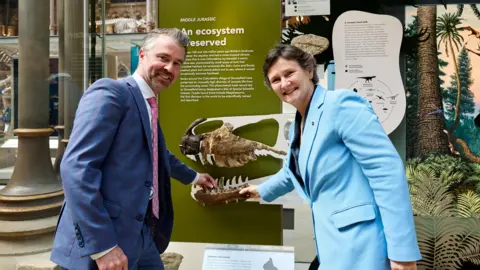
Two other Oxfordshire dinosaurs - the predatory Eustreptospondylus, discovered in Summertown in 1870, and Cumnoria, named after its discovery in Cumnor in 1879 - will also be showcased.
Visitors will also be able to experience a series of touchable mineral specimens, a sculpture presenting a reconstruction of the Moon's surface and a virtual exploration of ocean ecosystems from the Jurassic era and even the Cambrian period.
The museum said the project's final phase has been supported by Biffa Award, which supports communities as part of the government's Landfill Communities Fund.
Oxford University's vice-chancellor, Prof Irene Tracey, said: "The completion of 'Life, as we know it' is a remarkable achievement that brings together cutting-edge science, outstanding collections and public engagement, helping new generations of visitors explore the history of our planet and the extraordinary diversity of life upon it."
 Fisher Studios and Museum of Natural History, University of Oxford