Hedgehogs suffering in record-breaking heat waves

 BBC
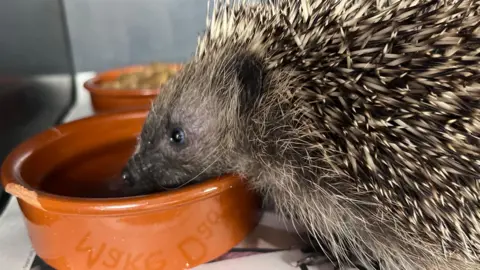
BBCA rescue centre says it has been "inundated" with baby hedgehogs who are suffering due to hot weather across the South East.
A series of heatwaves have made water scarce and caused the ground to harden, making it difficult for the animals to dig for insects that make up the majority of their diet.
Thorne Hedgehog Rescue in Kent, run by Lisa Steward and her team of volunteers, usually looks after around 1,200 hedgehogs a year but are experiencing a surge in the creatures being taken into care.
"The long hot dry spell has meant that mums are struggling to find food so their milk is of poor quality or it's drying up," said Steward. "We're inundated with hoglets, more than we've ever had before."

The registered non-profit organisation in Pluckley has also seen a huge rise in starving and dehydrated adult hedgehogs brought in to care.
In the 1950s it was estimated there were 35 million hedgehogs living wild in Great Britain, yet today that figure is around 800,000 due to urban development of habitats and climate change, according to Steward.
"They've been around for about 15 million years and done quite well up to this point and evolved as they need to, but this is all happening in such a short space of time they just haven't got time to adapt," she said.
Alice Serras-Carroll, manager of Wildlife Aid in Leatherhead, has also seen a sharp rise in the number of dehydrated animals taken in.
"It is unusual for this country to be this hot so that is why animals are not really used to it," she said.
The Met Office has confirmed that July in England and Wales was the driest and sunniest since records began, while southern England recorded its warmest July on record.
With 33.5C being recorded at Wisley on Monday that marks the 33rd day this year with temperatures of 30C or more.
While Kent is not officially in drought, seven other regions are - including most of Surrey.
It's not just hedgehogs who are feeling the heat and needing help from the Surrey rescue centre - vet Raul Romero Reyes said birds were also at risk.
"We had a pigeon who got completely engulfed in mud in a dried up pond, literally just the head was sticking out so we had to rescue it, then clean it up for release," he said.
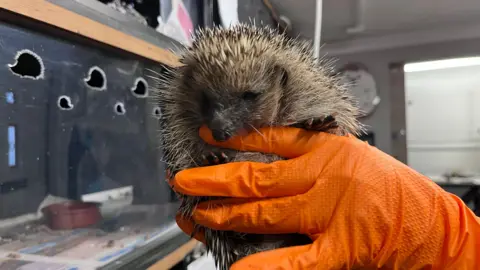
Wildlife Aid has also taken in more fox cubs than ever before due to their mothers struggling to care for them in the heat.
They are hand reared and then sent out into the wild when fit and able.
However, there is hope for animals if homeowners can leave natural areas in gardens which encourage wild flowers, or little log piles which they can make their homes in.
"Hedgehog highways are really important," added Steward.
As they need to travel two to three miles (three to five km) a night to forage for food, little gaps in fences or hedges of about 13 centimetres (five inches) will allow the biggest of hedgehogs to pass through and get food, water and nesting supplies.
Steward added that she encouraged people to leave a shallow dish of water out every evening during the hot spell for all wildlife.
Follow BBC Kent on Facebook, on X, and on Instagram. Send your story ideas to southeasttoday@bbc.co.uk or WhatsApp us on 08081 002250.
