Starmer warns of Russian aggression as UK agrees new treaty with Poland

 PA Media
Sir Keir Starmer has said the UK and Poland are facing "no greater challenge" than Russian aggression, as the two countries signed a new defence and security treaty.
The prime minister described the agreement as providing a "generational uplift" in the relationship with Poland.
Downing Street said the treaty's aims include supporting defence jobs, helping respond to cyber attacks, improving border security and dismantling organised crime groups.
But Ed Arnold, defence adviser at The D Group and senior associate fellow at the RUSI think tank, questioned the impact the treaty would have and how it differed from previous agreements between the two countries.
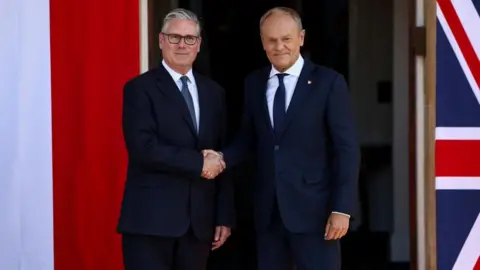
Sir Keir held talks with Polish Prime Minister Donald Tusk at RAF Northolt in west London on Wednesday to formalise the treaty.
They also visited the nearby Battle of Britain Bunker, where they laid a commemorative wreath.
Sir Keir said: "There's no greater challenge for either of our countries than the challenge of Russian aggression, and we see that not just in Ukraine itself, but beyond Ukraine, impacting on our own countries.
"So that's the context in which we sign what is actually a generational uplift in the relationship on security and defence between our two countries."
Tusk, speaking through an interpreter, said the UK and Poland's "shared values", including rule of law and human rights, provided the "foundation of the treaty".
He said some people "might say these values are now old-fashioned and obsolete, but they are important for us and for our nations".
The treaty text said it aims to "strengthen close co-operation in security and defence and preparing for the challenges facing" both the UK and Poland "and Europe as a whole".
It identifies Russia as "the most significant long-term threat" to Euro-Atlantic security and the "need to counter its malign actions".
It also reaffirms the UK and Poland's "ironclad commitment" to Nato and speaks of migrant smuggling being a "shared challenge requiring joint solutions".
The UK government said the two countries will discuss how to take action through a "new joint action plan on irregular migration".
They added this includes targeting the use of social media by smuggling gangs, maximising intelligence sharing and using new technologies to their monitor borders.
Arnold, asked if such treaties had an impact, told the BBC: "Quite frankly, specifically this one, not really."
He highlighted agreements signed between the two countries from 2018 and 2023, adding: "So I'm a bit confused why we've decided to add an additional treaty to that relationship already."
Arnold added: "The main parts of it are actually less on defence and security that are new, but more actually about migration and related security issues."
He noted these are important before, saying: "There's a bit of a risk whereby if you start to lump together lots of different policy areas, if you then have a bit of a disagreement on one policy area – for example, migration – then it can hurt the other parts of it i.e. defence and security.
"So I see a bit of a risk within the document itself of broadening the relationship with Poland, but there's nothing in there that is this sort of generational change or however the PM described it."
Arnold went on to question the UK's capacity to deliver on what it has signed-up to with its treaty-based agreements with other countries.
