Why can't newly qualified midwives get jobs?

 Nikki Fox/BBC
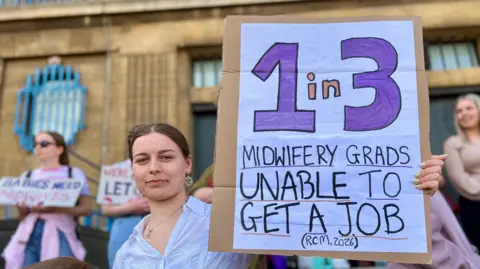
Newly qualified midwives are being pushed into lower‑paid work outside the NHS, despite repeated warnings about "chronic" understaffing in maternity services, campaigners say.
Some told the BBC they were working as receptionists or administrators because the number of advertised posts did not match the numbers being trained.
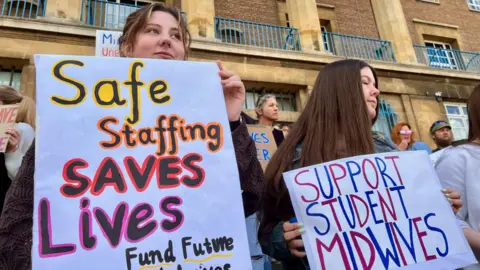
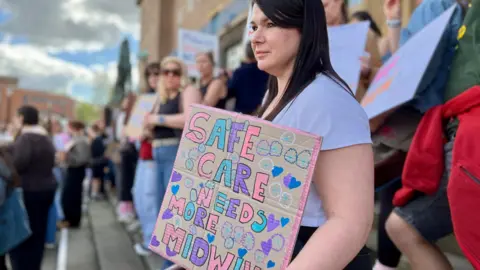
Students and graduates are now protesting under a campaign, Fund Future Midwives UK, with demonstrations already held in Norwich, Manchester and Birmingham.
The government said it sympathised and had funded 700 new midwifery posts costing £8m. But graduates say jobs remain scarce.
Why are student midwives protesting?
 Nikki Fox/BBC
The Royal College of Midwives (RCM) surveyed newly qualified members earlier this year and found almost one in three (31%) had not secured jobs.
Students protesting in Norwich said the outlook for those qualifying this summer may be worse.
They pointed to a webinar held on 17 March, facilitated by NHS England Workforce, Training and Education, where students said they were told there could be about 55 midwifery vacancies in the East of England for around 300 students qualifying this year — roughly one job for every five graduates.
The BBC understands that vacancy numbers fluctuate, but students say there is a clear gap between training numbers and available posts and are calling for guaranteed employment.
They also highlight training costs. They must complete 2,300 hours of unpaid clinical practice - including on‑call shifts - while paying tuition fees and placement travel expenses.
Students do receive a £5,000‑a‑year training bursary, which does not have to be repaid, prompting questions about whether public money is being wasted if graduates cannot find work.
How has it affected newly qualified midwives?
 Nikki Fox/BBC
Hollie Thornhill, 25, from Norwich, qualified as a midwife in 2025. She is currently working as a receptionist at a spa.
She says she has applied for seven midwifery jobs in 12 months.
"The response you always get is: 'We've got no money, no funding — we're over budget'," she said.
"It's not where I'd hoped to be 12 months down the line… I feel like I've been sold a dream.
"My skills are being wasted… I didn't expect to be sat behind a desk doing admin."
 Nikki Fox/BBC
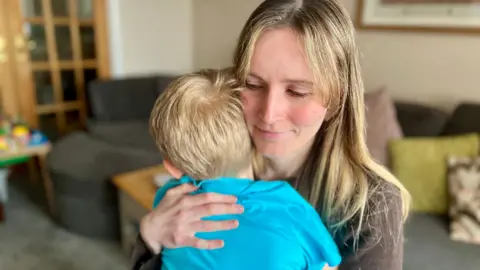
Emily, 30, from Mid Norfolk, is a third‑year student midwife and former air traffic controller. She retrained after forming a close relationship with her own midwife during the birth of her son.
"I've had to sell my house," she said.
"My family have stepped in to support me with childcare. I moved in with another family member.
"It was a sacrifice I was more than willing to make, because I believed I would have a job at the end of it."
She says many mature students on her course — often with families and mortgages — took similar risks because of what they had heard about a national shortage of midwives.
She describes the situation as "heartbreaking".
Midwives do not lose their professional registration if they cannot find work straight away.
But after three years they must show they have worked 450 hours, or complete a return‑to‑practice course.
What is causing the job shortage?
 Nikki Fox/BBC
During the Covid pandemic, the NHS expanded midwifery training in response to pressures and long‑standing shortages. Maternity care had to continue throughout the crisis, even as illness, isolation and redeployment affected staffing.
The previous Conservative government increased student midwifery places, describing it as "the largest expansion of NHS training in history". Because training takes several years, those decisions are only now feeding through into the workforce.
By contrast, NHS finances have since tightened.
The number of midwives graduating this year was effectively set in late 2022, before current budget pressures became clear.
While training is funded nationally, decisions about employing newly qualified staff are taken locally by NHS trusts, many of which are now under severe financial strain.
The Royal College of Midwives' director of midwifery, Fiona Gibb, said the situation had reached crisis point.
"Trusts up and down the country are having to make incredibly difficult financial decisions that are leading to recruitment freezes," she said.
"We are seeing healthy numbers of student midwives coming through… but the funding hasn't been there at the end of [training] programmes to ensure they are employed."
Are more staff needed to make things safer?
 Nikki Fox/BBC
The Care Quality Commission (CQC) has repeatedly linked staffing pressures in maternity units to safety concerns.
In its most recent inspections, nearly half of maternity services either required improvement or were rated inadequate.
Birth rates are falling. But experts say staffing requirements are driven by complexity rather than numbers, as more women present with diabetes, obesity, or mental health conditions.
Baroness Amos is currently leading a review of NHS maternity services, with interim findings already highlighting workforce shortages.
Jack Foreman, a third‑year student midwife from King's Lynn in Norfolk, said the situation was disheartening.
"We need safer staffing levels — this can't be swept under the rug," he said.
"You want to help… to go on the wards and see the mothers and babies, knowing that I might not be able to do this after I graduate, it's really disheartening."
But professional bodies warned that retaining experienced staff was just as important as recruiting new ones, to ensure appropriate supervision and training.
Why are midwives important?
 Nikki Fox/BBC
The World Health Organisation said that when midwives were educated to international standards — and when midwifery includes family planning — they could prevent more than 80% of maternal deaths, stillbirths, and neonatal deaths.
Research consistently linked adequate midwifery staffing to safer births, earlier detection of complications and better outcomes for mothers and babies.
Midwives care for women throughout pregnancy, during labour and birth, and after delivery, supporting recovery, feeding and mental health across hospitals and community settings.
What does the government say?
 Nikki Fox/BBC
A Department of Health and Social Care spokesperson said: "No one who dedicates themselves to a career in midwifery should be left in limbo when their skills are so urgently needed to rebuild the NHS."
The department said there was a record number of midwives in the NHS and that its 10‑Year Workforce Plan would show how staff would be trained, recruited, and retained.
It said £8m had funded around 700 additional posts. However, the roles were time‑limited, with trusts needing to decide whether they could afford to keep graduates once funding ended after 12 months.
The Royal College of Midwives warned the scheme risked creating short‑term jobs without addressing underlying funding pressures.
As of January 2026, there were 25,563 full‑time equivalent midwives working in NHS trusts and other organisations in England — a 31% increase compared with 2010.
A spokesperson for NHS England – East of England recognised the issue, but said there were hospitals with increased vacancies.
"We recognise some student midwives are experiencing difficulties securing their first role… as they approach graduation," they said.
"Access to opportunities can vary by region and speciality… and we understand how challenging and frustrating this can be."
The BBC understands that some trusts rated inadequate, including Bedfordshire Hospitals NHS Foundation Trust, were recruiting additional staff, although some were for more experienced roles.
NHS England said students should speak to their universities for advice.
Do you have a story suggestion for Norfolk? Contact us below.
Follow Norfolk news on BBC Sounds, Facebook, Instagram and X.
