Warning over death of woman who tripped in road

 Supplied
A coroner has said he will write to a council to express concerns over the state of Nottinghamshire's roads after a pedestrian tripped while crossing the street and died.
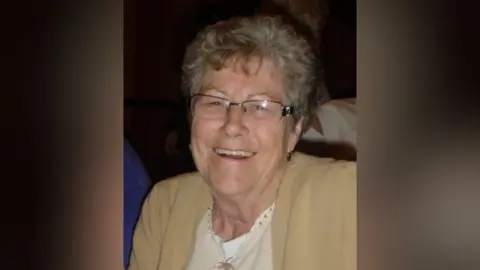
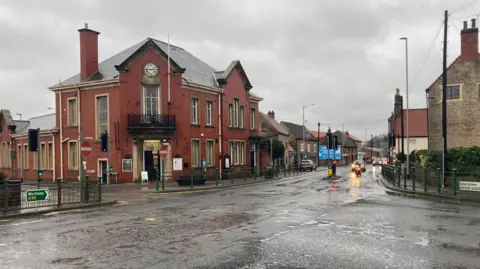
Beryl Barrett fell while crossing Church Street in Warsop on 19 December last year after a wheel in her walking frame became stuck in the road, leading to her losing balance and fracturing her hip.
The 87-year-old died six days later on Christmas Day, and an inquest at Nottingham Coroner's Court on Monday found her death was accidental.
Assistant coroner Nathanael Hartley issued a prevention of future deaths report over concerns at how the county council and its contractor assess reported damage, and over national guidelines.
The court heard Barrett died in hospital on Christmas Day, with a medical cause of death recorded as bronchopneumonia, with chronic obstructive pulmonary disorder (COPD), ischaemic heart disease, the fracture and diabetes among other contributory factors.
Recording a conclusion of accidental death, coroner Hartley said the fall "along with other co-morbidities contributed to her death".
"The fall more than minimally contributed to Beryl's death, because without it she would not have died when she did," he said.
Earlier this year, Labour MP Steve Yemm raised the issue of the state of Nottinghamshire's roads in Parliament, saying Barrett "tragically fell into an unrepaired pothole".
Former prime minister Sir Keir Starmer responded to the question by offering his "deepest sympathies" to Barrett's family.
However, at Barrett's inquest, no mention of the specific type of road defect was made, with the coroner concluding that any defect "was not actionable at the point of the fall".
Paying tribute, Barrett's daughter Marie Rickman told the court she was a "feisty" and "independent" woman who was active in her church and the local community.
She said Barrett "went out every day - she couldn't stand being in".
"She played bingo several times a week, went out with friends to Skegness. We had family holidays together," they added.
"She was involved with the community and the church and local old people's places. She was active, she was fit, she kept herself going and she had no interest with any healthcare. Within days of coming out of hospital she'd be sacking carers as she said she could do it herself.
"Even going into hospital she was in good spirits. For us that's the worst bit. If she'd gone in because of her COPD and just died it would've been the end naturally. We feel this wasn't a natural way to go."
The inquest was not told the depth or width of the road defect where Barrett's three-wheeled walking frame became stuck.
To be "actionable", according to guidelines by the UK Roads Leadership Group (UKRLG), a defect must be 20mm deep if it is on a pavement or crossing, or 40mm deep if it is on a road.
Steve Walton, a pre-construction director at Via East Midlands - which provides road maintenance services for Nottinghamshire County Council - gave evidence to the inquest.
The court heard inspections of the road had been carried out on 2 October, 3 November and 1 December that year, with no defects reported, but a re-examination of the video of the last inspection showed one of the defects on the pedestrian crossing that Barrett had used, which should have been flagged for repair.
'Unprecedented' demand
A report was made to the council after Barrett's fall, and the road was inspected on 31 December before being filled on 2 January.
Walton initially told the hearing that a pothole that had been thought to have caused Barrett's fall had been missed during the 1 December road inspection, because the inspector deemed it not deep enough to need filling in, but did not consider the lower threshold for potholes on pedestrian crossings.
After reviewing dashcam images of the fall during his evidence, Walton clarified that Barrett had not tripped on that pothole, but on a less severe road defect that did not require repair.
Walton said they were dealing with "multiple thousands" of calls about the conditions of the roads, which he said could deteriorate quickly due to the wet wintry weather.
"We were dealing with unprecedented levels of demand," he said.
"There were a number of defects at the time which were not repaired during the KPI [key performance indicator] window."
In his conclusion, Hartley said: "The leading wheel of the three-wheeled frame became stuck in the road, which caused her to lose her balance and fall.
"The defect thought to have been responsible was not in fact the cause of the fall."
The coroner added any defect "was not actionable at the point of the fall", but said he would write to the county council and Via over concerns about not "having a process in place that allows them to triage [calls] made to them" about the condition of the roads.
Hartley said he was concerned "there's a future risk to others" and would issue a prevention of future deaths report to Nottinghamshire County Council, Via East Midlands and the UKRLG.
The coroner said: "They do not appear to have a process in place that allows them to triage referrals alerting them to concerns about the state of the highways."
He said no review of the road Barrett fell on was done for 12 days, even though it was suspected she had tripped on a pothole.
Hartley said there was no system to prioritise the most severe road defects for urgent inspection.
He added that the UKRLG, which published a code of practice for managing roads, makes no specific recommendations about vulnerable pedestrians using walking aids with small wheels.
Following the inquest's conclusion, David Langford - director of highways, transport and waste management at the council - said: "Since this incident, we have been looking at the details of this case.
"Once we have received the letter of recommendations from the inquest, we will work with colleagues at Via to undertake a thorough review of our policies and procedures, and look at ways to make improvements which may help to avoid similar incidents occurring in the future."
Listen to BBC Radio Nottingham on Sounds and follow BBC Nottingham on Facebook, on X, or on Instagram. Send your story ideas to eastmidsnews@bbc.co.uk or via WhatsApp on 0808 100 2210.
