US pilot rescued after fighter jet downed over Iran, US media report
A US pilot has reportedly been rescued after their F-15 fighter jet was shot down over western Iran, the BBC's US partner CBS News reports, citing unnamed US officials. A search is under way for a second crew member.
The search and rescue mission to retrieve the crew - consisting of a Warthog jet and two helicopters - came under fire, causing the Warthog's pilot to eject over the Persian Gulf, where they were recovered, the report said.
The helicopter that rescued the F-15 pilot was also attacked, wounding crew members, CBS News further reports.
The apparent incident comes despite US President Donald Trump saying on Wednesday that Iran's drone and missile capabilities had been "decimated".
Reports that a US F-15E jet had been downed were first published by the Islamic Revolutionary Guard Corps (IRGC) affiliated Tasnim news agency.
If confirmed, it would mark the first time a US jet has been taken out by Iran since the start of the war.
CBS reports, citing two US officials, that the rescue helicopter that came under attack was able to land safely and all service personnel are receiving medical treatment.
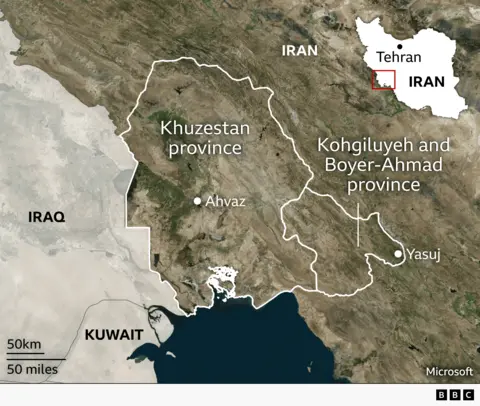
Social media footage verified by the BBC shows a plane and two helicopters flying low over Khuzestan province, consistent with a search and rescue mission.
The governor of Iran's southern Kohgiluyeh and Boyer-Ahmad province - which sits beside Khuzestan province - has said that "capturing" any downed US crew "alive" was a priority, according to the semi-official ISNA news agency.
Iranian outlets have said that a reward of 10 billion tomans (around £50,000) has been set to find the "intruder".
Asked by the BBC about reports that a US fighter jet had been shot down, the White House provided a statement that said only that "the president has been briefed".
Israel has held off planned strikes in the search area, CNN and Israel's Channel 12 report, citing Israeli officials. The Israel Defense Forces has not confirmed these reports.
The US had denied a report on Thursday morning by the IRGC that a fighter jet pilot had been shot down over Qeshm Island in the Strait of Hormuz.

The apparent downing of the jet comes after both Trump and US Defence Secretary Pete Hegseth have each repeatedly suggested that the US had already effectively won the war with Iran.
Trump said in a televised address on Wednesday that the US military had nearly completed its objectives, vowing to strike Iran "extremely hard" over the coming two or three weeks.
Iranian attacks across the region have continued despite US forces saying they had struck more than 12,300 targets, including naval vessels and facilities, missile launchers and defence manufacturing plants.
Trump has also touted talks with the Iranian regime, though Tehran has denied any contact with his administration. The Wall Street Journal reports that efforts to reach a ceasefire have hit a dead end, with Iranian officials unwilling to meet US counterparts.
The prospect of US casualties could also complicate Trump's efforts to assure the US public, particularly those within his Maga base who have grown alarmed at the prospect of a long-running, messy conflict overseas of the kind against which Trump campaigned.
New figures released by the Pentagon show 365 American service members have been injured as part of US operations against Iran.
Already, some commentators and political pundits are publicly questioning the utility of putting American lives at risk for a conflict they see as having poorly defined, rapidly morphing objectives and an unclear strategy to end the war.
The Trump administration initially said its goal was to destroy Iran's nuclear programme - but it has since also listed destroying Iran's ballistic missile capabilities and its navy, as well as diminishing its support for regional proxies, as among its aims.
Opinion polls have consistently shown that the US public is generally against the war and the Trump administration's handling of it.
The F-15 would not be the first US aircraft to be taken out of service during the course of the conflict, which began five weeks ago with US and Israeli strikes on Iran, prompting retaliatory strikes across the region.
Three US fighter jets were mistakenly shot down by Kuwaiti air defences in early March, in what Centcom described as "an apparent friendly fire incident". All six crew ejected safely and were recovered.
In March, six crew members of a US military refuelling aircraft died after it crashed in western Iraq. Centcom said neither hostile nor friendly fire were involved in the loss of the KC-135 aircraft.
The US-based Human Rights Activists News Agency says that 1,606 civilians, including at least 244 children, have been killed in Iran since the start of the conflict.
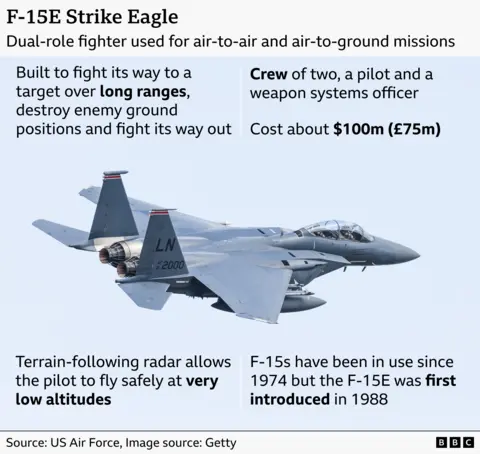
The F-15E Strike Eagle can fly at low altitudes and typically contains a pilot and a weapons systems officer.
One of them costs around $100m (£75m) and is equipped with a radar system that enables the detection of ground targets from long ranges.
It is designed to perform both air-to-air and air-to-ground combat missions.
