Rare 150-year-old Greenland shark washes up in Ireland

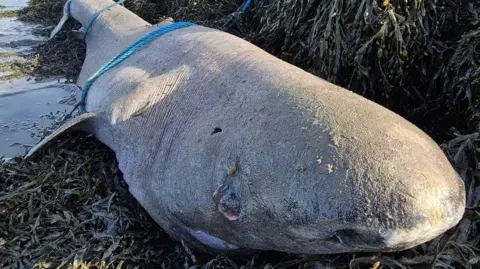 Natural History Museum of Ireland/Emma Murphy
It is hoped that a rare shark, which washed up in County Sligo, will be preserved and displayed in an Irish museum.
The Greenland shark, which can have a lifespan of more than 500 years - the longest of any known vertebrate - was discovered on the shores of Finisklin on Saturday.
It is the first known stranding of the species on the Irish coast and is thought to be up to 150-years-old.
Native to waters around the Arctic and north Atlantic, the discovery has been described as "very rare" by the Irish Whale and Dolphin Group (IWDG).
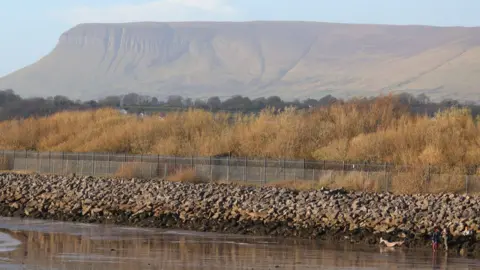 Emilie De Loose, IWDG
The IWDG said they received a report from two men of a 2m (6ft 6in) dead basking shark, however, all was not as it seemed.
Photos later confirmed that it was not a basking shark and "indeed a very rare and interesting stranding", later identified as a Greenland shark.
The IWDG said the Greenland shark was the longest living vertebrate in the world with a life span of several centuries - the oldest recorded specimen was" over half a millennium in age".
A large species, the shark typically reach lengths of 4m to 6m.
The shark lives in one of the most extreme environments with temperatures frequently falling below zero, yet this shark thrives.
Its slow way of life means it expends little energy when scavenging for food.
Powerful suction means the shark can suck food into its mouth from over a metre away. It finds its food using its sense of smell, which is highly developed, and it is thought this compensates for the shark being blind.
Known to reach sexual maturity about 150-years-old, the shark gives birth to its pups after a gestational period of eight to 18 years.
The male shark discovered in Sligo is said to "have had very developed claspers, perhaps on the brink of maturity".
 Google
Now in the possession of the Natural History Museum of Ireland (NHMI), a spokesperson told BBC News NI that the shark was found in a "difficult to access" part of the coast with the operation requiring specialist equipment, including a crane, to lift it from the shore.
The NHMI will carry out a "detailed scientific post-mortem examination" to help researchers understand "this elusive deep-water species", according to a NHMI spokesperson.
Allow Instagram content?
"Tissue samples and selected anatomical components are being preserved as part of the NHMI's scientific collections," they said.
"Subject to the condition of the skin and its suitability for preservation, the National Museum hopes to display the specimen in the future, which would allow visitors to learn more about one of the world's most mysterious shark species," they said.
