'Not fit for purpose' - the secret history of a deadly phrase

 AFP via Getty Images
"Our system is not fit for purpose."
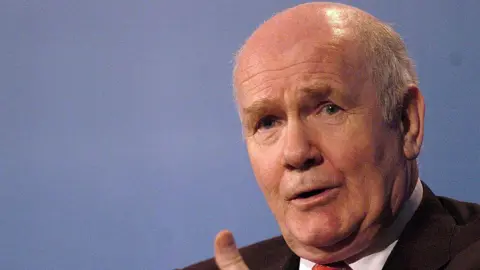
And with this description of parts of the Home Office in 2006, the then-Home Secretary John Reid minted a phrase that has lodged in the lexicon of British politics.
He was speaking a few months after thousands of foreign-born prisoners had been released from British jails without first being considered for deportation.
Lord Reid has previously attributed the four-word phrase to an unnamed senior civil servant. Now in a three-part series about the Home Office, the Newscast podcast can reveal the identity of its author.
It was the permanent secretary in the department at the time, Sir David Normington.
"It is my phrase, but it was written in a private memo to the Home Secretary, John Reid, just after he had arrived. [It was] me saying, 'This is what the Home Office is like,'" he told us.
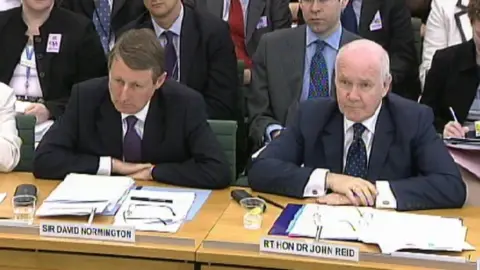
Sir David accompanied Lord Reid as he uttered the now infamous form of words to a House of Commons committee two decades ago.
"With me sat beside him, [I tried] to rearrange my face as he described all 70,000 civil servants in the Home Office as not fit for purpose," he recalled.
"That was a difficult moment and the civil service said to me: 'Well, why don't you stand up and tell him it's not true?'
"The trouble was… it was my phrase."
 House of Commons
In the 20 years since it was popularised, "not fit for purpose" has become an a universal by-word for state incompetence, something bureaucrats and their ministerial bosses reach for when they are trying to strike a tough, no-nonsense tone.
The Hansard record of parliamentary proceedings suggests it has been used nearly 3,000 times in the Commons and Lords since 2006. In the 20 years before that, the phrase was used just 37 times.
It has been deployed in debates ranging from conditions in armed forces housing to the sewerage system of a Cornish hospital.
In our interview with him, Sir David wanted to clear up some myths that have become attached to the term.
It was originally a reference to the Immigration and Nationality Directorate, a unit within the Home Office, rather than the entire Home Office.
And it was a description of technology, management and processes in the unit and not the whole staff or the immigration rules.
To be fair to Lord Reid, he made those distinctions at the time but his caveats have been lost in Whitehall lore.
Proving that words can go on hurting for decades, the phrase was dismissed on Newscast as "dismissive and "generic" by Lord Reid's immediate predecessor as Labour home secretary, Charles Clarke, who returned to the backbenches following the 2006 foreign prisoners debacle.
"Obviously, as in any organisation, there are things that are done well and things that are done badly," Clarke told us.
"And the job of the leadership… is to review how the department is doing, where it's doing badly, where it's going well, and what you have to do to rectify or learn from those things."
Nonetheless, those four little words - not fit for purpose - were followed by large consequences.
Prime Minister Tony Blair transferred responsibility for prisons from the Home Office to a new Ministry of Justice (MOJ).
The MOJ and its agencies now employ 90,000 staff, making it the largest government department, according to the Institute for Government think tank.
And "not fit for purpose" has become the phrase of choice for reforming politicians.

Even the current Home Secretary Shabana Mahmood resurrected it when she responded to a critical report into the department commissioned by her Conservative predecessor Suella Braverman. Both Mahmood and Braverman were invited to contribute to the podcast series but neither was available.
"The Home Office is not yet fit for purpose, and has been set up for failure," Mahmood said last October.
Former special adviser and co-author of the Conservative government's plan to deport asylum seekers to Rwanda, Hannah Guerin told Newscast that improving the fitness of the department can seem virtually impossible from its HQ in Westminster's Marsham Street:
"You don't have time to think. There is a lack of focus on the long term, because if you don't deal with the next 10, 15, 20, 24 hours, you're not going to survive.
"The amount of risk that people are carrying in there makes it incredibly, incredibly difficult."
And a former adviser to Labour on home affairs, Danny Shaw, acknowledged that the party also failed to plan for the long term when in opposition.
"I think the focus was winning the election. And that was where most of the energy went," he said.
"There hadn't been enough time given to thinking police reform, for example. When I was there working with [then shadow home secretary] Yvette Cooper and her team, we had a few meetings about it. There were a few papers circulating, but no decisions were made."
Yet, there is cross-party agreement that one area of the Home Office is more than fit for purpose: counter-terrorism.
Former Conservative Home Secretary Amber Rudd told Newscast: "You are phoned at 3am and you are whisked in to chair these meetings where the real heroes have to work out what to do."
Listen to the full Newscast mini-series on BBC Sounds now.

Sign up for our Politics Essential newsletter to keep up with the inner workings of Westminster and beyond.
