Invasive stoats spread to Orkney's outer isles

 Orkney Native Wildlife Project
Stoats have spread from mainland Orkney to the outer isles, experts have confirmed.
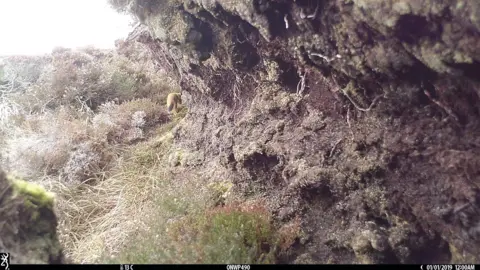
The creature, which is not native to the islands and consider invasive, was spotted in Rousay last week.
It was photographed on a camera set up by the Orkney Native Wildlife Project (ONWP), a £15m stoat eradication scheme set up in 2019.
They described the sighting as "desperately disappointing".
Stoats were first discovered in Orkney in 2010, but for 16 years they have been confined to Mainland and the south islands, which are linked by the Churchill Barriers.
For the team at ONWP, who have trapped around 8,000 stoats so far, this is an unsettling development - though not necessarily a surprising one.
Sarah Sankey, the project lead, said: "We always knew there was a high risk of stoats travelling to more islands and I am actually quite amazed that it's taken until now to do that."
 Getty Images
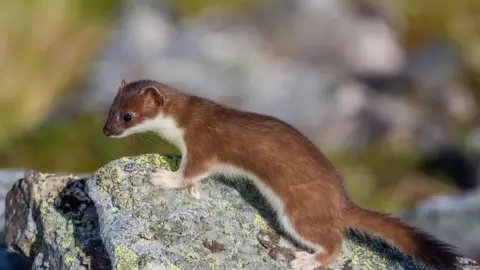
It is not yet clear how the stoat made it to its new home but the ONWP said that, at 1.8 miles (3km) from the mainland, Rousay is within swimming distance.
A spokesperson from the project also suggested it was possible that the creature was accidentally transported to the island, or that someone illegally released it.
Evidence of how a stoat arrived in Rousay may become clear over time, but for now, the ONWP's main priority is removing it.
Sankey said: "It took less than 10 years for stoats to spread 58,000ha and become the world's largest stoat eradication, so we can't sit on our laurels."
'Worst case scenario'
Stoat scat was initially spotted in Rousay in early April, and the ONWP were quick to set up a variety of traps, trail cameras, and AI cameras that alert the team when they are approaching.
Their presence was ultimately confirmed by two images captured by a remote camera.
Sankey said the gravity of the situation depends on the sex and number of the stoats.
"Stoats don't live very long, so a single male by itself is not going to do too much damage - it can't grow the population.
"Worst case scenario is that we have more than one stoat, and obviously a female in the mix would mean more stoats.
"This is the breeding season so it's a bad time for this to be happening.
We don't know if it's male or female, it's very difficult to tell from the camera footage."
 Getty Images
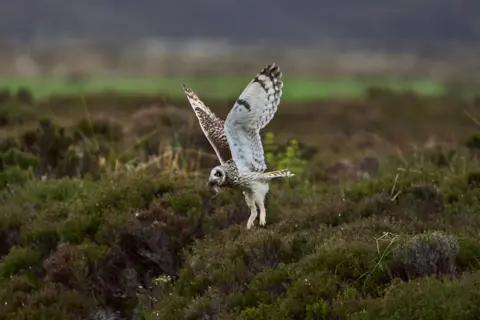
The spread could be a huge blow for the ONWP, who in March this year reported the highest number of the native Orkney vole, hen harrier, and short-eared owl since the eradication project began.
A spokesperson has also highlighted the adverse impact the arrival may have on the Rousay community.
"Even by Orkney's high standards, Rousay is an important place for nature - from breeding seabirds to birds of moorland, peatland and lochans like curlews, red-throated divers, hen harriers and short-eared owls.
"It's also one of the nine islands in Orkney that is home to the Orkney vole, found nowhere else on earth."
When asked whether number management was a more realistic goal than complete eradication on BBC Radio Orkney, Sankey was sceptical.
"Stoats are quite productive - their breeding strategy means they can increase their numbers quite quickly, so we would never be able to just contain stoats to the Orkney mainland.
""We tried costing it up and you would be looking at probably a million pounds forever to control stoats on Orkney.
Together with that, there's a high risk of failure, so it's not really financially feasible to do that, hence us following that eradication route."
