Saudi Arabia, Turkey and Pakistan sign defence pact

 Reuters
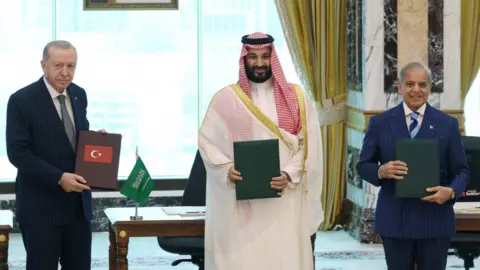
Saudi Arabia, Turkey and Pakistan have signed a joint defence agreement, saying an attack on one of them would be seen as an attack on all three.
The pact was announced at a meeting between Saudi Crown Prince Mohammed bin Salman, Turkish President Recep Tayyip Erdogan and Pakistani Prime Minister Shehbaz Sharif in the Saudi city of Mecca.
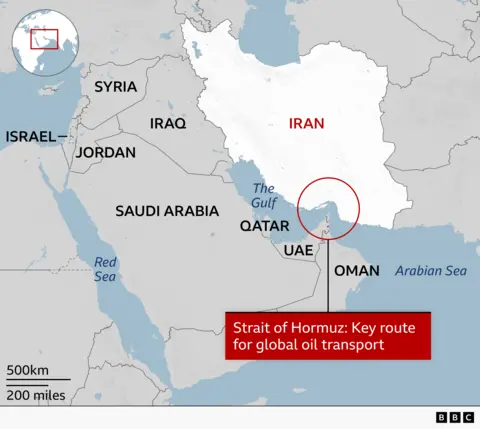
After the US and Israel attacked Iran on 28 February, Tehran and its allies struck targets in Saudi Arabia and other Gulf states and disrupted traffic through the Strait of Hormuz, a major oil shipping channel, and the Red Sea.
The Mecca agreement has drawn a sharp reaction from Tehran, where an senior member of parliament said it would not help Saudi Arabia.
"The Saudis should know that a paper agreement with Turkey and Pakistan does not bring them security, just as years of unilateral milking of the Americans did not bring them security," Ebrahim Rezaei, a member of National Security commission, wrote on his X.
Saudi Arabia and Pakistan had already announced a joint defence pact last year.
The new Mecca Joint Defence Agreement sees three of the world's most powerful Muslim nations come together to offer mutual defence guarantees.
It aims "to strengthen collective deterrence against any act of aggression, and stipulates that any armed attack against any one of the three States shall be regarded as an attack against them all", a joint statement reads.
"It further provides for the enhancement of all aspects of defence co-operation among the three States."
Although the pact pledges mutual support, it provides no specifics on the obligations of each party. A Turkish official quoted by Reuters news agency said the pact was "purely defensive in nature".
Pakistan, Saudi Arabia and Turkey each bring different qualities to the table, with each wanting something different out of it.
For the Saudis, this gives an extra level of security in a region whose security architecture has been upended by the US and Israel's war with Iran.
Last month, Yemen's Iran-backed Houthi rebels – who control much of the north-west of the country - announced a "maritime embargo" against Saudi Arabia and targeted Saudi airports, oil facilities and tankers in the Red Sea.
Furthermore, the Saudis will be keenly aware of last year's Israeli strikes on Doha, targeting senior Hamas officials. According to a report last year by the Centre for Strategic and International Studies, "across the Gulf, states recalibrated their defence strategies". This pact is one of Saudi Arabia's responses.
For Pakistan, the pact offers different but complementary benefits. In May 2025 its long-standing tensions with India boiled over into open conflict.
While an all-out war was avoided, having the economic muscle of Saudi Arabia and the military and industrial might of Turkey in their corner will be seen as increasingly valuable.
It also comes at a time when Pakistan has been taking on a far more significant role in global diplomacy.
It has acted as an intermediary between Iran and the US and hosted ceasefire negotiations, significantly increasing its status in the region - something this pact further cements.
As for Turkey, the benefits are different. According to Burcu Ozcelik from the London-based Royal United Services Institute (Rusi), the deal offers opportunities for the country's significant defence industries through "joint production, technology partnerships, procurement and greater military interoperability".
While, on the surface, the concept of a mutual defence agreement seems straightforward, in practice the circumstances in which they would come into play are both complex and uncertain.
Would, for example, Turkey be obliged to join in strikes on Yemen if Saudi Arabia's full-scale war with the Houthis were to restart?
Would Saudi Arabia have to declare war on India were there to be a re-emergence of conflict with Pakistan?
Each instance would require complex calculations and careful diplomacy, often in an attempt to avoid escalation. It is, in short, uncertain.
The one consequence of a mutual defence agreement that sides involved will be banking on, however, is deterrence.
The very fact that they each now have two other regional powers standing behind them may not make aggression impossible, but it will make its potential cost significantly higher.
