Pig farmers fear for future as industry at 'breaking point'

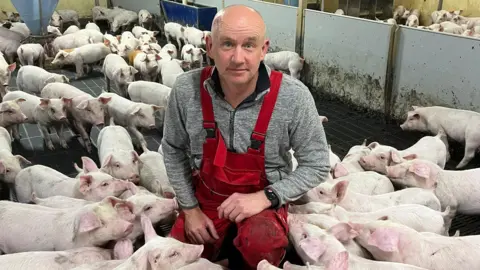 Christie family
Pig farmers have warned that their industry is at "breaking point", as increasing numbers are choosing to sell their herds and leave the sector all together.
An over-supply of pork in Europe, increased production costs and lower supermarket prices are making it difficult for farmers to make a profit.
Among them is Gregor Christie whose family business in Port William, Dumfries and Galloway, took a £70,000 hit in the first three months of 2026.
"Three or four more months of this and we'll be needing to look at whether we can continue at all," he said.
Christie and his brother Rory are third generation dairy and pig farmers, working on the farm their grandfather started in 1954.
At any one time they have about 2,700 pigs and they sell about 6,000 every year.
But he told BBC Scotland News he was facing the most financial pressures he had experienced in 30 years.
''To produce a pig on my farm is approximately £1.80 per kilogram," he said.
"We are receiving shy of £1.40 per kilogram currently. So there's a 40p per kilogram loss on each animal, which is completely unsustainable.
''For the first quarter of our financial year, which finished at the end of March, we were £70,000 down in income. So another three quarters of that will be in the realms of £250,000."
He added: "This is a case of save our bacon. We can usually fix issues internally within the industry - but it is now a breaking point.''
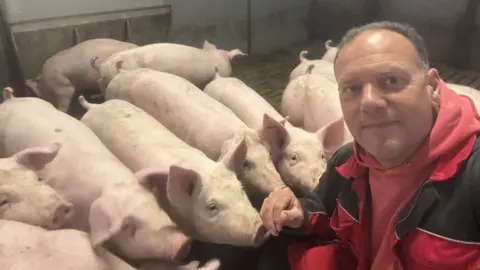 Alistair Lane
Another farmer, Alastair Lane, from Lockerbie, sold the last of his 3,500 pigs - including 250 breeding sows - in February.
He made the decision to quit the sector due to "unsustainable and constant uncertainty" in the markets and described the crisis facing farmers as "beyond devastating".
"It's wrenching," he said.
"It's a lifetime of work that's been done by the whole family and staff, but financially it just doesn't make sense to keep investing in something that doesn't have the security going forward.
"There is just too much uncertainty and I think it's best to exit stage left.''
Markets 'awash with pork'
The National Farmers Union Scotland (NFUS) estimates that about 10% of Scottish sow herds have been lost since the beginning of 2026.
Scottish government figures indicate that the total number of pigs in Scotland in 2025 was 312,300 - a 7.3% decrease on the five year average.
The number of breeding herd pigs (sows in pig, gilts in pig, and other sows) had decreased by a fifth on the five-year average, with 25,600 recorded.
Meanwhile the NFUS estimates that producers are losing between £700 and £1,000 per sow place this year - that equates to losses of up to £500,000 for a typical 500-sow unit.
The root of the problem facing pig farmers is the presence of African Swine Fever (ASF) in Spain.
Some countries that would usually buy Spanish pork are not because of the presence of the disease, so there is much more of the Spanish product available in Europe.
Spain is the second largest exporter of pig meat behind the US.
This has caused a significant and sustained drop in pig prices with processing plants facing a back-log of animals waiting to be slaughtered. The result is supply exceeding demand and farmers faced with producing pork at a loss.
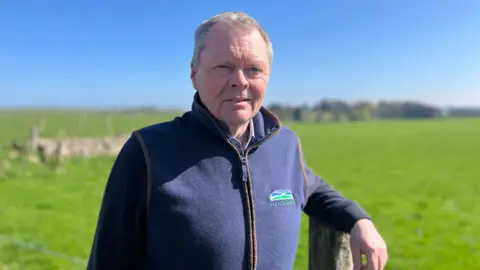 BBC news
NFUS president, Andrew Connon, said that the industry was now under unsustainable pressure.
''This is indeed a crisis," he said.
"We are facing prices and market returns which are well below the cost of production and at the moment the financial situation for pig producers in Scotland is actually industry and business threatening. It's a dire situation.''
He said that the UK has some of the highest animal welfare standards in Europe, but cheap meat is "flooding in" from the continent.
The UK government only restricts pork imports from the region of Spain where ASF has been detected.
Conon said: ''We're being undermined and we're asking for immediate help.
"NFUS is calling on the Scottish government for immediate help and support.
"We're also encouraging the retailers to support Scottish produce and I'm directly appealing to consumers to look our for Scottish pork on the shelves.''
A spokesperson for the Scottish government said: "We have worked with the UK government and other devolved administrations on supply chain fairness regulations, designed to improve and create greater fairness in the agricultural supply chain which enable producers to raise concerns with the supply chain adjudicator if they feel they have been treated unfairly.
''We will continue to work with NFUS and others across industry and rural communities to protect the sustainability of farming and food production in Scotland."
