Could dog poo compost be used to grow fruit and veg?

 BBC
BBCA university trial will investigate if turning dog poo into compost is safe after a councillor's personal experiment.
Stroud District councillor Gill Thomas does not own a dog, but she has collected more than 750 bags of dog poo since September to compost at her house using a wormery.
A University of Gloucestershire trial will now assess the safety of different dog poo composting methods and determine if it can be used to grow flowers and vegetables.
"I would ultimately love to see [the compost] on the shelves of big DIY outlets," Thomas said. "Because I have proof that it can grow things and it can be more than just poo that goes in the ground or gets burnt up in to the air."
'Stomach-churning'
Thomas, who is the only master composter specialising in dog poo in Gloucestershire, started an experiment after a resident made her aware of a "dog poo grot spot" near Bussage.
She collected 350 bags of poo from the area and installed her own waste bin for dog owners.
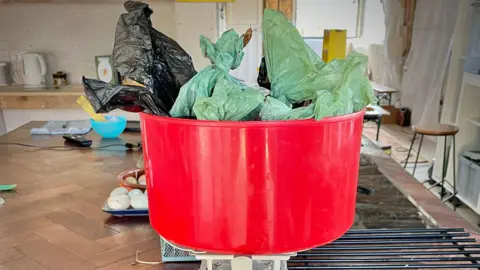
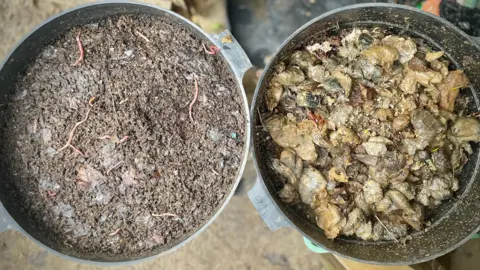
Thomas now collects about 60 bags a month and feeds the poo to worms, in a process she described as "stomach-churning" and "revolting".
It takes about six months for the poo to be composted.
 Gill Thomas
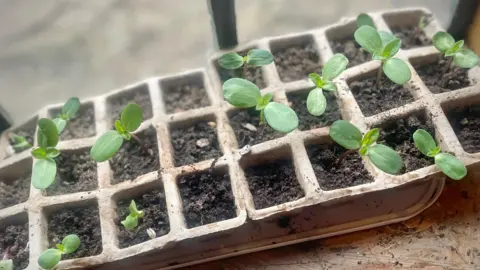
Thomas has started using some of her dog poo compost to grow pumpkins and sunflowers.
Depending on the results of the trial, she hopes to launch community composting schemes and change how dog waste is processed.
"We've just got to be looking at this waste in a different way, we've got to retrain our brains, because at the moment [we are not making] sustainable solutions, and we can't just accept this is the best we can do when we're striving and accelerating in so many different technologies," she said.
 Gill Thomas
It has generally been assumed it is not safe to compost dog poo as it contains harmful bacteria including E.coli, salmonella, roundworm, hookworms and whipworms.
Veterinary surgeon Dr Alice Judge, who is working with Thomas, said there was a lack of data about dog poo composting.
"It can be done with strict precautions," she said.
"We don't know about the resulting compost regarding some pathogens, antibiotic resistance, veterinary drugs in the faeces and microplastics from dog poo bags."
She added some places in North America compost dog poo and some studies have shown it was higher quality than livestock manure.
 Gill Thomas
The University of Gloucestershire-backed trial will start in the autumn and compare cold and hot composting techniques.
Researcher Dr Richard Cook said one of its main aims will be to ensure the compost produced is safe to use.
"What we will do in our approach is to try to put in a way to find some funding to do some proper testing to make sure that what comes out the other end, excuse the pun, is pathogen free, that's our main concern," he added.
A doggy daycare company will provide poo for the research to take place.
Follow BBC Gloucestershire on Facebook, X and Instagram. Send your story ideas to us on email or via WhatsApp on 0800 313 4630.
