Benjamin Britten statue unveiled in his home town

 Jamie Niblock/BBC
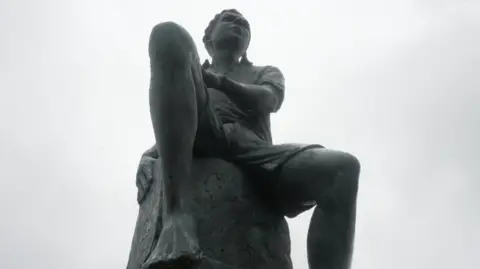
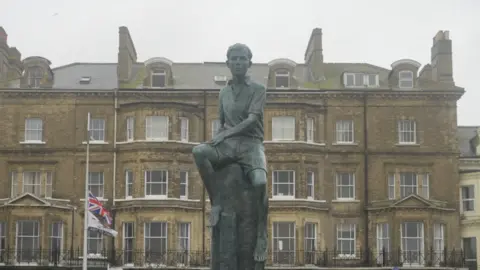
A life-sized statue depicting Benjamin Britten as a child has been unveiled in his home town following a three-year campaign.
The bronze sculpture of the composer has been installed near the seafront in Lowestoft, Suffolk, opposite the house in which he was born in 1913.
Designed by Ian Rank-Broadley, the creation was made possible after £110,000 was raised from many "little donations" from the community.
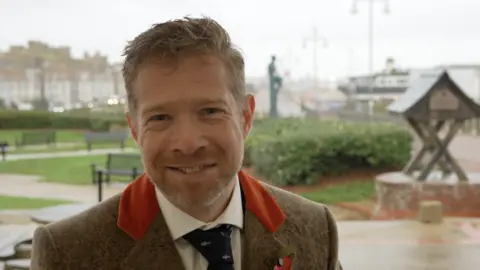
Zeb Soanes, vice chairman of the Britten as a Boy project, said the statue was a "symbol of hope and aspiration" that will inspire the next generation.
 Jamie Niblock/BBC
"Depicting him at 14, gazing out to the horizon, says to other children from the town that they can achieve whatever they want to if they work hard," said Mr Soanes, who recently became chancellor of the University of Suffolk.
"It has very much been a community effort with a fantastic committee, and I think he would be delighted – his family said how honoured and touched he would be by this."
 Jamie Niblock/BBC
The project has been a long-running labour of love for broadcaster Mr Soanes and his fellow co-founder, teacher and artist Ruth Wharrier, for more than three years.
The campaign to raise funds was first launched in early 2022 after Mr Soanes came up with the idea during lockdown to honour Britten, who died in 1976.
It was decided the statue would represent him at the time when his mother took him to the Norwich and Norfolk Festival and introduced him to composer Frank Bridge.
Sculptor Mr Rank-Broadley was then brought on board to create the piece before it was officially revealed during a special ceremony in Kitchener's Garden yesterday.
 Jamie Niblock/BBC
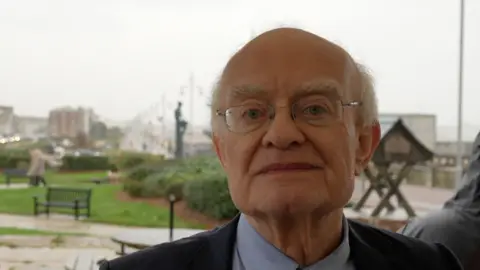
It was unveiled by composer Sir John Rutter, who was conducted by Britten for the 1963 recording of the War Requiem when he was a member of his school choir.
He told the BBC that Britten meant a lot to him and that the "beautiful sculpture" encapsulated "something very special about him".
"He could have lived anywhere in the world, and he would have been hailed and welcomed, but he came back to Suffolk and was rooted in this community," he said.
"He was living and working here until he died, and this statue says something about that sense of loyalty to where his journey began and where he wanted it to end."
Follow Suffolk news on BBC Sounds, Facebook, Instagram and X.
