Glasgow buzzing about bees as new city trail is launched

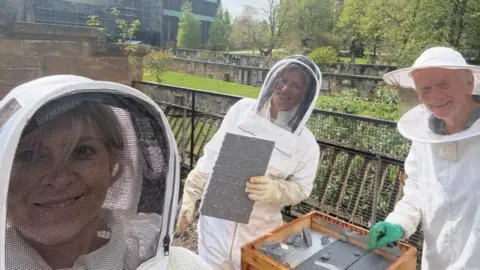 Dr Kate Stevens
Hollywood actor Nicholas Cage once dramatically yelled "not the bees!" during his disastrous remake of horror classic the Wicker Man - but a group of Glaswegians are feeling more favourable to the striped insects.
A new trail has launched in the city centre, taking in Glasgow Cathedral and the Royal Infirmary, featuring small models of bees hidden among plants, trees and on gates and plaques.
The real thing can be found nearby, with hives of bees kept at the Royal Infirmary, with the honey produced by them being sold on every winter.
Now organisers hope the new trail will hit a sweet spot - by providing a way of learning about bees and a chance to get in some exercise too.
But why bees to begin with?
The answer goes back several years, and is linked to the Friends of Glasgow Royal Infirmary volunteer group, dedicated to preserving and publicising the hospital's history.
Dr Kate Stevens, a consultant nephrologist, is a volunteer with the group and found herself unexpectedly being offered the chance to look after a hive at the GRI.
"We thought having the bees at the hospital would be nice, to have some nature and sustainability there - and we all like honey, too," she laughs.
"It's the nicest hobby. There is something therapeutic about it, just watching them buzz around and seeing everyone has a role within the hive. You feel a sense of calm when you are with the bees."
From there she developed the idea of a trail around part of the city with another volunteer and beekeeper, Dr Hilary Wilson - who had the idea to bring in a hive to begin with.
"I'm not sure why I had the idea at first," admits Hilary, who is a a consultant physician and rheumatologist by day.
"We use the storeroom roof at the back of the hospital, and we started off with three hives.
"One of them had to be split up, and Kate and I got asked if we wanted to look after a hive each."
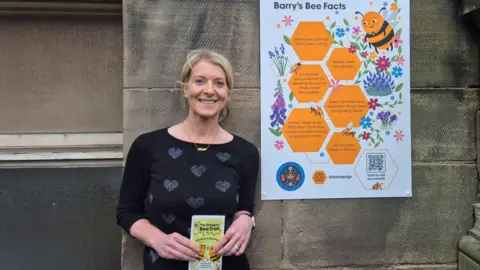
Already passionate about making people aware of the hospital's history, the duo soon struck upon the idea of spreading the word about bees about Glasgow.
"The trail came as an idea after that - Kate originally sketched it out on this piece of paper, and it's now this nice off-shoot of the Friends of Glasgow Royal Infirmary."
Kate hopes it brings attention to what she feels is a hidden treasure trove of nature in Glasgow.
"The cathedral precinct area is such a nice part of the city, but although people come to the cathedral, they often don't realise there are these nice green spaces hidden around here, with a lot of wildflowers and a lot of nature," explains Kate.
"Each bee is positioned somewhere that has both history and also aspects of nature in the middle of a bustling city."
A total of 23 bees - all given names starting with B, which Kate jokes became an increasingly hard challenge - can be found on the walk, along with two bonus bees set slightly further afield.
Kate estimates completing the whole trail would take 4,000 steps and about 2.5km (1.55 miles).
Locations along the way include the Necropolis, the Barony Hall and Glasgow's oldest house, Provand's Lordship.
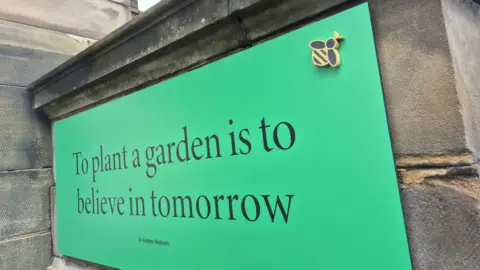
Emma Murray, an architect and Glasgow School of Art graduate, was brought on board to make the small bee sculptures which can now be spotted about the city.
She said: "It's been a really good project to be involved, especially as Kate and Hilary are doctors and are doing this all on the side.
"It's exploring a historic part of the city that you maybe wouldn't think to take your kids to."
Kate believes more awareness of the insects will help wider issues too, with some types of bees facing decline in the face of a changing environment.
In recent years studies have warned that some species could be lost from Britain altogether, with wild bees particularly at risk and an overall picture of biodiversity being lost.
"People love bees, but they often don't know a huge amount about them, other than they are important," concludes Kate.
"So it's quite nice to have some bee facts around, explain why they are important and what you can do to help them."
