Smoker watching wildfire 'started second blaze'

 BBC/Oli Constable
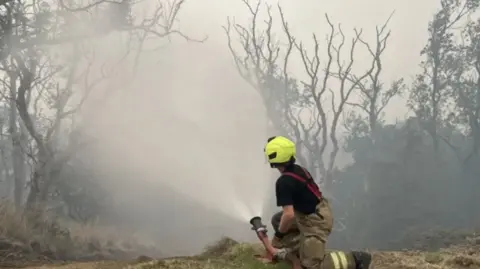
The second of two wildfires which broke out on moorland last summer was started by a smoker who had stopped to watch the first blaze, a report has found.
North Yorkshire Fire and Rescue Service's new debrief into the incident on Langdale Moor in the North York Moors confirmed that a discarded cigarette likely triggered a secondary fire 1.8 miles (3km) away from the first.
In February it was announced that the first fire to develop was caused by a campfire or gas burner lit in remote woodland.
Chief fire officer Jonathan Dyson said the findings highlighted the dangers of "seemingly minor acts of carelessness".
The report stated: "The cause of this fire is known to have been the careless disposal of smoking materials, most probably by a bystander who had stopped their vehicle at the roadside to observe the main incident and subsequently disposed of a cigarette in dry vegetation.
"This incident further emphasised the heightened wildfire risk created by extreme environmental conditions and the dangers posed by seemingly minor acts of carelessness during periods of prolonged heat and drought."
Writing in the report's introduction, Dyson said officers and fire crews, working alongside regional and national partners, farmers, gamekeepers and many others, "acted decisively to protect life, critical infrastructure and communities."
"The absence of loss of life or damage to residential property represents a significant outcome," Dyson wrote.
He added: "We will ensure that learning is not only identified, but embedded, translating into practical, sustained improvements in how we plan for and respond to complex, protracted incidents."
The fire service report concludes with 17 recommendations, the first being to "review and update wildfire planning assumptions to reflect increased scale, duration, endurance and concurrent incidents."
The second was to strengthen "site-specific wildfire pre-planning," including where the water needed to fight fires could be sourced from.
During last August's fire, both firefighters and volunteers spoke of the challenges of finding the necessary water, partly due to the size of the fire, the area's geography and the severe dry conditions.
A further report by the York and North Yorkshire Local Resilience Forum was also published earlier.
Writing in the introduction, chair Richard Flinton said the fire was the region's first major incident since the Covid-19 pandemic
He wrote: "The tireless efforts of responding fire crews, farmers, and local communities during the fire deserves high commendation. The evident risks and hazards meant that individuals demonstrated truly heroic actions in helping to fight the extensive flames, fanned by continuously changing winds."
The first recommendation in the forum's report was for the review of the response to the region's major and critical incident plan.
The plan is based around a practice called joint emergency services interoperability principles, known as JESIP, a framework to make sure the emergency services work together effectively during major incidents.
The critical incident response represents "good practice" in meeting those principles, the report said.
But it added: "However, during the incident it was evident that, although JESIP was applied at the operational, tactical, and strategic levels, there were occasions where a lack of alignment between command levels affected shared situational awareness and the joint assessment of risk.
"It was also apparent that a number of agencies not routinely involved in the resilience forum had little or no prior knowledge of JESIP."
Flinton said: "Where lessons are identified, we must acknowledge them so that we can continue to develop our capacity and capabilities."
York and North Yorkshire's elected Labor mayor David Skaith, who oversees the fire service, said the report's findings were clear.
"Incidents of this scale can no longer be treated as rare or exceptional.
"The response from firefighters, farmers, landowners, volunteers, and local communities was outstanding, but we cannot rely on goodwill alone. As the risk of wildfires grows, so too must our preparedness.
"We need stronger resilience, better coordination and a more robust approach to preventing, responding to and recovering from major wildfires," Skaith said.
Listen to highlights from North Yorkshire on BBC Sounds, catch up with the latest episode of Look North.
