'Overlooked' war heroes to be celebrated decades on

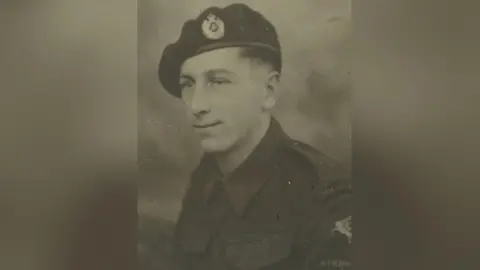 Carole Stewart
A woman whose uncle was involved in the taking of Pegasus Bridge in World War Two has organised a memorial service specifically for him and his fellow military engineers.
Frederick George Shorey, from North Shields, of the 249th Field Company (Airborne) Royal Engineers, was on the first glider to land in France just after midnight on 6 June 1944.
Injured a few days later, he spent time in hospital writing a full account of what he called "one of the many small jobs" that were part of the D-Day invasion.
His niece Carole Stewart, from Longhirst, Northumberland, who discovered her uncle's letters, wanted the role of the sappers, as the engineers were known, to be recognised with its own event.
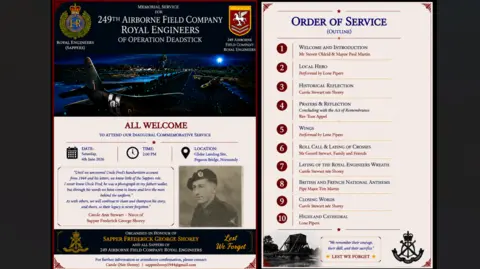 Gerard Stewart
Operation Deadstick involved a small force of men landing at Ranville-Benouville in gliders, having been towed across the Channel by Halifax Bombers.
The bridge was captured after a fierce 10 minute firefight, the action all over by 00:26 on 6 June 1944 six hours before the D-Day beach landings.
The role of the sappers was to discover and disable any detonator wires leading to German demolition charges attached to the bridges.
It is believed Fred's account was the first to be written by a soldier involved in the offensive.
He was killed on Boxing Day 1944 during the Battle of the Bulge.
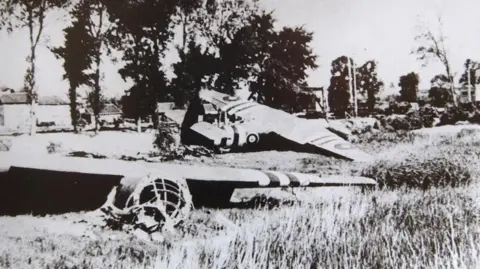 PA Archives/PA Images
Carole and her husband Gerard Stewart have organised a memorial service to be held on the Glider Landing site at Pegasus Bridge at 14:00 BST on 6 June, the 82nd anniversary of D-Day
"We have had incredibly support in Normandy particularly from the Mayor of Benouville," Carole said.
She said: "While the name of all the sappers are on all the memorial stones, far less is known about their role, they are just overlooked heroes sitting quietly in the background.
"But the role they played was absolutely pivotal."
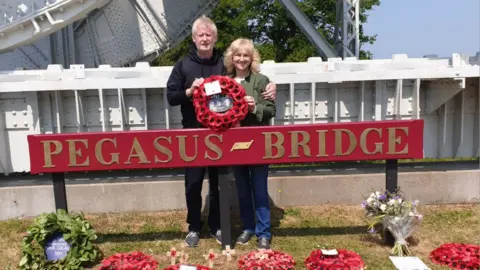 Carole Stewart
The couple believe it is the first memorial service to the sappers who took part in Operation Deadstick to take place at the site and they hope other families will be present.
"To keep people's interest alive we need to shine a light on new stories of D-Day," Carole said.
"It feels like everything we're doing, all the research, is giving Fred back the life he lost," Gerard added.
