How ransom notes could help catch Nancy Guthrie's kidnappers

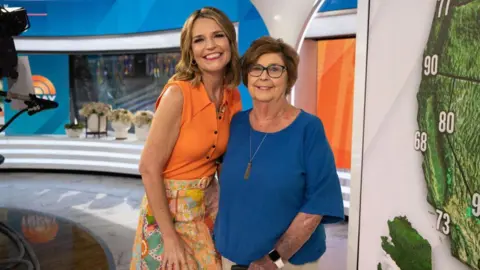 NBC via Getty Images
On Friday, exactly six months after Nancy Guthrie was abducted, police released two ransom notes in the hope that they would help identify her kidnappers.
Guthrie, the mother of US news presenter Savannah Guthrie, was 84 when she went missing from her Arizona home in January.
Her disappearance sparked a months-long investigation which has turned up few apparent leads and fewer suspects.
So how could Nancy Guthrie's kidnapper, or kidnappers, be caught from these brief ransom notes?
The first of the notes, which are being treated as apparently credible, demanded millions of dollars in Bitcoin. The other claimed Guthrie died shortly after she was taken.
While the language in the notes might seem straightforward, police said the writer's "distinct linguistic characteristics" may be recognisable.
"There are a number of pieces of information in these notes that just might jar someone to say 'you know, I've heard that'," said Pima County Sheriff Chris Nanos.
A forensic linguist told the BBC it's possible to glean crucial information about a person from just a few sentences.
"It's built upon the premise that we each carry an idiolect, or a word print, of our own that distinguishes our language from others," said William Eggington, a retired linguistics professor from Brigham Young University who is now a forensic consultant.
But, he said, investigators have to hold scientific scepticism when they analyse notes like this - especially when they have so few words to work with.
Furthermore, they have to account for the possibility that the person may be trying to disguise their natural writing voice.
 Pima County Sheriff's Department
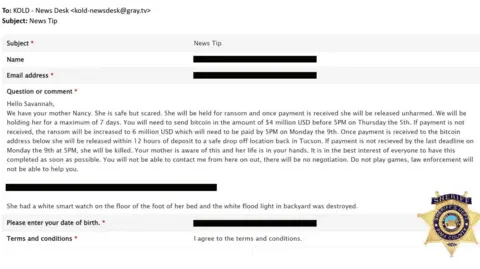
The first note, sent to a local TV station on 2 February, began: "Hello Savannah, we have your mother Nancy. She is safe but scared. She will be held for ransom and once payment is received she will be released unharmed."
Here, the fact the writer heavily relies on passive voice and uses an "if-then" sentence construction suggests they have at least a high-school level education, and possibly some university exposure, Eggington said.
Later on, the note says: "Once payment is received to the bitcoin address below she will be released within 12 hours of deposit to a safe drop off location back in Tucson. If payment is not recieved [sic] by the last deadline on Monday the 9th at 5PM, she will be killed."
In this section, the writer at first spells "received" correctly, but goes on to spell it incorrectly. That indicates that the person is not particularly tuned in to the proper spelling of the word, or that they didn't do a close edit of what they wrote, Eggington explains.
 Pima County Sheriff's Department
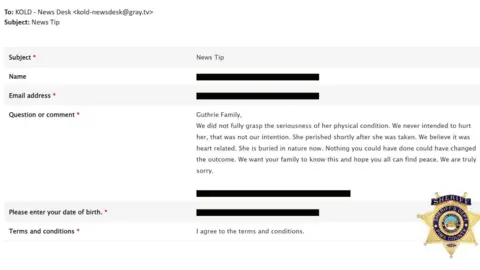
Four days after the first note, the second arrived: "Guthrie Family, we did not fully grasp the seriousness of her physical condition. We never intended to hurt her, that was not our intention.
"She perished shortly after she was taken. We believe it was heart related. She is buried in nature now."
In these lines, Eggington said, the person is "dehumanising Nancy by talking about her in the third person" and "even putting the blame for her death on her".
While local officials say they cannot verify her death, Eggington said by claiming she "perished", the writer is not accepting responsibility, while using the distinctive phrase "buried in nature".
The passage contains restricted, academic-style language - but this may not be a natural reflection of this person's language, and they could be intentionally writing in a stilted manner as a way to disguise their true voice, he said.
It's clear that the same person wrote both Guthrie ransom notes, Eggington believes, based on the style of writing.
 Courtesy FBI
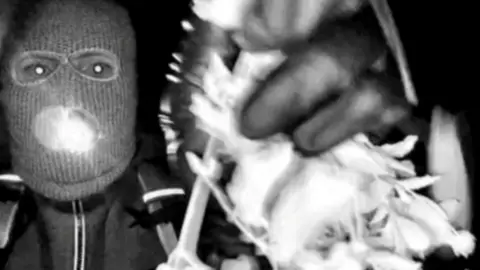
Investigators will be using these small details to build an investigative profile of the writer.
When they find a suspect, either through their own profile or a member of the public coming forward, they can compare known writings from that person to the ransom notes, Eggington said.
Given six months have passed, "it seems like a stretch" that the suspect will be identified based on these notes, said Prof Jeffrey Adler, who teaches the history of American crime and violence at the University of Florida.
"Kidnapping is not a common crime," Adler notes, adding that most kidnappings involve family members fighting over the custody of children.
In other high-profile cases in American history - like the abduction of Charles Lindbergh's baby in the 1930s and Frank Sinatra's son in the 1960s - the kidnappers had a clear motive to extract ransom money.
Still, it wouldn't be the first time a suspect has been caught based on their writing. When authorities agreed to publish the manifesto of Theodore Kaczynski, known as the Unabomber, in 1996, it was his brother who recognised his writing and came forward to identify him.
In Nancy Guthrie's case, police said they spoke to the family before releasing the notes.
Hours afterwards, Savannah Guthrie expressed hope the notes could catch whoever took her mother: "We are desperate. We need someone to come forward. Someone knows something.
"Someone suspects something. Someone recognises the writing in the ransom demand notes."
