Prostate cancer survivor urges men to get tested

 The Royal Wolverhampton NHS Trust
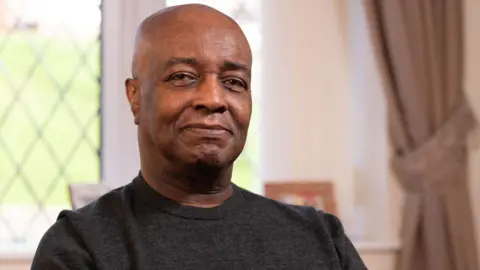
A prostate cancer survivor who lost all three of his brothers to the disease has urged black men with a family history to get tested.
Simeon Greene, 60, from Wolverhampton, said a reluctance to talk about cancer meant his brothers never shared their prostate cancer diagnoses, until he revealed his own.
He has since researched his family history and believes as many as 54 relatives may have had the condition.
"I was shocked to discover my brothers also had prostate cancer when I told them about my diagnosis," he said. "There is a clear reluctance to talk about it, and that has to change."
Greene first saw a doctor when he was aged 49 in 2015 after noticing symptoms, but he was not diagnosed with prostate cancer until the following year.
Now a patient advocate for West Midlands Cancer Alliance, he is urging men over 40 with a family history of the disease to speak to their doctor about a prostate-specific antigen (PSA) blood test - even if they have no symptoms.
The blood test measures the level of PSA protein, produced by the prostate gland, and may help detect early signs of prostate cancer.
According to charity Prostate Cancer UK, more than 64,000 men are diagnosed with the disease every year.
It is the most commonly diagnosed cancer in the UK and kills more than 12,000 men each year.
 Cancer Equals
Greene, who will attend a Prostate Cancer UK conference at the Molineux Stadium on Tuesday, now campaigns to raise awareness of the disease in the black community.
The 60-year-old, originally from Jamaica, also highlighted that black men were more likely to be diagnosed at a later stage, when the disease was harder to treat.
He said some men put off seeking help but the PSA test was a "simple blood test".
"While there is no national screening programme, men can still be proactive and ask their GP about it," he said.
"Black men are twice as likely to develop prostate cancer, with one in four affected."
Keith Morgan, associate director of black health equity at Prostate Cancer UK, added: "Too many black men are being diagnosed with incurable prostate cancer.
"We must act now to prevent more families from being affected."
Follow BBC Wolverhampton & Black Country on BBC Sounds, Facebook, X and Instagram.
