Barrister able to 'rejoin the world' after losing speech following road accident

 BBC
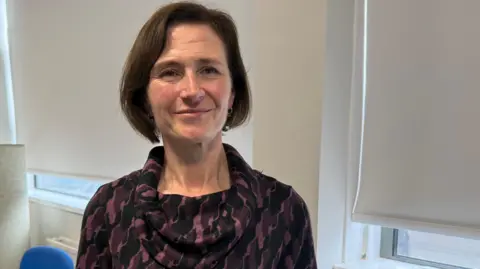
BBCAfter a road accident, barrister Annette Morris suffered a devastating stroke on both sides of her body which left her unable to walk or talk.
Battling the isolation this caused, the 51-year-old described how her speech therapist "has given me a chance to rejoin the world".
But the Royal College of Speech and Language Therapists (RCSLT) said unsafe staffing levels and widespread recruitment freezes are making it hard to help people such as Annette - creating further strain on an already stretched workforce in Wales.
The Welsh government said it is vital its workforce, including speech and language therapists, "is supported to deliver timely and quality care to all those that need it".
"When I was in hospital and they said you've lost your language, I knew what the word language meant," said Annette, from Cardiff.
"But how could I lose my language? Because in my mind I still had all the words.
"My speech therapist has given me a chance to rejoin the world because when you have aphasia you're in your own mind and it's really hard to find the words."
Annette was a barrister and a law professor, whose work was her life.
But after the accident seven years ago, she went from being an articulate and commanding speaker to not having a voice.
Annette also went from reading legal documents to children's Ladybird books.
Aphasia is a condition that makes it difficult to communicate, affecting speaking, reading and writing, and often follows a stroke or brain injury.
Annette was at Llandough Stroke Unit for three months where she had to learn to speak all over again.
After being discharged from hospital, she continued to have speech language therapy at home.
"When you grow up, talking is automatic, but when you lose it again as an adult, it isn't automatic because your brain is trying to find the right word to get a sentence out so it is very tiring," Annette added.
"When they say you have recovered your speech, I think I haven't recovered my speech at all because my speech is totally different.
"Because you're always having to find different words and you have to go around the houses to say what you want because you forget the words, so you do feel you lose some of your identity."
 Lowri Price
While speech therapy was vital for Annette, RCSLT's State of the Nation Report for Wales said lack of access to support affects people of all ages.
It describes how high-risk infants in neonatal units are put at risk of serious feeding, swallowing and communication issues.
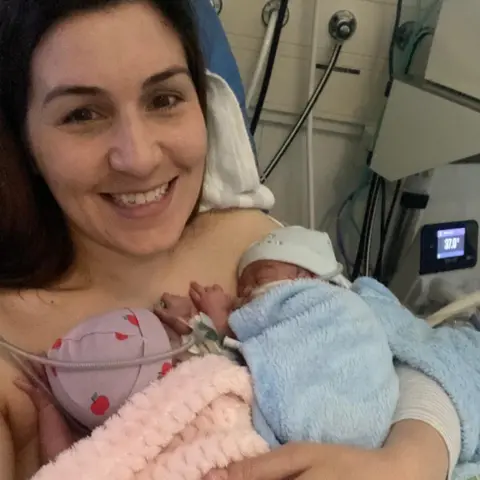
"It's a vital service and if babies miss out on that service it can have lifelong implications," said Lowri Price, from Gwynedd.
Her twins were born at 26 weeks, and needed the support of a speech and language therapist.
"I remember being surprised meeting a speech and language therapist at the hospital because the twins couldn't even breath let alone talk," she added.
"But she explained to me they were in charge of swallowing feeding elements."
 RCSLT
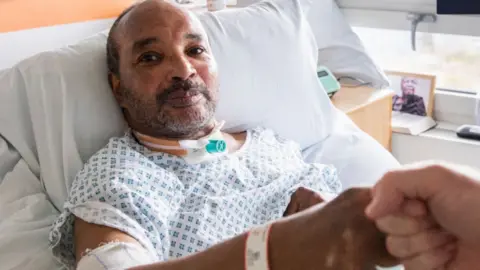
RCSLTThe RCSLT said demand for speech and language therapy continues to rise across Wales.
This is not only in terms of the number of people who rely on these services, but also in the increasing complexity of their needs.
From early years support to adult rehabilitation, they say their workforce is responding to more diverse and intensive demands than ever before.
It also described a reduction in student places across two universities - Wrexham University and Cardiff Metropolitan - as a matter of significant concern.
Head of the RCSLT's Wales office Philippa Cotterill said the provision saves lives.
"Those patients might not be able to speak and might not be able to swallow," she added.
"But without a speech and language therapist there, these issues might be missed and the patient might not be able to communicate they're distressed so this is an aspect of patient safety."
Its report said widespread health board recruitment freezes saw only 57% (24 out of 42) summer 2025 graduates from speech and language therapy courses, who received the NHS Wales Bursary, secure jobs as of March 2026.
The number of speech and language therapist training places has also reduced from 55 in 2026 to 38 in 2027.
"Fewer people will be trained now as speech and language therapists and that in the context of increased demand is exceeding worrying," Ms Cotterill added.
 Getty Images
"It was a challenge to find a job," said newly-qualified Catrin Khalbi, who has started working in the Betsi Cadwaladr health board area.
"It was a six-month process and it was really competitive, and that was the same for all graduates.
"It wasn't an easy course, it's a three year commitment and I think that doubt over whether there will or won't be a job at the end of it will put people off doing the course."
The Welsh government said: "The NHS is nothing without its staff. It is vital that its workforce, including speech and language therapists, is supported to deliver timely and quality care to all those that need it.
"The first minister has now appointed his cabinet which he has said will have a relentless focus on doing what's best for Wales.
"Each minister will be setting out their priorities shortly."
