Battery storage plans approved despite objections

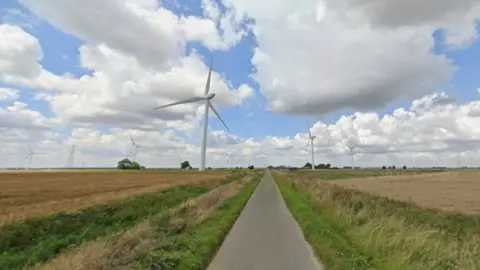 Google
Plans to build a battery energy storage system (BESS) in Lincolnshire have been approved, despite concerns over losing an area of farmland.
The 42-acre (17-hectare) site, which will be built at Bicker Fen, near Boston, was passed by Boston Borough Council's planning committee on Tuesday.
The proposed 1.2 gigawatt facility would cover a site larger than 20 football pitches, across two fields that lie to the south of Bicker Drove and east of Vicarage Drove.
It will include up to 1,056 units which are up to 15ft (4.5m) high.
BESS facilities take in power from renewable energy sources and release it back to the National Grid when demand is high.
Councillors were told that there had been 32 objection letters to the proposed application with the majority coming from people living nearby.
Paul Lock, a Reform UK councillor on Lincolnshire County Council (LCC) attended the meeting to object to the application.
He said: "This is a permanent loss of food production and socio-economic value. Once lost, it's lost permanently."
Boston councillor James Cantwell said the plans would have a "significant impact on the character of the area".
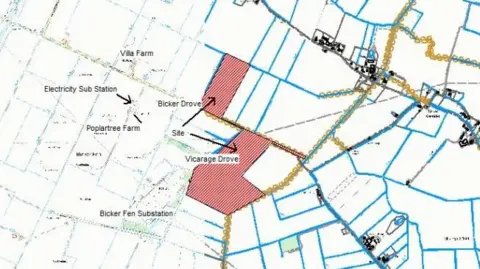 Boston Borough Council
Chris McKerrow, representing the applicants Bicker Drove Limited, said the site was selected as it was close to a connection at Bicker Fen substation.
He said: "I do understand that there's local frustration about the amount of change that this area has seen.
"But the question before members today is whether this particular proposal is in the right place and whether its impacts are acceptable in planning terms."
Despite objections, Boston councillor Stephen Woodliffe said he could not see a sufficient reason to refuse the application, according to the Local Democracy Reporting Service.
"There doesn't seem to be anything in the report itself which would stand up against an inspector," Woodliffe said.
The plans, which would also include a 17-acre biodiversity enhancement area to soften the visual impact on the landscape, were approved but are subject to conditions.
Existing renewable energy projects within the area include the Viking Link interconnector, the world's longest undersea and land power cable, which connects at the Bicker Fen substation.
Listen to highlights fromLincolnshire on BBC Sounds, watch thelatest episode of Look North.
Download the BBC News app from the App Storefor iPhone and iPad orGoogle Play for Android devices
