Union pushes ministers to deliver promise of work for state-owned shipyard

 Christopher Brindle
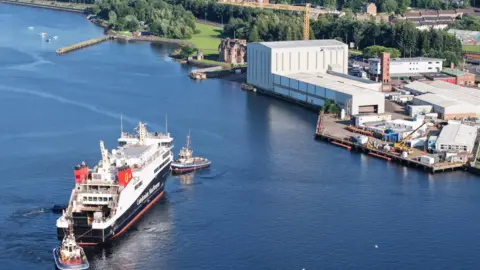
Ministers have been urged to make good on their pre-election promise of new ship orders to secure the future of the state-owned Ferguson shipyard.
The Scottish government announced in March it would directly award contracts for four vessels to Ferguson Marine - a fisheries research vessel, a marine protection ship and two small CalMac ferries.
The GMB union warned that, more than two months on from May's Holyrood election, no contracts had yet been confirmed and the Port Glasgow yard's future was at risk because it was losing key staff.
The Scottish government said it needed more time to carry out "due diligence" to ensure the direct awards comply with subsidy control and competition law.
Ferguson Marine currently employs 283 staff, including 34 apprentices, and has seen a net reduction in its workforce of 18 since the start of the year.
While the yard is still working to complete MV Glen Rosa, the second of two large and long delayed dual-fuel ferries for CalMac, most of the remaining work involves specialist contractors rather than the core workforce.
Subcontracting work from BAE Systems, building units for the Type 26 frigates under construction at Govan, has now been completed and no repeat orders have been agreed as yet.
 Getty Images
Union representatives have repeatedly raised concerns about a shortage of work for apprentices to practice on, while those who complete their training often leave for jobs at BAE Systems where they see a better career path.
BBC Scotland News understands the yard now directly employs only seven platers and 11 welders, and there is little work for traditional "black squad" metal-working shipyard trades to do.
GMB Scotland secretary Louise Gilmour warned that even if ministers delivered on their promises of new ship orders today, it would be another year at least before any steel was cut because design work needs to come first.
 GMB Scotland
She called on the Scottish government to provide urgent help to sustain the yard in the interim and to prevent skills and experience being lost.
She said: "Ministers were loud enough in March when promising support for Ferguson Marine but, four months later, have absolutely nothing to say.
"These contracts were fanfared by the Scottish government right before an election campaign but weeks are turning into months without news or apparent progress.
"Ferguson's does not have the luxury of time to allow more boxes to be ticked at Holyrood. It needs work now."
What was the government's promise?
Ferguson Marine was nationalised in 2019 after an acrimonious stand-off between the government's ferries agency CMAL and its former owners.
CMAL's rejection of extra cost claims for the two LNG-powered ferries had led to the firm falling back into administration.
Since then trade unions have repeatedly called for new investment and publicly-funded contracts to be directly awarded to the shipyard to help it restore its reputation and competitiveness.
Two years ago the Scottish government turned down a request from the yard's management to directly award it the contract for seven small CalMac ferries which they saw as the ideal vehicle for the shipyard's recovery.
Instead, Ferguson's was forced to compete against overseas shipyards which have lower labour costs and, while its bid was praised for its quality, it was undercut on price by a Polish rival.
At the time the Scottish government said it was unable to directly award work to Ferguson's because of the UK's subsidy control law.
And CMAL argued it was forbidden under Scottish procurement law to factor in "social value" - the wider economic value of placing orders with a domestic shipyard.
However, in early March - nine weeks before the Scottish Parliament elections - then economy secretary and deputy first minister Kate Forbes announced the government now believed a direct award to Ferguson's might be possible.
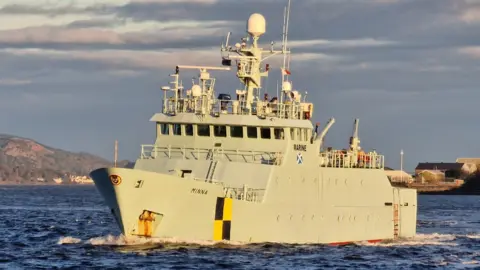
She told MSPs the government planned to directly award the yard a replacement for the fisheries protection ship Minna and the research ship Scotia, both of which had been built at Ferguson's many years ago under previous ownership.
 Christopher Brindle
Forbes also said there would be direct awards from CMAL of contracts for two small CalMac ferries under the second phase of the Small Vessel Replacement Programme.
These are similar to the seven vessels awarded to the Polish yard but designed for heavier seas.
Forbes caveated the announcement by saying it was subject to a "detailed due diligence process" and a potential referral to the Competition and Markets Authority.
At the same time another minister, Fiona Hyslop, announced that the contract for the next new CalMac ship, a replacement for MV Lord of the Isles which Ferguson's also wanted directly awarded to it, would instead go to competitive tender.
CMAL began that procurement the following month with pre-qualification conditions that, in effect, blocked Ferguson's or any other UK-based shipyard from bidding.

Governmental responsibility for Ferguson Marine now lies with newly-appointed Economy and Transport Secretary Stephen Flynn.
Flynn held a meeting last week with the shipyard's GMB shop stewards along with local SNP MSP Stuart McMillan, but BBC Scotland News understands no concrete assurances were given.
A spokesperson for the Scottish government said: "While Ferguson Marine works to complete the Glen Rosa, the Scottish government is working at pace to progress the necessary due diligence, legal, commercial and subsidy control assessments required to support the proposals to directly award four new vessel contracts to Ferguson Marine.
"Taxpayers would expect that these assessments are thorough and comprehensive in order to secure a robust, sustainable and legally compliant route forward.
"We are working closely and constructively with Ferguson Marine while we undertake this work, and Ministers will keep Parliament updated on progress."
The chief executive of Ferguson Marine, Graeme Thomson, said the promise of four directly awarded vessels contracts in March was "a watershed moment" for the firm.
He added: "We are now working closely with Scottish government stakeholders to map out the detailed technical requirements, timelines, and legal frameworks to get these projects underway smoothly."
Shaking off the 'ferries fiasco' stigma
Both the current management and workers at Ferguson Marine are keen to move on from the controversy over construction of MV Glen Sannox and MV Glen Rosa, two large CalMac ferries.
The £97m contracts for the ships were awarded in 2015, but Glen Sannox was not delivered until November 2024, more than six years late, while Glen Rosa is still under construction and currently due for delivery by the end of the year.
The two ferries are estimated to have cost around £500m when money paid out prior to nationalisation and written down government loans are included.
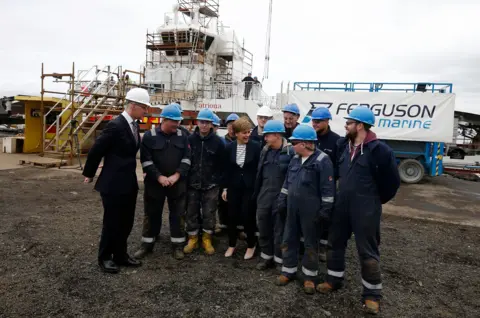
Many factors came together to scupper the construction, and most commentators believe the shopfloor workforce were not to blame.
 PA Media
The contracts were awarded just a year after Ferguson's - the last commercial shipyard on the Clyde - had gone bust, a few weeks before the 2014 independence referendum.
The yard had been rescued by Jim McColl, a successful businessman who was a friend and adviser to former First Minister Alex Salmond.
Some have questioned whether the contracts for the two 100m ships, which are the first LNG vessels of their type ever built in the UK, were the right project for the small shipyard which at the time of its rescue, had just 76 staff working in antiquated facilities.
Four years ago a BBC documentary The Great Ferries Scandal presented evidence that the procurement process was rigged by CMAL employees - although the ferries body disputes this.
Other explanations put forward for the debacle include an unrealistic specification and immature concept design prior to going to procurement, incompetent management at various stages of the build and disruption due to Covid.
