Police watchdog calls for live facial recognition to tackle football disorder

 PA Media
The head of the Scottish police watchdog is calling for the introduction of live facial recognition technology and drones to help combat football-related disorder.
HM Chief Inspector of Constabulary in Scotland (HMICS) Craig Naylor has used the publication of his annual report to highlight the need for better use of technology to help fight crime.
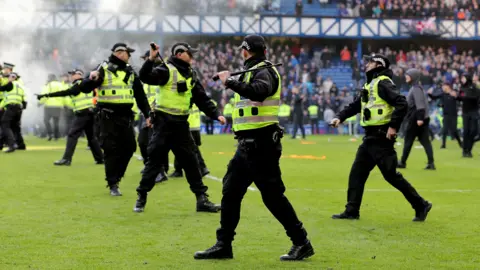
Naylor described recent football violence, like the disorder between Celtic and Rangers fans at Ibrox in March, as "a situation that cannot continue to be tolerated."
He also said the increasing violence in Scotland outside football grounds was likely to require more police deployments.
Naylor said: "Elements such as restricting the number of fans allowed to attend matches, banning orders with more rigor, requirements to use modern technologies such as facial recognition to prevent the attendance of banned individuals should all be explored and enacted to ensure that this behaviour is stopped."
Live facial recognition technology has been used by police forces at football matches in England.
 PA Media
But its deployment remains controversial amid concerns over privacy, civil liberties and the potential for errors in identification.
The technology has never been used by Police Scotland but the force has been engaged in a public consultation on its deployment.
The report comes after disorder at several games towards the end of last season's Scottish Premiership.
This included high-profile matches between Celtic and Rangers in the Scottish Cup in March and the title decider between Celtic and Hearts in May.
Later that day two police officers were seriously injured and 14 arrests were made during trouble in Glasgow city centre as Celtic supporters celebrated the club's Premiership win.
Police Scotland's Assistant Chief Constable Tim Mairs said: "We have a duty to use new technologies to safeguard our communities.
"New technologies can offer transformative opportunities for modern policing, through supporting investigations and identification.
"We want people to recognise both the value of new technologies and be confident that Police Scotland has the right governance and the right measures in place, and that consideration and implementation of new technologies reflects our commitment to human rights, ethical oversight, and transparency."
How does facial recognition technology work?
 Getty Images
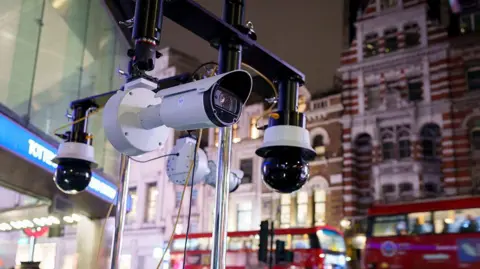
There are different ways police forces around the UK use facial recognition technology, including tapping into existing CCTV systems, although it is not frequently used in Scotland.
Forces in England and Wales have deployed vans with cameras, while the Met Police have also trialled the technology at tube stations.
Prof Kay Ritchie, head of sociological and psychological sciences at Abertay University, told BBC Scotland that the cameras take images of faces and, instead of storing them, "translate" them into a different "digital representation" of the face.
This is then compared with a list of known or wanted faces - people who have committed crime or are suspected of committing them.
Over the past decade, campaign group Big Brother Watch has claimed the technology flagged up a "staggering" number of innocent people as suspects.
It took legal action in an attempt to limit the Met Police's use of facial recognition over concerns that it could be used arbitrarily or in a discriminatory way - but the group lost its challenge earlier this year.
According to the Met Police, 2,100 arrests have been made since the start of 2024 using the technology.
Last year, more than three million faces walked past the live facial recognition cameras and 12 false alerts were logged, with none leading to an arrest.
Prof Ritchie said people were not very well informed on how accurate facial recognition is, adding: "Actually, the technology is extremely accurate and there are very few demographic differences at all."
She said tests run by the National Physical Laboratory in London and the National Institute for Standards and Technology in the US showed that the systems were becoming "increasingly accurate" and were "far more accurate than a human would be".
 Getty Images
Any introduction of the technology in Scotland could be difficult and the proposals have already been met with opposition from civil rights groups and supporters associations.
A spokesperson for Amnesty International UK said: "Facial Recognition Technology is a dangerous and discriminatory tool of surveillance that should be scrapped, not rolled out further across the UK."
The spokesperson said use of FRT in England and Wales has led to "repeated cases of harassment and false arrest."
"To move forward with FRT would bring about a historic shift in the relationship between the police and the public in Scotland and we want to see its use ruled out," they said.
Paul Goodwin, from the Scottish Football Supporters Association, also urged authorities to set aside the "reckless proposal".
He said they should "instead focus on deepening co-operation with local fan groups and clubs in building a community safety approach."
Justice Secretary Neil Gray told the BBC's Radio Scotland Breakfast programme that deployment of technologies such as facial recognition was the responsibility of the police.
He said: "We would clearly wish to see any advancement in the detection of criminality so long as that is proportionate with the European Convention on Human Rights, the commissioner of biometrics and other regulatory factors.
"I also think there is a role for clubs and individuals here to ensure that we're seeing better behaviour at football matches."
The SPFL and Scottish Football Association have been approached for comment.
