How the battle for Bempton's birds was won

 BBC
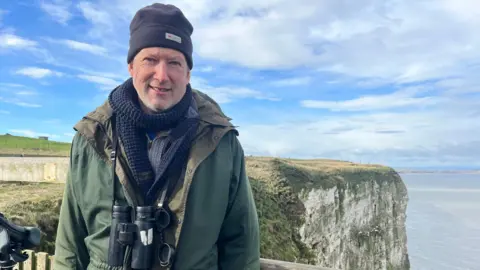
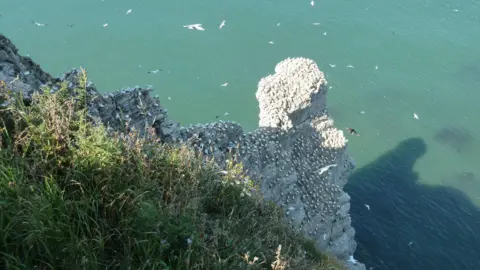
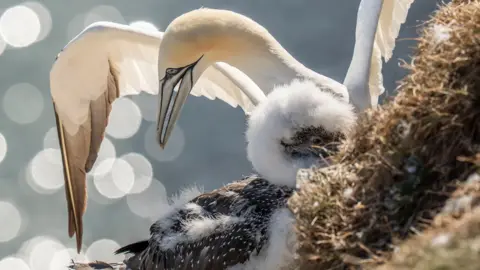
BBCThe towering chalk cliffs of Bempton are home to England's "largest seabird city", with about half a million puffins, gannets, kittiwakes and guillemots living there between March and August each year, according to the RSPB.
Today, these breeding grounds, at Flamborough Head in East Yorkshire, are protected under law.
But this was not always the case. In the mid-19th Century, the birds were considered fair game and day-trippers would hire steam yachts to shoot them, sometimes killing thousands at a time.
"It was an awful thing to have so many people coming on boats and just wantonly slaughtering birds for sport," says Dave O'Hara, the RSPB site manager at Bempton.
That the reserve and its colonies are here today is thanks to a fight led by a handful of enthusiasts – including two clergymen and a colourful MP – who paved the way for the first law to protect wild birds in Britain.
They led the drive for the Seabird Preservation Act, which was passed by Parliament in 1869.
"It was one of the first actual laws that protected nature," O'Hara tells the Hidden East Yorkshire podcast. "So it was incredibly important.
"Many of our seabirds are very long-lived, so a puffin can live for 40 years, if it's lucky.
"If they get shot when they're still sort of midway through their breeding season, it's not just the chick that dies, it's also that the breeding population is reduced."
The men behind the new law included Francis Orpen Morris, a naturalist who was rector of Nunburnholme, and Henry Barnes-Lawrence, the vicar of Bridlington, as historian David Neave explains.
Morris had produced a history of British birds.
"He himself collected birds' eggs and stuffed birds, but he was worried about the slaughter of birds on the East Riding coast," Neave says.
"He wrote quite a long letter to The Times, pointing out how many birds were being slaughtered."
The birds' plumage was used to decorate women's clothes and headdresses, while eggs were being taken for various reasons, including collectors.
"So the birds were decreasing in numbers," Neave says. "People were coming out and killing thousands at a time.
"Some were just left dead lying in the ground."
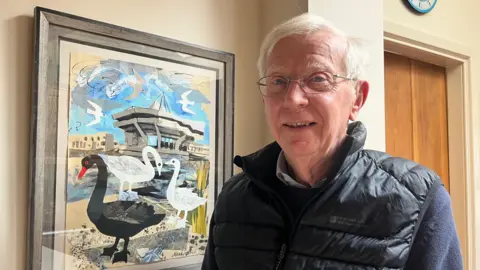
Meanwhile, Barnes-Lawrence became concerned that the people of Bridlington were being blamed for declining bird numbers, when it was actually day-trippers, who would arrive in the resort by train and take boats to the cliffs, who were responsible.
"So he decided to do something about it," Neave says.
"In October 1868, he launched, at a meeting at Bridlington Vicarage, the Association for the Protection of Seabirds.
"He got lots of support, even support from members of the Royal family and many quite important people, a lot of local landowners."
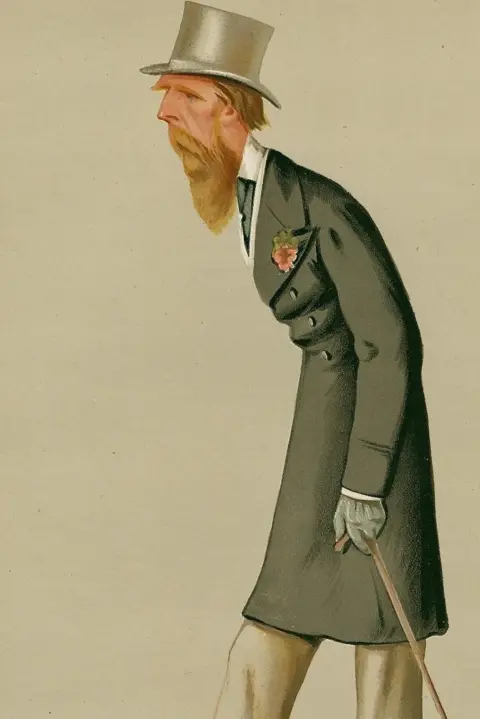
The third man behind the law was Christopher Sykes, son of Sir Tatton Sykes of Sledmere.
He "detested his father", according to Neave, and left East Yorkshire for London's fashionable society.
"He was known very much as a snob and as a dandy, a man who dressed elegantly.
"But he wanted a role in life and eventually, without really family support, he became MP for Beverley."
 Vanity Fair
Sykes was in Parliament for 27 years, eventually serving the Buckrose constituency in the Yorkshire Wolds.
He only spoke on six occasions, according to Neave, but one of those times was to introduce a bill for the protection of seabirds.
"This gave him the nickname among his socialite friends as the gull's friend," Neave says.
Barnes recruited Sykes, who introduced the Bill into Parliament in February 1869.
It was the beginning of a period of reform which included the establishment of the Royal Society of Protection of Birds in 1889.
"The beginning of so much of the agitation and really getting things moving is very much from the East Riding, from Bridlington," Neave adds.
 PA Media
According to O'Hara, the passing of the Bill was an important step for the East Yorkshire coast.
"The local people here at Flamborough were very keen for the seabirds to be protected because actually the noise of the birds on the cliffs alerted them in foggy conditions, which we see quite a lot here.
"Often it can be clear as a bell a mile inland and you hit the fog at the coast. And the call of the seabirds helped them navigate and keep clear of the rocks.
"We tend to think that there's almost unlimited supplies because these birds are at these big colonies.
"But for many of our seabirds, the number of colonies is really quite few.
"So for gannets, there's now 30 or so colonies around the UK and Ireland. But back when this law was passed, there were only three.
"They may have become extinct if that law hadn't come in.
"The gannets, kittiwakes, and the guillemots, puffins, razorbills, you have this community here, totally oblivious to what we're doing, feeding out at sea, coming back to the cliff.
"We're really privileged to have that glimpse of them, and it's thanks to that protection."
Listen to highlights fromHull and East Yorkshire on BBC Sounds, watch the latest episode of Look North.
Download the BBC News app from the App Storefor iPhone and iPad orGoogle Play for Android devices
