'Glencoe Massacre' coin hoard to be displayed in folk museum

 Gareth Beale/University of Glasgow
Coins possibly connected to a victim of the infamous Massacre of Glencoe are to go on display at a local museum.
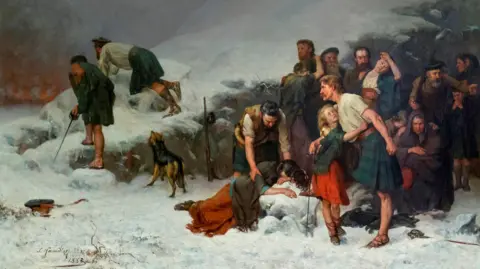
Almost 40 members of Clan MacDonald of Glencoe were killed in February 1692 after soldiers were ordered to attack them.
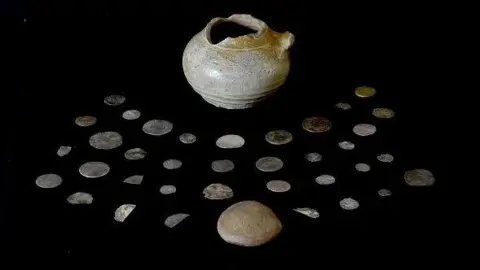
The 36 coins were found in 2023 by a student on her first archaeological dig - they were inside a pot hidden under the fireplace of a ruined house which was linked to a murdered MacDonald clan chief.
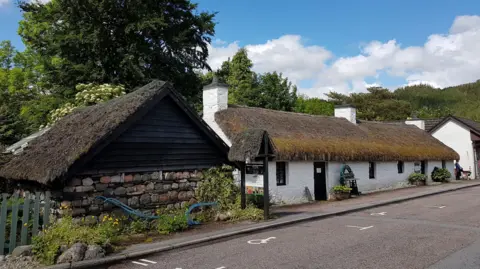
The items are to be part of a new exhibition at Glencoe Folk Museum when it reopens next year following a major redevelopment project.
The coins were inside a pot which had a small round pebble as a lid and had been placed beneath a hearth stone slab in the fireplace.
The discovery was made by student Lucy Ankers in August 2023 during an excavation at the site of the ruined house, led by archaeologists from the University of Glasgow.
The property was associated with clan chief Alasdair Ruadh "MacIain" MacDonald of Glencoe.
He was among the estimated 38 people killed in the massacre.
The MacDonalds were targeted because of their support for the exiled King James VII of Scotland and II of England.
The clan backed the restoration of the Stuart dynasty to the British throne and had taken part in the first Jacobite Rising of 1689.
Historians say they were late delivering an oath of allegiance to the Protestant King William III, and had been branded as rebels by the secretary of Scotland, Sir John Dalrymple.
 Getty Images
Glencoe Folk Museum successfully applied for the finds to be added to its collections through Treasure Trove, a unit which investigates and assesses newly-discovered objects and allocates them to museums and galleries.
Curator Catriona Davidson said: "We are so excited to be adding these artefacts to our collection.
"One of the aims of our current redevelopment project is to create exhibition spaces with the environmental conditions and security to allow us to acquire more significant objects – and we're thrilled that this has already paid off.
"Items such as these give us a tangible connection to the people who lived here in the past and can tell us so much about everyday life in the glen."
 Glencoe Folk Museum
The University of Glasgow has suggested a number of reasons why the coins could be connected to the massacre.
None of them were minted after the 1680s, which has led archaeologists to suggest they were most likely deposited under the fireplace either just before or during the killings for safekeeping.
The archaeologists also said whoever buried the coins did not return for them, possibly indicating they were among the victims of the massacre.
The coins are dated from the late 1500s through to the 1680s, and include pieces from the reigns of Elizabeth I, James VI and I, Charles I, the Cromwellian Commonwealth and Charles II.
There were also coins from France and the Spanish Netherlands, as well as one coin which appears to have originated in the Papal States in Italy.
Dr Eddie Stewart, of Glasgow university's Glencoe Landscape, Archaeology, and Storytelling Project, said the discoveries in 2023 had helped to "paint a vivid picture" of the world of the MacDonald of Glencoe chiefs.
He said: "Instead of wild and savage clansmen in a remote glen, they were highly educated, well-travelled and better connected - with access to continental educations, imported wine and tobacco, and fine dining wares from Germany, France, and England.
"The coins from the hoard highlight these connections which surely played a part in how the chiefs presented themselves and performed their status and worldliness to their clan, kin, and guests."
 Getty Images
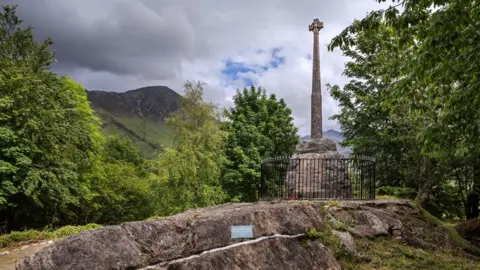
The massacre is one of the most notorious chapters in Scotland's history.
In late January 1692, about 120 soldiers from the Earl of Argyll's Regiment of Foot arrived in Glencoe from Invergarry led by Capt Robert Campbell of Glen Lyon.
The troops were billeted with members of the clan, before turning on their hosts on 13 February.
Some people tried to escape in a snow blizzard to nearby glens, including Gleann Leac-na-muidhe, where the coin hoard was found.
