The unlikely vineyard inside a London railway station

 BBC News
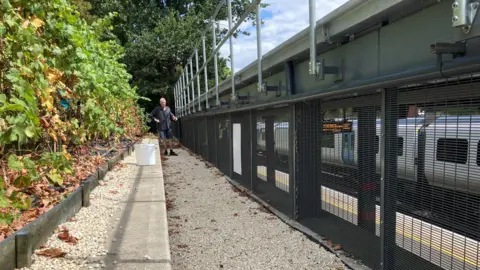
There are few places you would expect to stumble across a vineyard in inner London and a sunny railway embankment in south London is probably not high on the list.
Yet just metres from the tracks at Denmark Hill station, a small group of volunteers is growing grapes to turn into wine.
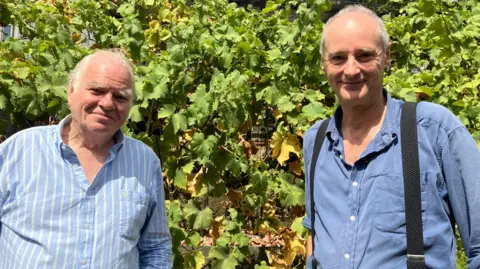
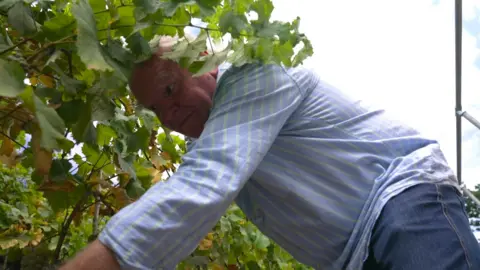
The aptly named Château Denmark Hill Station vineyard is the work of Camberwell Society members Nick Mair and Tony Coleman, who saw a neglected patch of land as a place with the potential for making wine.
"We had this beautiful, south-facing slope covered in brambles, bindweed and stuff like that," says Tony. "And Nick said 'this could be a vineyard'. And we thought, 'wow, wouldn't that be an amazing thing to do?'"
 BBC News
Neither Nick nor Tony is a professional winemaker, although Nick has been making wine since he was a child after finding a passion for pressing grapes.
But the process of turning a disused patch of land into a flourishing vineyard was no easy feat - and actually began with planting a patch of sunflowers.
"The horizon's very low, the Sun comes across, it's a nice 30-degree slope, and the sunflower seeds were fantastic," says Nick.
That was enough to give them the confidence to try growing grapes.
"Actually putting the vines in was a total doddle," says Nick. "Trowel, scoop, scoop, scoop, put it in, pad it down, etc. But digging the ground was a killer."
 BBC News
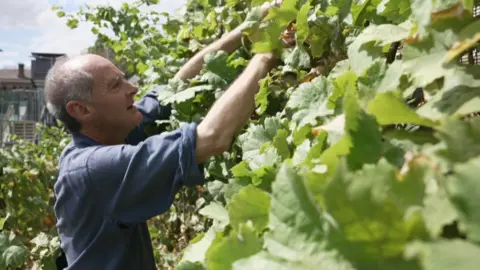
Today, about two dozen Bacchus vines occupy the slope in the shadows of homes, businesses and King's College Hospital.
The vineyard forms part of a wider transformation of Denmark Hill station, where the Camberwell Society has been working with Thameslink, which runs the station, to turn previously unloved spaces into something a little more cheerful.
There are artworks around the station, along with areas containing lavender and other planting.
But the vineyard is perhaps the most unexpected addition.
Nick and Tony have been learning as they go, taking advice from English wine growers and even some French ones.
"We're feeling our way here," says Nick. "And it seems to work pretty well."
Heatwaves and drought
But running a vineyard in London isn't without its problems - mainly the Great British weather.
Last year, the young vines produced just two bottles. That was partly intentional, as Tony and Nick removed many of the grapes early to encourage the vines to put their energy into developing strong roots.
One bottle went to a retiring station manager. The other was eventually opened by the pair.
"And it was pretty good," Nick says. "We didn't manage to leave it unfinished and we're both still standing today, so it was pretty reasonable."
This year looks set to be much more productive with Nick and Tony expecting to make about 30 bottles.
However, the summer has seen them having to contend with multiple heatwaves and very little rain.
"The vines were looking very productive. But then of course we've had this really strong drought," says Tony.
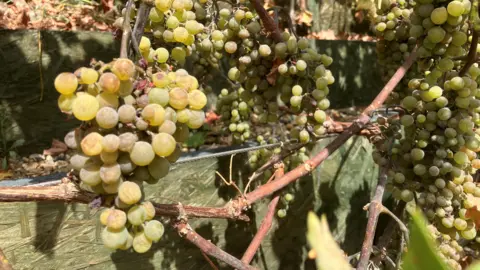
The young vines have suffered, and the grapes haven't swollen quite as much as they might have after a wetter summer.
But Tony says the weather hasn't compromised their taste.
"They're very flavoursome," he says. "I'm sure it's going to be delicious."
 BBC News
There are no plans to put their creation on supermarket shelves. In fact, the wine won't be sold at all.
Instead, it will be kept in the community, with bottles used at local tasting events and shared among those involved in the project.
"We're strictly local, amateur and passionate people," points out Nick.
And, although its future will be left to the next generation of locals, they have no interest in turning their little vineyard into a wine empire.
"We're unlikely to produce the volume that supermarkets want," Nick jokes. "So they're not going to be knocking on our door saying we need thousands of bottles."
 BBC News
The project has received support from Network Rail and from rail operator Thameslink, which helped fund the vineyard as part of wider efforts to improve station spaces and biodiversity.
Angie Palmer, Thameslink's head of stations, says the aim is to make better use of railway land through projects that support wildlife and local communities.
For Nick and Tony, one of the nicest surprises has been how much the project gets people talking.
"It's really nice," says Nick. "And it's surprising how many conversations you get into with random people asking about one of the art installations, planting or something."
Château Denmark Hill Station has turned a forgotten piece of railway land into something contributing to local life - but also somewhere people actually notice.
Listen to the best of BBC Radio London on Sounds and follow BBC London on Facebook, X and Instagram. Send your story ideas to hello.bbclondon@bbc.co.uk
