Widespread racism in hospital trust maternity care

 BBC
BBCRacism and discrimination is widespread at the Sandwell and West Birmingham Hospitals NHS Trust (SWBH), a review into maternity and neonatal services said.
Investigators heard concerns from families and staff who said care varied based on ethnicity or background. Researchers also said they witnessed a racist incident among staff during a visit.
Chief executive Diane Wake said the trust was "deeply sorry" to those whose care "did not meet the standards they have the right to expect".
The trust, which runs Midland Metropolitan University Hospital that opened in 2024, was one of 12 trusts investigated by the Independent National Maternity and Neonatal Investigation led by Baroness Valerie Amos.
She said issues included staff blaming patients for their circumstances, language barriers, and cultural insensitivity.
"Women and families described discrimination not just about themselves, but what they had seen in terms of discriminatory behaviour against other patients," she said.
"We also heard from staff who have experienced racism - in fact, some staff broke down in sessions that we had with them."

The neonatal investigator recalled hearing about a woman who threatened to leave because she she said her pain was being ignored.
"[We've] got to break out of the cycle of that," Baroness Amos continued.
"Women have to be able to say, 'I need pain relief', and they're believed. It's particularly an issue with women from black and Asian communities, where simply they're told, 'You have a higher threshold for pain, so we're not going to give you pain relief'."
Before the Midland Met Hospital opened in Smethwick, there was a consultant-led maternity unit based at City Hospital in Birmingham with midwife-led units in West Bromwich and Smethwick.
Staff said there was a stigma attached to the quality of Sandwell's service across the neonatal network, with phrases like "typical Sandwell baby" used about children transferred for care elsewhere.
Sandwell is a neighbouring area to Birmingham and comprises towns including Oldbury, West Bromwich, Smethwick, Tipton, Wednesbury and Rowley Regis.
 Sandwell and West Birmingham NHS Trust
The report said SWBH served an area that was more deprived than 91% of neighbourhoods in England and had a higher-than-average proportion of Asian and black mothers.
Families and staff told investigators language used within the service sometimes suggested patients were "outsiders" or were to blame for their circumstances or outcomes due to cultural beliefs, language barriers or refusal of interventions such as induction or a caesarean.
Staff described a workplace culture where speaking up felt unsafe, with fears of negative consequences contributing to low morale and behaviour described as bullying. Investigators said they witnessed a racist incident among staff during a two-day visit to gather evidence.
In an open letter to the local community, Wake said the trust was "appalled" by the report's accounts of racism and discrimination.
"It is unacceptable that any woman or family felt they were not listened to, respected or treated fairly because of who they are or where they came from," she said.
'Suffocated by sheer volume'
Families reported feeling judged and ignored during care. Some said they felt forced to exaggerate their pain to be taken seriously by staff.
One patient said: "Whatever you feel, make it twice and three times worse, otherwise they don't believe you."
Another described reaching breaking point in labour: "I am going to tear out all these tubes and I'm literally going to walk out because I've had enough… I'm going to walk out because you're not listening to me. I'm telling you that I'm in pain."
The investigation also found families were sometimes sent home after raising concerns and told symptoms were "normal" only for serious complications to emerge later. Birth plans, they said, were at times ignored.
Women who had experienced traumatic births or baby loss were sometimes placed on standard postnatal wards alongside healthy newborns.
Some clinicians told investigators they had left the organisation because they believed care was not safe.
One said that staff were "overloaded".
"I would almost use the term suffocated by the sheer volume," they said.
Inspectors acknowledged the new Midland Metro Hospital was modern and clean, but said improved facilities had not necessarily led to better care.
Wake said the trust had appointed a new director of midwifery and head of midwifery, adopted a zero-tolerance approach to discrimination, recruited 25 more midwives and improved maternity triage performance.
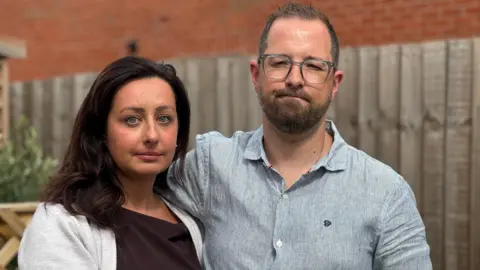
Tom and Ewa Hender, whose son Aubrey was stillborn at the trust's City Hospital in 2022, said the report reflected their own experiences.
Ewa Hender said: "I think the biggest failing that was a direct cause of Aubrey's death in my opinion was that I wasn't being listened to or that my concerns weren't being taken seriously. When I tried to highlight that Aubrey's movements were less or fainter, I was being dismissed."
She added: "It certainly didn't feel safe at the time and we believe that's why Aubrey's not here today."
Tom Hender described the report on SWBH as "damning".
"It uses quite strong language and it almost reads to me as if it is saying that it is a dangerous trust," he said. "If there is a dangerous trust, who is stepping in to make sure that babies don't die tomorrow?"
The couple say there should be a national statutory public inquiry into maternity services.
'I can only hope'
Kayla Palmer, 23, from West Bromwich, lost her son Hendrix at the Midland Metropolitan University Hospital in 2024. He was delivered by emergency caesarean on Boxing Day, 26 December, but died three days later after suffering a brain injury linked to oxygen deprivation around birth.
"If I went to another hospital would they have done different? Would my boy be here?" she said.
Palmer said she had experienced delays in pain relief and at one point collapsed during labour while a midwife walked past her.
"I hope this taskforce becomes something good. And a very good outcome comes out of it as well. I can only hope," she said.
Palmer is also supporting calls for a national public maternity inquiry.
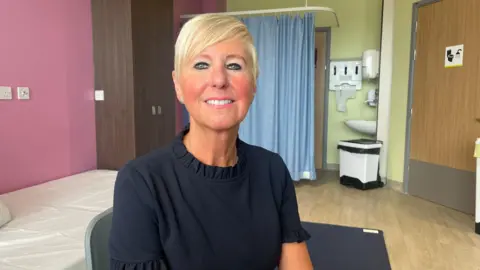
Wake said reading the report was "absolutely devastating".
"I'd like to use this opportunity to offer a heartfelt apology to any patient or family affected by reading the report, or of their experiences," she said.
"The standard of care that some of our patients and families received was absolutely unacceptable."
The review by Baroness Amos heard from more than 450 families and 9,000 staff across England, leading her to conclude that the findings pointed to a system where too many patients were still not being heard.
Among the report's recommendations was the creation of a national maternity and neonatal commissioner to drive reform.
The government is expected to respond with a national action plan overseen by a new maternity taskforce, which will chaired by the health secretary.
Follow BBC Birmingham on BBC Sounds, Facebook, X and Instagram.
