Scotland's universities face 'bleak' future as £200m funding gap revealed

 Getty Images
Scotland's universities face a funding gap of about £200m a year, according to major new report which warns it could increase in the future.
The picture is "bleak", the report's author Prof Sir Anton Muscatelli says, with total income no longer enough to sustain core activities such as teaching and research.
The report also spotlights the increasing dependence on fee-paying international students to cross-subsidise the tuition of Scottish undergraduates.
Universities Scotland said the analysis made clear that the current position was not sustainable.
The analysis comes from the Funding Gap Analysis team, a joint initiative launched by the Scottish government and Universities Scotland to review the funding of Scotland's 18 higher education institutions.
It highlights a funding gap between what they spend on teaching, research and infrastructure and the income they get from the Scottish government, tuition fees from students such as those from abroad and the rest of the UK and other areas such as research.
Full-time undergraduate students who live and study in Scotland do not pay tuition fees for their first degree so the Scottish government gives universities cash to cover the costs.
The report says the amount they get is £288m a year less than it costs to teach these courses.
BBC News has calculated that this means there was a shortage of £2,703 per Scottish student in 23/24, the academic year mentioned in the report.
The Funding Gap Analysis team says fee-paying students, who are mostly those from abroad and studying postgraduate courses, generated a surplus of £445m, but this amount is also used to subsidise a £500m shortfall in research.
The report explains that a recent decline in international students has led to "immediate and severe" consequences for the higher education balance sheet.
It also says a reduction in public funding, rising inflation and high energy prices have also harmed Scotland's higher education institutions.
In the past decade, the sources of income for universities have changed quite dramatically.
Ten years ago, fees from international students made up less than a third of teaching income but that element now provides just under half of the money that comes in for teaching - and has overtaken Scottish government funding as the largest source.
The other main sources of teaching income are provided by the Scottish government, via SAAS undergraduate tuition fees of £1,820 a year plus a block grant per university.
Income from fee-paying students from the rest of the UK, about 19,000 in total, is also part of the mix.
They now pay fees equivalent to the level if they were going to a university in England.
 Getty Images
The amount universities in Scotland get from the block grant has not matched inflation across time, meaning universities have had to look to international students and other areas to grow income.
The report states that this "growing dependence creates vulnerability", however, universities have long used income from non-publicly funded teaching, along with commercial income, to offset shortfalls.
The warning now is that the proportion of funding coming from international students will not continue to grow and cannot be solely relied upon to keep universities afloat.
Some universities rely on international students more than others – with as many as 46% of those at St Andrews and 36% of students at the University of Glasgow coming from abroad, according to recent HESA figures.
International student figures in Scotland have fallen for two years in a row, with a 5% drop most recently.
The decline in those from the EU was steeper, with a 22% drop in 24/25 academic year.
The largest cohort of international students in Scotland come from China.
The Funding Gap Analysis report was commissioned after a series of financial crises hit institutions across the country.
Dundee University received a £62m bailout from the Scottish government after financial mismanagement.
It is one of many institutions to suffer financially after significant drops in international student income.
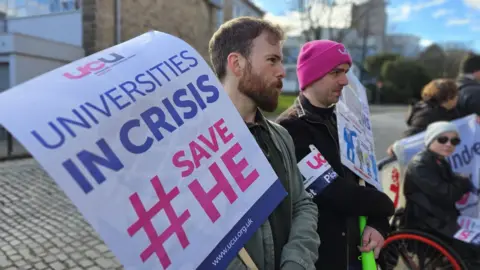
Thousands of jobs have been lost throughout the entire sector due to funding shortages.
Cuts of £140m at Edinburgh University have led to a current dispute with staffing unions over compulsory job losses, 190 jobs were lost at RGU in Aberdeen last winter due to savings and next week staff who are members of Unison will walk out at Glasgow Caledonian University due to 100 jobs at risk.
Many other universities have proposed cuts and job losses.
Prof James Miller, from Universities Scotland, said: "Scotland's universities have faced significant financial pressures for some time, and this report provides an important, evidence-based, assessment of their scale."
He said the report needed to be the start of a conversation about how to ensure Scotland's universities remained sustainable, successful and able to deliver for future generations.
 PA Media
NUS Scotland President Justine Pédussel said the report laid bare the stark reality of the systemic funding crisis in Scotland's universities.
"Public funding no longer covers the true cost of teaching and other services, leading institutions to plug the gap with international tuition fees.
"This model is not only unsustainable but is also unfair, placing too high a burden on students."
Scottish government Education Secretary Màiri McAllan said free tuition meant that Scottish students were not hampered by the levels of debt seen elsewhere in the UK.
"However, I recognise the need to ensure a sustainable model of funding which recognises wider financial pressures facing universities in Scotland and indeed across the UK," she said.
"This is not a challenge unique to Scotland. The UK Government's crackdown on international student visa routes, coupled with Brexit, inflation, energy prices and increases to employer National Insurance contributions have all added to the sector's financial pressures."
The education secretary added: "This report, which is transparent in addressing the financial pressures in the sector, establishes a shared and evidence-based understanding of the need for change."
Funding settlement 'totally broken'
Andrew Bowie, Conservative MP for West Aberdeenshire and Kincardine, said the "stark" report reflected everything he had been told by senior leadership at Scottish universities.
He said: "The current funding settlement is totally broken and something needs to change. Radically.
"The funding gap is now £200m. That means teaching and research is threatened and puts the very future of our world leading higher education institutions at risk."
Scottish Labour tertiary education spokeswoman Jenny Young said higher education institutions had been "badly" let down by SNP ministers.
And she accused them of consistently ignoring warnings from the sector about the challenges they faced.
Young said: "Universities Scotland has previously been clear that the major contributing factor in this crisis has been a drop in funding provided by the SNP government."
She said the sector was "critically underfunded" and added that the backlog for maintenance on university estates was now in excess of £1.1bn.
Young warned: "It is well past time for the Scottish government to wake up to the dire financial crisis our universities are now facing."
'University sector at crunch point'
Duncan Dunlop, education spokesperson for the Liberal Democrats, said the Scottish university sector was at a "crunch point."
"Our university sector that has been at the backbone of practical and intellectual innovation for centuries is at risk of entering a demise similar to our newspaper industry," he said.
"It is incumbent on all of us to seek sustainable solutions. Universities need to reflect on their own model. The SNP government need to finally lead, instead of diminishing a proud sector via continual underfunding."
Iris Duane MSP for the Scottish Green Party said the report confirmed what students and university workers had been saying for years.
"This crisis didn't come from nowhere," she said. "It is the direct result of political choices by government and university executives.
"Staff and students are now being made to pay the price, with cuts, redundancies and course closures hitting campuses from Dundee to Glasgow Caledonian and beyond.
"Students and workers are being asked to accept less, work harder and put up with worse conditions while university management pushes ahead with cuts."
