Gnome-care: Butchers shop becomes figurine hospital

 Alex Dunlop/BBC
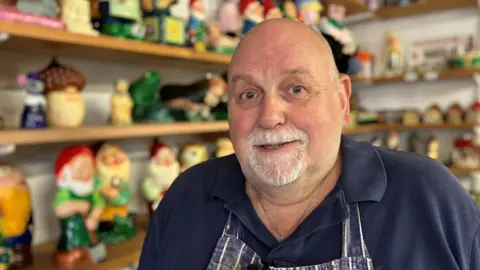
A retired butcher has swapped his meat cleaver for a paintbrush as he turns his hand to a spot of gnome improvement.
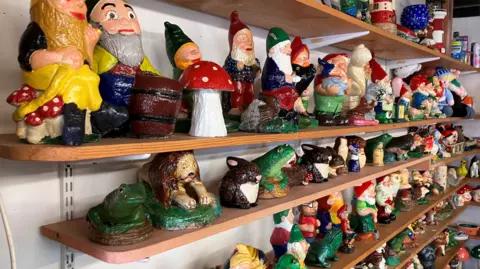
Alistair Dent opened the gnome hospital 18 months ago in his former butcher's shop in Hilgay near Downham Market, Norfolk. He now displays the ceramic figures in the refrigerated meat counters.
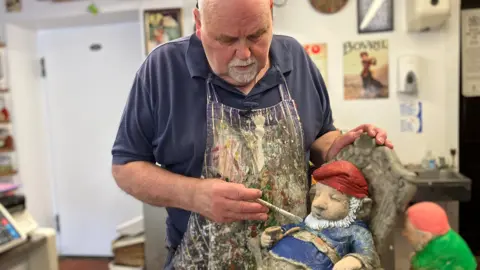
Once donated to Dent, the gnomes are given figurine first-aid: cleaned up, restored, repainted, sealed to protect them from the weather and then resold - with proceeds going to charity.
"I always find if you buy a gnome and like a gnome you are usually a happy person. Gnomes are very good luck, you look at one and think what a lovely face. My wife says I look like a gnome," he said.
"Really the gnomery has taken over from the butchery, instead of meats we have gnomes and garden ornaments."
Whether you like them or loathe them, Dent cannot get enough.
"You do get some people that say, 'Oh no I wouldn't have a gnome in my garden', but it's all a bit of fun really. There's nothing wrong with having a gnome in your garden," he said.
 Alex Dunlop/BBC
The idea of the hospital began several years ago, Dent said, when he was given about 20 gnomes which he sold after restoring and donated the money to charity.
He believed he has raised more than £12,000 for the East Anglian Children's Hospice and Tapping House since he began the project.
Dent described how his grandad was an artist, and while he said he was not as good as him, he added: "I enjoyed doing the gnomes so I thought I would start it up again."
While he has done many of the stereotypical figures with a spade or fishing rod in hand, he does not discriminate what sort of ceramic figure he takes in and has restored anything from elephants, to highland cows and tortoises.
 Lamport Hall
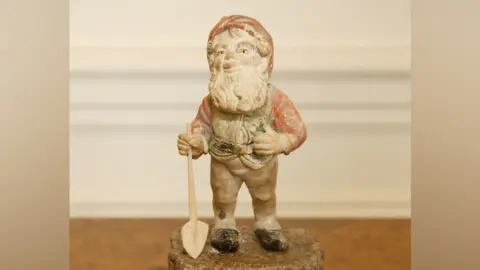
A symbol of European folklore, gnomes were believed to have been first produced and carved from wood in Switzerland before being made out of ceramics in Germany in the 1840s.
Sir Charles Isham, who lived in Lamport Hall in Northamptonshire, is credited with being the first person to have a gnome in England after he brought back the terracotta figures from a trip to Germany in 19th Century.
Once used as dining table placeholders, Sir Charles moved them outside to become part of his 24ft (7m) high rockery in 1874.
But not everyone welcomes the ceramic figures.
 Alex Dunlop/BBC
They were first officially prohibited from the RHS Chelsea Flower Show in 1927, when the rules stated "no statuary or other sundries may be exhibited in the tents, either alone, or as a part of an exhibit".
The ban was later extended to all RHS Chelsea gardens in 1931, with gnomes specifically name checked among the items prohibited from being displayed.
The RHS said the rule was to preserve the show's focus on horticultural skills and garden design and not distract from the plants.
The RHS said that "as well as being indicative of personal tastes at the time, as early as 1922, the show's committee sought to distinguish between gardens which should highlight 'horticultural excellence' and 'sundries displays' - which were to advertise sales".
Yet the ban has been relaxed for charity occasions and was temporarily lifted in 2013, for the Chelsea centenary, when celebrity-decorated gnomes were auctioned for charity, and this year to raise funds for the RHS Campaign for School Gardening.
Indeed, even King Charles III is known to have a gnome or two in the stumpery of his Highgrove Estate.
Norwich-based garden designer, Rajul Shah, said she thinks there "maybe a bit of a class issue around our taste for garden ornaments" but people should "have in [their] garden what brings [them] joy".
"Let's have a bit of whimsy in gardens," she said.
"I think we take things too seriously, let's have a bit of fun in our gardens, after all, it's your garden, do what you like with it."
For some, it seems, there is gnome place like home.
Do you have a story suggestion for Norfolk? Contact us below.
Follow Norfolk news on BBC Sounds, Facebook, Instagram and X.
